

A Global Effort to Save Our Night Skies
For most people living in cities, stepping outside at night means seeing only a handful of stars. According to the World Atlas of Artificial Night Sky Brightness (2023), more than 80% of the global population can no longer view the Milky Way under natural darkness.
This growing glow is a clear sign of light pollution — an overlooked environmental issue affecting wildlife, energy use, human health, and our cultural connection with the night sky.
The Dark Sky Movement brings together scientists, educators, policymakers, artists, and communities to protect night environments. The goal is simple: use light responsibly so nature and progress can coexist.
This guide explains how the movement began, the major types of light pollution, global success stories, and practical steps anyone can take to restore natural darkness.
Table of Contents
Real-World Success Stories Backed by Data
Tucson, USA
Retrofitted 18,000+ streetlights with shielded 3,000 K LEDs, cutting energy use by about 60% and reducing sky brightness by 7% (Barentine et al., 2018).
Flagstaff, USA
The world’s first International Dark Sky City, where over 90% of lighting complies with dark-sky standards. Tourism increased following lighting reforms (IDA, 2020).
Jaisalmer, India
A 2024 pilot adopted night-sky-friendly lighting expected to save ~30% power, supporting eco-tourism and reducing skyglow.
The Ministry of Power estimates India could eliminate 2.5 million tonnes of CO₂ annually through nationwide lighting upgrades (MoP, 2024).
What Is the Dark Sky Movement?
The movement promotes responsible outdoor lighting that reduces glare, skyglow, energy waste, and ecological disruption. Originating in the 1980s, it gained momentum when astronomers recognized that growing urban brightness threatened scientific research.
In 1988, the International Dark-Sky Association (IDA) was founded — now the global leader in night-sky protection.
Why Light Pollution Matters
- Ecosystems: Artificial light disrupts migration, feeding, and breeding in birds, insects, sea turtles, and nocturnal animals.
- Energy Waste: Nearly 30% of outdoor lighting shines where it is not needed, wasting billions of dollars yearly.
- Human Health: Excessive night lighting influences sleep cycles and circadian rhythms.
- Cultural Impact: Losing the night sky removes an essential part of human heritage.
Dark Sky Movement in India
India is emerging as a dark-sky leader with major initiatives:
- Hanle, Ladakh (2022): India’s first Dark Sky Reserve (1,073 sq km).
- Spiti Valley, Himachal Pradesh: Under evaluation for certification.
- Rann of Kutch, Gujarat: Strong candidate due to low population and vast open skies.
- DST & ASI: Developing national outdoor-lighting guidelines.
These steps show how India is combining astronomy, sustainability, and tourism.
Types of Light Pollution (with Examples & Drawing Ideas)
1. Skyglow — The Lost Stars
Skyglow is the most recognizable form of light pollution, often seen as a bright dome hovering above cities and towns. This glow occurs when excessive or misdirected outdoor lighting scatters into the atmosphere and reflects off dust, moisture, and airborne particles. As a result, thousands of stars become invisible to the naked eye—even in areas far from major urban centers. Skyglow affects astronomy, wildlife navigation, and our cultural ability to connect with the natural night sky.
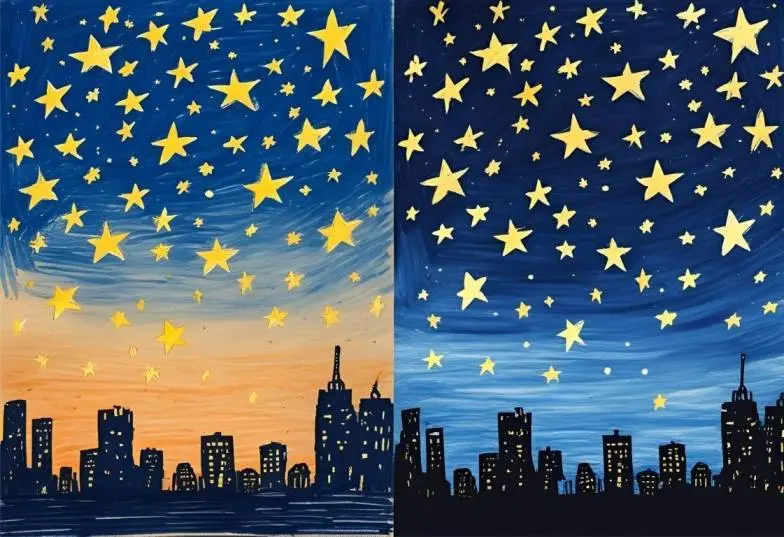
Use this concept in drawings by showing a polluted orange sky on one side and a dark, star-rich sky on the other to illustrate how cities lose their stars due to over-lighting.

2. Glare — Light That Hurts
Glare occurs when outdoor lights are overly bright or poorly positioned, shining directly into people’s eyes instead of lighting the ground. This creates intense visual discomfort, reduces night visibility, and can even be dangerous for drivers, cyclists, and pedestrians. Unshielded LED streetlights and security floodlights are common sources of nighttime glare, especially in residential neighborhoods.
A drawing idea for students: compare an unshielded light that produces harsh white glare with a shielded, warm-toned lamp designed to illuminate safely without blinding passersby.

3. Light Trespass — Crossing Boundaries
Light trespass happens when unwanted artificial light spills into spaces that are meant to remain dark—such as a streetlamp shining into a bedroom window or a neighbor’s garden light illuminating another person’s yard. This intrusion disrupts sleep patterns, affects health, and reduces nighttime comfort for residents. Many cities now recognize light trespass as a legitimate environmental and public health concern, recommending shielded fixtures and motion sensors to reduce overflow lighting.
A simple drawing idea: show a bright streetlight entering a window in the first frame, and a properly shielded lamp keeping the room dark in the second frame.

4. Clutter — Too Many Lights
Light clutter refers to the visual chaos created by groups of overly bright or competing light sources—such as neon signs, billboards, decorative LEDs, and high-intensity floodlights. Cluttered lighting makes it hard for the eye to adjust at night, increases skyglow, and can create confusion for both drivers and wildlife. This type of pollution is especially common in commercial zones, busy traffic intersections, and city centers famous for their illuminated skylines.
For drawings, compare a crowded street full of overlapping lights with a redesigned version that uses balanced, well-planned lighting to create a calmer, more energy-efficient nighttime environment.

Key message: Lighting itself isn’t harmful — misused lighting is.
Light Pollution Art for Schools & Communities
Art transforms awareness into action. Organizations like IDA, UNESCO, and Earth Hour Schools encourage creative learning programs because visual storytelling helps learners understand environmental impact quickly.
Examples of Classroom or Community Projects
1. Before & After City Drawing
2. Wildlife-at-Night Illustrations (based on NOAA research showing sea turtle disorientation)
3. ‘One Earth, One Sky’ Mural
4. Smart Lighting Design Sheets
5. Digital Illustration Challenges
These activities help communities visualize the consequences of poor lighting and the benefits of smart lighting.
Global Dark Sky Success Stories
1. Utah, USA — The World’s First Dark Sky State
Utah has become a global model for night-sky conservation. With more than 20 certified Dark Sky Parks and Communities, the state has built an entire conservation framework that combines policy, engineering, tourism, and citizen participation.
Between 2015 and 2022, Utah’s municipalities progressively replaced older sodium lamps with full-cutoff LED fixtures, cutting 60–65% of public lighting energy use. Several rural towns implemented lighting curfews after midnight, reducing skyglow so effectively that faint constellations and the Milky Way are now visible from the edge of many communities.
Utah’s commitment has transformed stargazing into a significant economic asset — local parks report rising demand for guided night walks, astrophotography workshops, and seasonal “star parties,” which now draw visitors from around the world.

2. Cévennes National Park, France — Europe’s Largest Dark Sky Reserve
Cévennes achieved one of Europe’s most ambitious lighting transformations. Working with more than 150 neighboring municipalities, the park coordinated thousands of lamp retrofits, switching to fully shielded fixtures and warm LEDs below 3000K.
Satellite observations from European environmental agencies show a noticeable decline in skyglow intensity, making Cévennes one of the few places in Europe where the night sky approaches natural brightness.
Educational programs like “Nuit des Étoiles” (Night of the Stars) invite students and visitors to learn astronomy under pristine skies. The region now markets astro-tourism as a cultural experience, linking local heritage, conservation, and scientific awareness.
3. NamibRand Nature Reserve, Namibia — Africa’s First Gold-Tier Dark Sky Reserve
Located in one of the driest regions on Earth, NamibRand offers exceptionally clear desert skies. To preserve this natural advantage, the reserve adopted strict lighting guidelines: no fixed outdoor floodlights, mandatory shielding, and a strong preference for motion-sensor lights.
Eco-lodges in the reserve redesigned their night-time lighting to protect nocturnal animals such as caracals, jackals, and desert insects. This approach also enhanced the visitor experience — guests now enjoy guided nocturnal ecology walks and astronomy sessions using high-powered telescopes.
NamibRand’s conservation-led tourism model is widely cited as a leading example of how dark-sky protection can coexist with luxury tourism and wildlife conservation.
4. Aoraki Mackenzie, New Zealand — A Southern Hemisphere Star Sanctuary
Aoraki Mackenzie was one of the earliest regions to be awarded official Dark Sky Reserve status, and its success stems from a partnership between scientists, Māori communities, local councils, and tourism operators.
The region implemented lighting curfews, strict shielding requirements, and low-color-temperature LED conversions, collectively reducing light pollution by up to 90% compared to pre-certification levels.
Māori communities emphasize the cultural significance of the night sky — particularly Matariki (Pleiades), which marks the Māori New Year. Guided cultural astronomy tours now form a significant part of regional tourism, blending tradition, science, and conservation.
5. Seoul, South Korea — Urban Innovation for the Night Sky
Seoul demonstrates that even densely populated megacities can make progress. The city introduced adaptive smart-light systems that automatically dim or brighten based on pedestrian traffic and time of night.
Within the first phase of the rollout, Seoul reported a 45% reduction in municipal lighting energy use, healthier sleep patterns among surveyed residents, and a measurable reduction in skyglow in outer districts.
The city is now testing “light zoning,” where residential, commercial, and natural areas have different lighting rules — a strategy that urban planners worldwide are watching closely.
6. Atacama Desert, Chile — A Protected Scientific Sky
The Atacama Desert hosts some of the world’s most advanced observatories, including ALMA and the Very Large Telescope Array. To preserve these scientific assets, Chile implemented some of the strictest lighting regulations on the planet, controlling everything from lamp wattage to shielding and emission direction.
Nearby towns cooperate by using low-intensity amber LEDs, enforcing signage curfews, and restricting industrial lighting near astronomical facilities. As a result, the Atacama remains one of the last major regions on Earth where the Milky Way is visible in broad, high-contrast clarity.
Astro-tourism has flourished — visitors arrive not only for observatory tours but for night-sky photography workshops, desert star-gazing camps, and indigenous sky mythology experiences.
How You Can Support the Dark Sky Movement
1. Use Responsible Outdoor Lighting
One of the most effective ways to reduce light pollution starts right at home. By choosing lighting that directs light only where it is needed, households can dramatically decrease glare, skyglow, and wasted energy. The International Dark-Sky Association (IDA) recommends following the Five Principles of Responsible Outdoor Lighting, which encourage using light only when necessary, only in the amount needed, and only in the correct direction.
Quick Guide to Smart Lighting Choices
| Lighting Type | Recommended? | Why It Matters |
|---|---|---|
| Shielded Fixtures | Yes | Directs light downward, improving visibility and reducing skyglow. |
| Warm LEDs (<3000K) | Yes | Produces less blue light, which scatters widely and disrupts wildlife. |
| Unshielded Floodlights | No | Causes glare, light trespass, and unnecessary energy consumption. |
| Motion or Timer Sensors | Yes | Ensures lighting is used only when required, preventing all-night brightness. |
Making these changes at home is simple, cost-effective, and immediately beneficial to your surroundings.
2. Support Local Dark-Sky Programs
Across the world, schools, nature groups, and astronomy clubs host events that celebrate the night sky while educating communities about the impact of artificial light. Participating in these programs not only spreads awareness but also helps create a culture of responsible lighting in your area.
Examples include:
- Earth Hour, where millions switch off lights to highlight energy conservation.
- Globe at Night, a citizen-science project that helps scientists map global light pollution.
- International Dark Sky Week, encouraging people to experience natural darkness.
- Community stargazing nights, where families and students observe constellations and learn basic astronomy.
Joining even one of these events makes you part of a global effort to restore natural night environments.
3. Spread Awareness Creatively
Awareness grows faster when people connect emotionally with the issue. Creative activities such as drawings, posters, reels, digital illustrations, or short awareness videos can inspire others to rethink how they use light. Schools often display student artwork that contrasts star-filled skies with polluted ones — a powerful visual lesson.
Sharing your work online with hashtags like #SaveTheNight and #DarkSkyMovement helps amplify the message and encourages others to take small but meaningful actions.
4. Protect Nocturnal Wildlife
Many animals depend on darkness to hunt, migrate, navigate, or breed. Bright yard lights can confuse birds, delay insect activity, or even mislead sea turtle hatchlings away from the ocean. By switching to motion-sensor lighting, keeping garden lights low and warm, and minimizing illumination during sensitive breeding seasons, you help create safer habitats for wildlife around your home.
Even simple steps — such as avoiding upward-facing decorative lights — can significantly improve local ecological health.
5. Experience the Night Sky Firsthand
One of the strongest motivations for protecting darkness is experiencing it yourself. Visiting a dark-sky park or a rural area with minimal light pollution allows you to see the Milky Way, faint constellations, and planetary alignments that many city residents have never witnessed. These moments often inspire people to take action at home and encourage others to value natural darkness.
Stargazing trips, guided astronomy walks, and astrophotography sessions are great ways to reconnect with the night sky.
6. Advocate for Responsible City Policies
Individual action is important, but long-term change requires thoughtful urban planning. You can contribute by encouraging local authorities to adopt smart lighting strategies, review outdated fixtures, and enforce community-wide standards for shielding, brightness, and color temperature.
Cities can also introduce adaptive lighting, which adjusts brightness based on traffic or time of night, and require environmental impact assessments before installing large-scale lighting systems. When citizens voice their support for these measures, municipalities are more likely to invest in sustainable lighting solutions.
Conclusion
Restoring the night sky is a shared responsibility. By adopting responsible lighting, supporting community programs, and educating future generations, we help preserve an essential part of Earth’s natural heritage.
Every light turned off brings us one step closer to a world where future generations can still see — and dream under — the stars.
Disclaimer:
This article summarizes publicly available research and environmental guidelines. It is for educational purposes only and does not replace official government or scientific recommendations.
Frequently Asked Questions (FAQ)
1. What does the Dark Sky Movement actually aim to achieve?
The movement’s core mission is to help communities use outdoor lighting in a way that supports safety without damaging the natural night environment. Instead of asking people to switch off lights entirely, it promotes lighting designs that reduce glare, skyglow, and energy waste. The goal is simple: keep the night dark enough for ecosystems, human health, and astronomy — while still keeping public spaces functional.
2. Why should ordinary people care about light pollution?
Light pollution is not only about losing the stars. It influences sleep cycles, increases energy bills, disturbs wildlife, and alters local climate rhythms. Many homeowners discover that by improving outdoor lighting — shielding lamps, choosing warmer LEDs, adding motion sensors — they save electricity while creating a more comfortable night environment.
3. What are the different forms of light pollution?
Light pollution appears in four main forms:
- Skyglow: The bright dome seen above cities.
- Glare: Harsh light that makes it difficult to see properly.
- Light Trespass: Light entering places where darkness is expected, such as bedrooms.
- Clutter: Overcrowded or competing lighting in commercial zones.
Although these categories overlap, understanding them helps communities design lighting that serves people rather than overwhelms the sky.
4. Are there proven ways for a city to reduce light pollution?
Yes. Cities worldwide are adopting practical measures such as dimming unnecessary streetlights at night, switching to shielded fixtures, using warm LEDs below 3000K, and enforcing curfews for commercial lighting. Municipalities that adopted these measures report lower electricity costs, improved night visibility, and higher participation in astronomy and nature-based tourism.
5. How does artificial light affect wildlife at night?
Many species — including bats, owls, insects, and sea turtles — rely on predictable darkness to migrate, find food, or breed. Bright lighting can confuse their navigation signals or delay essential nighttime behavior. For example, research near coastal regions shows that hatchling sea turtles often crawl toward hotel lights instead of the ocean. Reducing unshielded light around natural habitats can significantly improve survival chances.
6. What practical steps can families take at home?
Homeowners can make meaningful improvements by using shielded outdoor lights, selecting warm LEDs (ideally under 3000K), installing timers or sensors, and turning off ornamental lighting late at night. These small adjustments lower monthly electricity use and create a healthier sleep environment for everyone in the household.
7. Can protecting dark skies support local economies?
Absolutely. Many regions have built thriving “astro-tourism” industries around dark-sky reserves and stargazing events. Visitors often stay in local lodges, use local guides, and spend on nearby businesses. Communities in France, Chile, New Zealand, and India have demonstrated that preserving natural darkness can generate sustainable revenue without harming local ecosystems.
8. Which global organizations guide dark-sky protection efforts?
The International Dark-Sky Association (IDA) provides guidelines, certification programs, and technical recommendations for responsible outdoor lighting. UNESCO and several regional alliances also support night-sky preservation by identifying potential dark-sky sites and helping governments shape evidence-based lighting policies.
9. Is switching to LEDs always better for the night sky?
Not always. While LEDs are efficient, blue-rich LEDs cause more skyglow than warmer alternatives. The safest choice for homes and cities is warm white LEDs (below 3000K) paired with shielding. This combination protects visibility and wildlife while still offering energy savings.
10. How can someone get involved in dark-sky conservation?
Joining a citizen-science project like Globe at Night, attending local stargazing events, sharing night-sky photographs, or encouraging schools to participate in dark-sky art programs are excellent starting points. Even reporting poorly designed public lighting to local authorities can contribute to long-term improvement.
Download our Free Dark Sky Drawing Worksheet – GreenGlobe25
This worksheet is an original educational resource created by GreenGlobe25 for non-commercial learning purposes.
Author Bio
I’m Soumen Chakraborty, the founder and lead researcher at GreenGlobe25. I specialize in translating complex data on pollution, climate risks, and sustainability into clear, actionable guides for Indian households and communities.
My work is based on a rigorous analysis of authoritative sources like the CPCB and WHO, following our publicly-available Fact-Checking Policy to ensure every piece of content is accurate and trustworthy.
LinkedIn: chakrabortty-soumen
Facebook: Ecoplanet
Last update on December 2025.
REFERENCES
- UNESCO. Starlight Reserves & Protected Night Sky Criteria.
https://whc.unesco.org - Falchi, F., et al. (2023). World Atlas of Artificial Night Sky Brightness.
https://www.lightpollutionmap.info
(Used for global skyglow and “80% of world population cannot see the Milky Way”.) - International Dark-Sky Association (IDA). Responsible Outdoor Lighting Principles, Dark Sky Places Program.
https://darksky.org - UN Environment Programme (UNEP). Energy Efficiency and Outdoor Lighting Guidance.
https://www.unep.org - Barentine, J. et al. (2018). Measured Reductions in Skyglow Following Street Lighting Retrofits.
Journal of Quantitative Spectroscopy & Radiative Transfer.
https://doi.org/10.1016/j.jqsrt.2018.03.017 - Ministry of Power, Government of India (2024). National LED & Smart Outdoor Lighting Report.
https://powermin.gov.in - NOAA (National Oceanic and Atmospheric Administration). Sea Turtle Hatchling Orientation & Artificial Lighting Studies.
https://www.fisheries.noaa.gov/ - Department of Science & Technology (DST), Government of India. Outdoor Lighting Guidelines (Draft).
https://dst.gov.in - Astronomical Society of India (ASI). Dark Sky & Astronomy Outreach Resources.
https://astronomyindia.org - International Dark-Sky Association. Flagstaff Dark Sky City Case Study.
- https://www.darksky.org/flagstaff-dark-sky-city/
- European Environment Agency (EEA). Satellite Observations of Night-Sky Brightness.
- https://www.eea.europa.eu/
Some of the images in this article were generated using AI to help illustrate concepts. They are not photographs of real events or locations.

- Groundwater Pollution in India (2025): Nitrate, Fluoride & Arsenic Contamination Explained - December 1, 2025
- How Air Purifiers Work: Real Science, Real Effectiveness & India-Focused 2025 Guide - November 20, 2025
- Indoor Air Pollution in India (2025 Guide): Hidden Sources & Health Risks - November 16, 2025