
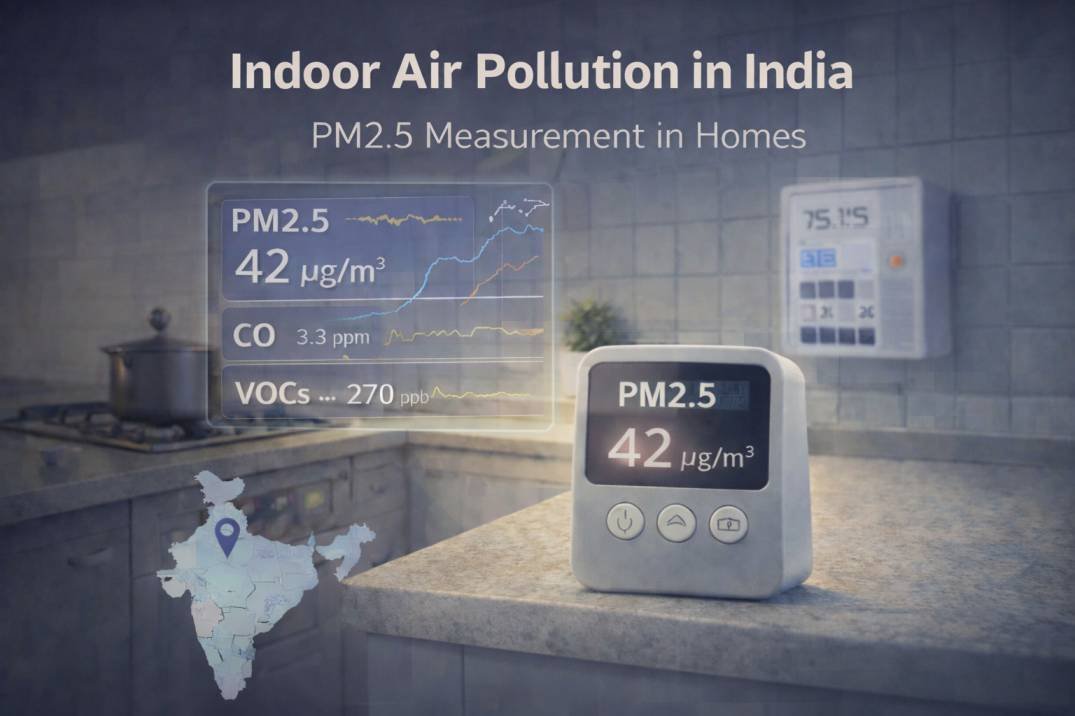
Measurement studies typically monitor particulate matter, combustion-related gases, and volatile organic compounds using specialised sampling instruments.
Introduction
Indoor air pollution refers to the presence of particulate matter and chemical pollutants inside enclosed environments such as homes, offices, and other buildings. In India, indoor air pollution is primarily studied through household exposure research and academic monitoring campaigns rather than continuous national monitoring networks. As a result, much of the available evidence comes from field measurement studies that examine pollutant concentrations, emission sources, and exposure patterns in indoor environments.
Unlike ambient (outdoor) air pollution, which is monitored through institutional observation networks in many countries, indoor air pollution in India is typically documented through targeted household studies and research-based exposure assessments. For foundational definitions and classification boundaries, refer to: What is Air Pollution in India?
Indoor environments vary widely by housing type, ventilation characteristics, household activity patterns, and regional climate conditions. Because of this variability, indoor pollutant concentrations often show greater fluctuation than ambient outdoor datasets, and interpretation depends strongly on sampling duration, measurement location, and behavioural context.
This article explains how indoor air pollution is measured in India in 2025, which pollutants are commonly assessed, which instruments are used in research studies, and what methodological limitations should be considered when interpreting indoor air quality datasets.
What Indoor Air Pollution Means for You
- Indoor pollution can be higher than outdoor levels in India
- Cooking and outdoor AQI both affect your home air
- Even if AQI is in the ‘Moderate’ category (CPCB), indoor exposure can still be high.”
What is Indoor Air Pollution in India?
Indoor air pollution in India refers to the presence of harmful pollutants like PM2.5, carbon monoxide, and VOCs inside homes and buildings. It is mainly caused by cooking emissions, household fuels, and outdoor pollution entering indoor spaces, especially in urban areas with high AQI levels.
Indoor Air Pollution in India – Real Exposure Context
- In cities like Delhi, indoor PM2.5 levels can exceed 150–300 µg/m³ during cooking
- CPCB data shows outdoor pollution often enters homes, especially in winter
- Studies show Indian households using solid fuels face significantly higher exposure levels
Indoor air pollution in India is not only caused inside homes but also influenced by outdoor AQI levels, especially in polluted cities.
Indoor Air Quality in India vs Household Air Pollution (Terminology)
Indoor air pollution and indoor air quality (IAQ) are frequently used interchangeably, but the terms reflect different framing. Indoor air quality is often used as a descriptive measurement term that refers to pollutant concentration levels inside enclosed spaces. Indoor air pollution is used more explicitly when indoor pollutant concentrations are treated as a contamination condition.
A related term, household air pollution (HAP), is widely used in public health literature. In Indian contexts, HAP typically refers to indoor exposure conditions linked to household energy use, particularly cooking and heating practices, and may involve specific focus on fuel type, kitchen design, and exposure duration.
These distinctions are important because many Indian studies are not designed to describe indoor environments in general, but rather to quantify pollutant exposure patterns in specific household settings.
Indoor Air Pollution as an Observational Category
As in ambient air pollution research, indoor air pollution is best understood as an observational concept. It refers to measurable pollutant presence in indoor air, documented through concentration measurements, chemical sampling, or particle monitoring.
Indoor air pollution datasets typically describe:
- pollutant concentration levels inside rooms or kitchens
- variation during activity periods such as cooking
- persistence of pollutants across hours or days
- the relationship between indoor and outdoor pollutant infiltration
Unlike ambient air monitoring systems, indoor measurement coverage is not standardised nationally. Most indoor datasets are produced through research sampling and therefore vary in methodology and comparability.
How Indoor Air Pollution Is Measured (Simple Explanation)
Indoor air pollution is measured using:
- PM2.5 sensors (real-time monitoring)
- Gas sensors for CO, NO2, SO2
- Passive samplers for long-term measurement
- Laboratory analysis for VOCs
These methods are used in Indian household studies to measure both short-term pollution peaks and long-term exposure levels.
Pollutants Commonly Measured in Indian Indoor Studies
Indoor air pollution studies in India typically focus on particulate matter, combustion-related gases, and volatile organic compounds. Measurement priorities depend on study objectives, household conditions, and instrument availability. For pollutant-specific definitions used in India’s ambient reporting framework,see PM2.5 and other criteria pollutants.
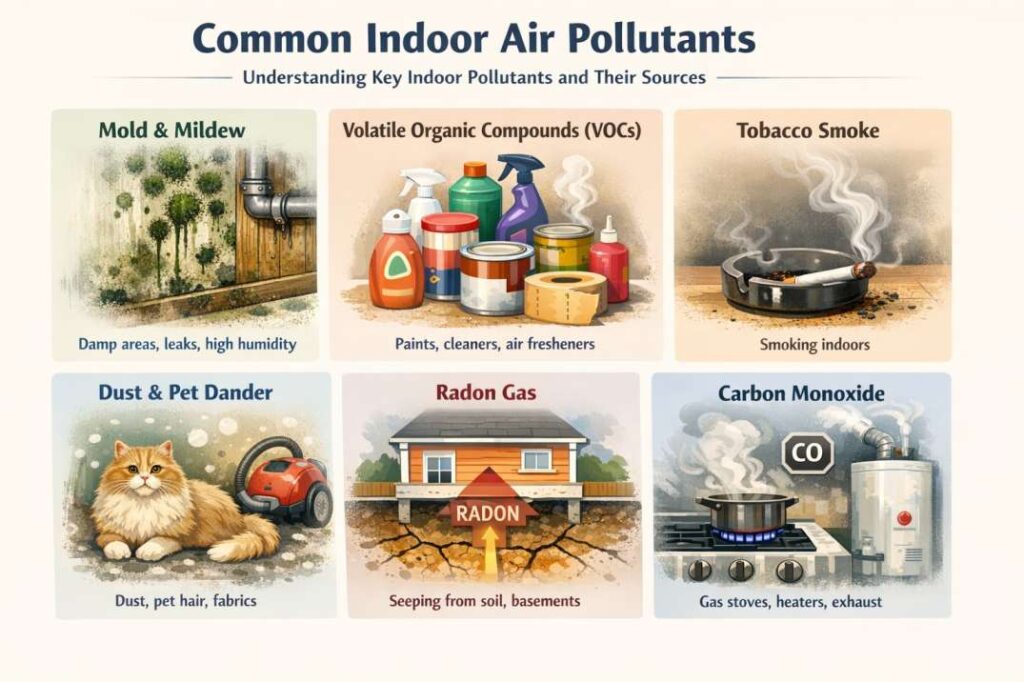
Common Indoor Pollutants Measured in Indian Indoor Air Studies
| Pollutant | Typical Unit | Measurement Method | Common Indoor Sources | Health Relevance |
|---|---|---|---|---|
| PM₂.₅ | µg/m³ | Gravimetric sampling, optical sensors | Cooking emissions, outdoor infiltration | Respiratory and cardiovascular effects |
| PM₁₀ | µg/m³ | Gravimetric sampling, optical monitoring | Dust resuspension, construction influence | Airway irritation |
| CO | ppm / mg/m³ | Electrochemical sensors | Incomplete combustion from cooking fuels | Reduces oxygen delivery in blood |
| NO₂ | µg/m³ / ppb | Passive samplers, chemiluminescence | Gas stoves, traffic infiltration | Respiratory irritation |
| SO₂ | µg/m³ | Passive samplers, gas analysers | Combustion emissions, industrial influence | Airway inflammation |
| VOCs | µg/m³ | Sorbent tubes + laboratory analysis | Household products, solvents | Chemical irritation and exposure risk |
Note: Sources vary by building type, ventilation conditions, household practices, and regional climate. Categories shown above are illustrative rather than exhaustive.
Measurement Instruments and Sampling Approaches
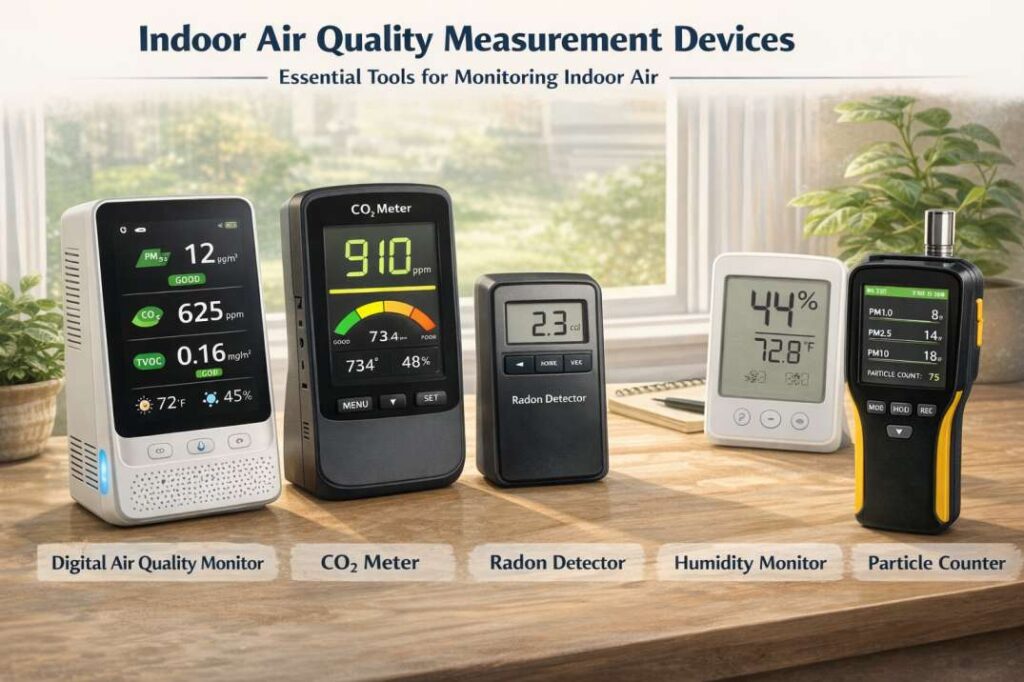
Indoor air pollution measurement studies in India generally follow two methodological approaches: integrated sampling and real-time monitoring.
Integrated Sampling (Filter-Based and Passive Sampling)
Integrated sampling methods measure pollutant concentration over a defined time window. For particulate matter, gravimetric sampling is widely used, where air is drawn through a filter and mass concentration is calculated from collected particle mass and sampled air volume.
For gases such as NO₂ and SO₂, passive samplers are often used in indoor studies. These devices absorb pollutants over a fixed period, after which the sampler is analysed in a laboratory.
Integrated sampling methods are valuable because they provide stable average concentration estimates and support chemical analysis, but they may not capture short-duration peaks.
Real-Time Monitoring (Continuous Sensors and Portable Devices)
Real-time monitoring instruments measure concentrations continuously or at short intervals. These are used to document:
- rapid concentration increases during cooking
- hourly variability inside rooms
- indoor-outdoor infiltration patterns
Low-cost optical PM sensors are increasingly used in indoor studies, though their accuracy depends on calibration and environmental conditions such as humidity. CO is often measured using portable electrochemical sensors due to cost and deployment feasibility.
Example: Indoor Air Pollution Measurement in a Household Study
In many Indian exposure studies, researchers place particulate matter monitors inside kitchens or living areas to measure indoor pollutant concentrations.
For example:
- A portable PM₂.₅ sensor may be placed at breathing height inside a kitchen.
- Measurements are recorded continuously during cooking periods.
- Researchers compare concentration peaks during cooking with background levels recorded during non-activity periods.
- Outdoor measurements may also be collected to understand how much pollution enters the home from surrounding environments.
Such monitoring designs help researchers identify short-term exposure peaks as well as daily average concentration levels.
Sampling Duration in Indoor Studies (Short-Term vs 24-Hour vs Seasonal)
A major factor shaping indoor air pollution interpretation is sampling duration. Indian indoor datasets commonly use one of the following approaches:
Short-Term Activity Monitoring (Minutes to Hours)
Many studies monitor indoor PM₂.₅ or CO during cooking periods. These measurements capture peak concentration episodes and are useful for identifying short-term exposure patterns.
However, peak-period measurements should not be interpreted as representative of full-day indoor air quality.
8–12 Hour Sampling (Partial Day Observation)
Some studies use half-day monitoring to represent daytime household activity. This approach can capture multiple emission events but remains incomplete without overnight measurements.
24-Hour Integrated Sampling (Daily Average)
24-hour sampling provides a more comparable dataset for interpreting average indoor concentration levels. It is often used in epidemiological and exposure assessment contexts because it reduces the influence of short-term peaks.
Multi-Day or Seasonal Monitoring
Higher-quality studies repeat measurements across multiple days or across seasons. This is particularly important in India because:
- ventilation changes across monsoon and winter periods
- cooking and heating patterns differ seasonally
- outdoor infiltration varies with meteorology
Sampling duration should always be considered before comparing results across studies or regions. Sampling duration is also important when interpreting air quality indicators reported in ambient monitoring systems such as the Air Quality Index (AQI).
Indoor air data differs from structured air quality monitoring systems in India
Data Interpretation Challenges in Indoor Air Pollution
Indoor air pollution datasets require cautious interpretation because concentration levels depend on both measurement design and household variability.
High Variability Across Household Types
Indoor environments differ substantially by:
- housing materials
- kitchen design and enclosure
- window opening practices
- fuel type and combustion efficiency
- occupancy density
As a result, pollutant levels reported in one indoor study may not represent broader regional conditions.
Indoor vs Outdoor Interaction
Indoor pollutant concentrations can originate from indoor emission sources, outdoor air infiltration, or a combination of both. In many Indian settings, particulate matter levels indoors reflect a combination of cooking emissions and infiltration from ambient PM pollution, especially in high-traffic urban regions.
Peak vs Average Concentrations
Several Indian studies report PM₂.₅ concentrations exceeding 100–300 µg/m³ during cooking or enclosed activity periods. Reported ranges differ significantly across study designs, seasons, kitchen configurations, and fuel types, and such values often reflect peak cooking-period measurements rather than full-day averages. Such peak-period concentration ranges are consistent with exposure patterns documented in WHO household air pollution evidence reviews and related measurement literature from Indian household exposure studies.
WHO indoor air quality guideline documentation on household fuel combustion is commonly used as a benchmark reference when interpreting Indian exposure datasets.
For interpretation, it is essential to distinguish:
- peak exposure windows
- daily average concentrations
- multi-day averages
Indoor Air Pollution and CPCB Reporting Frameworks (AQI and NAAQS Boundaries)
India’s National Air Quality Index (AQI), introduced by CPCB in 2014, translates monitored ambient pollutant concentrations into standardised air quality categories for reporting. For a detailed breakdown of how CPCB converts pollutant concentrations into index categories, refer to: how AQI is calculated in India.
India’s National Ambient Air Quality Standards (NAAQS) define benchmark concentration limits for regulated pollutants in ambient outdoor air. These standards are used for regulatory assessment and national reporting, but they are not designed as indoor air quality standards. For benchmark comparison between India’s NAAQS standards and WHO guideline values, see: CPCB vs WHO Air Pollution Standards in India.
This distinction is important because indoor air pollution studies may use the same concentration units as ambient monitoring (such as µg/m³), but indoor measurements are typically influenced by household activities, ventilation conditions, and building characteristics. As a result, indoor concentration values cannot be interpreted as direct equivalents of ambient compliance benchmarks without careful methodological context.
Is AQI Used for Indoor Air Quality?
No. India’s AQI system, developed by CPCB, is designed for outdoor air pollution monitoring. Indoor air quality does not have a standardized national index and depends on household conditions, ventilation, and indoor pollution sources.
Indoor vs Ambient Measurement Comparability
Indoor air pollution data cannot be interpreted as directly comparable to ambient monitoring datasets without methodological context.
Ambient monitoring systems such as NAMP and CAAQMS:
- use standardised station locations
- follow institutional measurement protocols
- produce comparable long-term datasets
Indoor studies, in contrast:
- vary by sampling location (kitchen, bedroom, living room)
- differ in sampling height and placement
- differ in ventilation and occupancy patterns
- may capture activity peaks rather than average conditions
Indoor datasets are therefore most useful for understanding exposure patterns and indoor environment variability rather than for producing nationwide comparability in the same way as CPCB ambient datasets.
For example, during winter in Delhi, AQI frequently reaches ‘Severe’ levels (300+), increasing indoor pollution infiltration.
What These PM2.5 Levels Mean in Real Life
- 100–300 µg/m³ during cooking = very high short-term exposure
- Indoor pollution can exceed outdoor AQI levels in Indian homes
- Long exposure increases health risk, especially for children
Key Takeaways
• Indoor air pollution in India is mainly documented through research studies and household exposure assessments, rather than continuous national monitoring networks.
• PM₂.₅ is the most frequently measured indoor pollutant, as it indicates combustion-related exposure and particulate infiltration.
• Measurement approaches typically include gravimetric sampling, passive gas samplers, and real-time sensor monitoring.
• Indoor pollutant concentrations vary significantly depending on household activities, ventilation, building characteristics, and outdoor pollution infiltration.
• Interpretation of indoor datasets requires careful consideration of sampling duration, measurement location, and study design.
Why Indoor Air Pollution Measurement Matters
- Helps understand real exposure, not just outdoor AQI
- Explains why health risks exist even indoors
- Supports better household decisions (ventilation, cooking methods)
- Important for cities with high pollution like Delhi, Kolkata, Lucknow
Conclusion
Indoor air pollution in India is primarily documented through research-based measurement studies rather than standardised national monitoring systems. Measurement approaches commonly include gravimetric particulate sampling, real-time sensor monitoring, passive gas samplers, and laboratory-based chemical analysis for VOCs and related compounds.
Interpretation depends strongly on sampling duration, household conditions, ventilation patterns, and the extent of outdoor infiltration. Indoor pollutant concentrations can vary widely across housing types and regions, meaning indoor datasets should be evaluated with explicit attention to representativeness limits.
In 2025, indoor air pollution remains a measurable but methodologically diverse category of environmental observation in India. Reliable interpretation requires careful reading of sampling design, instrument type, and temporal coverage rather than reliance on single concentration values.
Understanding how indoor air pollution is measured helps interpret research findings correctly and supports better assessment of household exposure patterns in different Indian environments.
Related Guides on Air Pollution in India
- What is Air Pollution (Basics)
- PM2.5 and Criteria Pollutants Explained
- How Air Quality is Measured in India
- CPCB vs WHO Standards
- AQI Explained (India System)
How to Reduce Indoor Air Pollution in Indian Homes
Improve Ventilation
- Open windows when outdoor air is cleaner (early morning or after rain)
- Use exhaust fans in kitchen and bathrooms
- Avoid cooking in fully closed rooms
Reduce Cooking Emissions
- Always use chimney or exhaust while cooking
- Prefer LPG or electric cooking over biomass fuels
- Keep kitchen windows or doors open
Control PM2.5 Indoors
- Use air purifiers (HEPA filter) if affordable
- Do wet mopping instead of dry sweeping
- Avoid incense sticks and indoor smoking
Prevent Outdoor Pollution Entry
- Close windows during high AQI periods
- Use curtains and door mats to trap dust
- Clean surfaces regularly
Do Indoor Plants Help?
- Plants like snake plant or areca palm have limited effect
- They are not a substitute for ventilation or filtration
What to Do When AQI is Above 300 (Severe in India)
- Keep windows and doors closed
- Avoid indoor pollution sources (frying, incense, smoking)
- Use air purifier if available
- Wear mask when going outside
- Track AQI using apps like CPCB SAMEER
How This Information Was Prepared
This article is based on:
- CPCB air quality frameworks
- WHO indoor air quality guidelines
- Indian household exposure studies
The content simplifies measurement-based research into practical public understanding.
Frequently Asked Questions (FAQ)
Is indoor air pollution measured by CPCB in India?
CPCB primarily monitors ambient air pollution through outdoor station networks. Indoor air pollution evidence is usually produced through academic studies and exposure assessment surveys rather than routine CPCB monitoring.
Is AQI applicable to indoor air quality?
No. India’s AQI framework is designed for ambient air reporting and is not intended as an indoor classification system.
Which pollutant is most commonly measured indoors in India?
PM₂.₅ is the most frequently measured indoor pollutant because it is widely used as a combustion and particulate exposure indicator.
Are indoor pollutant levels directly comparable to outdoor concentrations?
Not always. Indoor levels depend on indoor emission sources, outdoor infiltration, ventilation conditions, and sampling duration.
Why do some studies report extremely high PM₂.₅ levels indoors?
High values often reflect short-term peak measurements during cooking or enclosed activity periods, rather than whole-day averages.
What units are used for indoor PM₂.₅ reporting in India?
Indoor particulate matter concentrations are most commonly reported in micrograms per cubic metre (µg/m³). Interpretation depends on whether the value represents short-term peak monitoring, a 24-hour average, or multi-day sampling.
What causes indoor air pollution in Indian homes?
Indoor air pollution in Indian households can result from cooking fuels, gas stoves, biomass combustion, tobacco smoke, cleaning chemicals, and outdoor pollution entering buildings through ventilation or infiltration.
GreenGlobe25 Standard Disclaimer
This content is educational and includes general public health guidance based on scientific research and Indian air quality data.
References
World Health Organization (WHO). Household Air Pollution and Health – Fact Sheet.
https://www.who.int/news-room/fact-sheets/detail/household-air-pollution-and-health
World Health Organization (WHO) (2014). Indoor Air Quality Guidelines: Household Fuel Combustion.
https://www.who.int/publications/i/item/9789241548885
Institute for Health Metrics and Evaluation (IHME). Global Burden of Disease (GBD) – Household Air Pollution Exposure and Health Burden Estimates.
https://www.healthdata.org/research-analysis/gbd
Balakrishnan, K., Mehta, S., Ghosh, S., Johnson, M., Brauer, M., Naeher, L., & Smith, K. (2014). Population Levels of Household Air Pollution and Exposures – WHO Evidence Review.
https://www.who.int/airpollution/guidelines/household-fuel-combustion/Review_5.pdf
State of Global Air (Health Effects Institute). Household Air Pollution – Source Overview.
https://www.stateofglobalair.org/pollution-sources/hap
Last update – April 2026