
Introduction
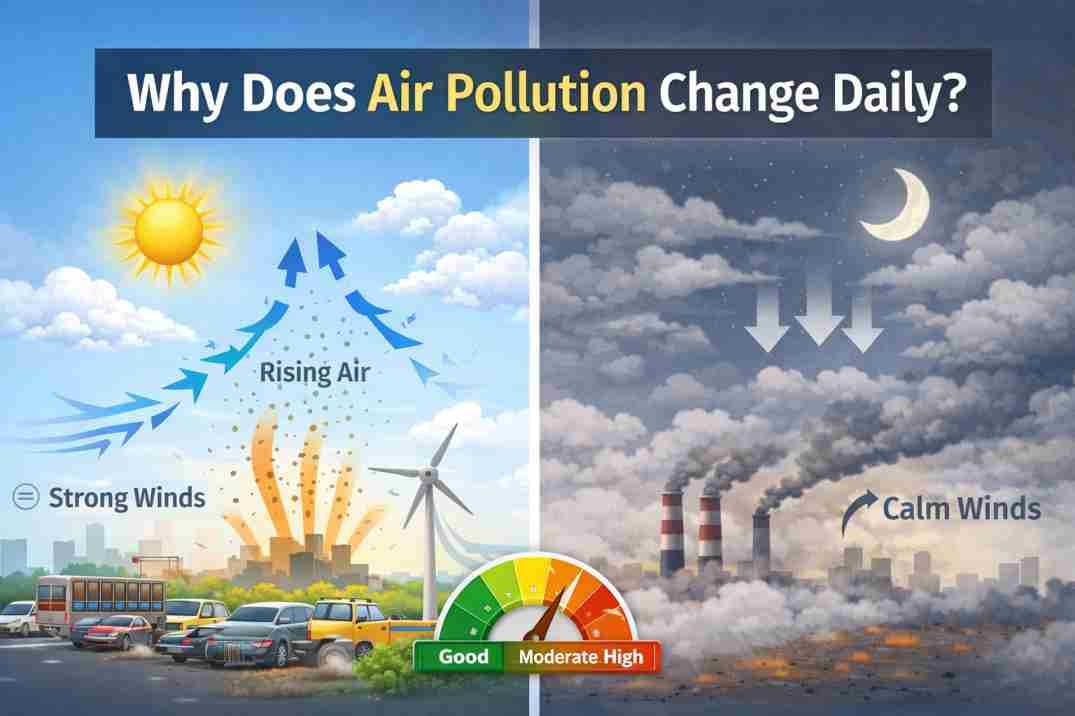
In many Indian cities, AQI levels can rise sharply within just a few hours—even under similar traffic and industrial conditions. This happens because air pollution depends not only on emissions, but also on weather conditions such as wind, temperature, humidity, and atmospheric mixing.
A windy afternoon may temporarily improve air quality, while a calm winter night can trap pollutants near the ground and rapidly increase pollution levels. Understanding how these atmospheric conditions affect AQI helps explain why air pollution changes so frequently from day to day.
As atmospheric conditions change throughout the day, AQI levels may improve temporarily or worsen rapidly within just a few hours.
Real Example: How AQI Changes Overnight in Delhi
In cities like Delhi, AQI can change dramatically within a single day despite comparable pollution sources across the city. During winter, afternoon AQI levels may stay around the “Moderate” category before rising to “Very Poor” or “Severe” conditions by the next morning.
This shift often happens because atmospheric conditions change rapidly after sunset. As temperatures drop, vertical air mixing weakens and wind speeds become lower, allowing pollutants to remain trapped close to the ground.
As a result, pollution gradually accumulates overnight, especially during calm winter conditions in North India. Similar overnight AQI spikes are commonly observed across Delhi NCR during severe winter pollution episodes.
How Pollution Builds Up or Clears
Air pollution is not fixed. It changes continuously depending on how emissions interact with weather and atmospheric conditions.
As a result two days with nearly identical urban activity can still have very different AQI levels. On some days, pollutants disperse quickly and air quality improves. On others, pollutants remain trapped near the ground and gradually accumulate.
In many cases, the difference is not simply how much pollution is produced, but how effectively the atmosphere can disperse it after release.
Weather conditions such as wind speed, temperature, humidity, and vertical air movement constantly affect how pollutants behave in the atmosphere. Even small changes in these conditions can significantly alter pollution levels within a short period.
A useful way to understand this is to imagine smoke inside a closed room. Without proper airflow, the smoke gradually accumulates instead of clearing away. Air pollution behaves in a similar way when atmospheric dispersion becomes weak.
Air pollution in cities behaves in a similar way. Severe pollution episodes are often caused not only by emissions, but also by atmospheric conditions that prevent pollutants from dispersing efficiently.
Why This Matters for Daily AQI Changes
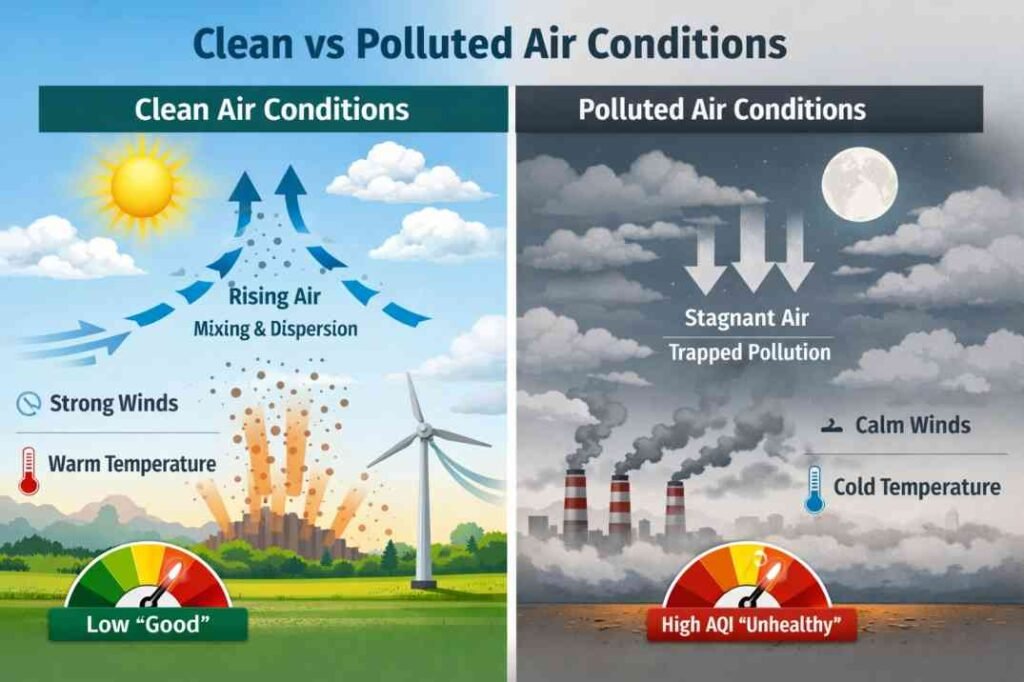
Air pollution is not controlled by emissions alone. In the short term, weather and atmospheric conditions often have a stronger influence on how polluted the air becomes.
As a result AQI may improve quickly on windy days but worsen rapidly during calm or cold conditions. Even without major changes in emissions, weak atmospheric dispersion can allow pollutants to accumulate near the ground and sharply increase pollution levels.
Many severe pollution episodes are caused not only by emissions, but also by the atmosphere failing to disperse pollutants efficiently.
Why AQI Changes Daily: Main Factors
Several atmospheric conditions influence how pollution behaves throughout the day. These factors determine whether pollutants disperse into the atmosphere or remain concentrated near the ground.
Strong winds usually improve air quality by dispersing pollutants over a wider area, while calm conditions allow pollution to accumulate near the surface. Wind direction can also transport pollution from nearby regions.
Temperature and vertical air movement also affect AQI levels. Warm daytime conditions improve atmospheric mixing and help pollutants disperse upward. During cold mornings and winter nights, weaker air movement allows pollution to remain trapped near breathing level.
Humidity affects fine particles such as PM2.5 by making haze and smog more visible. At the same time, the boundary layer — the lower part of the atmosphere where pollutants mix — can become shallow during winter, compressing pollutants into a smaller volume of air and rapidly increasing AQI levels.
In simple terms, pollution becomes more concentrated when the atmosphere has less space available for dispersion.
Human Activity Patterns
Daily human activities also influence short-term pollution levels.
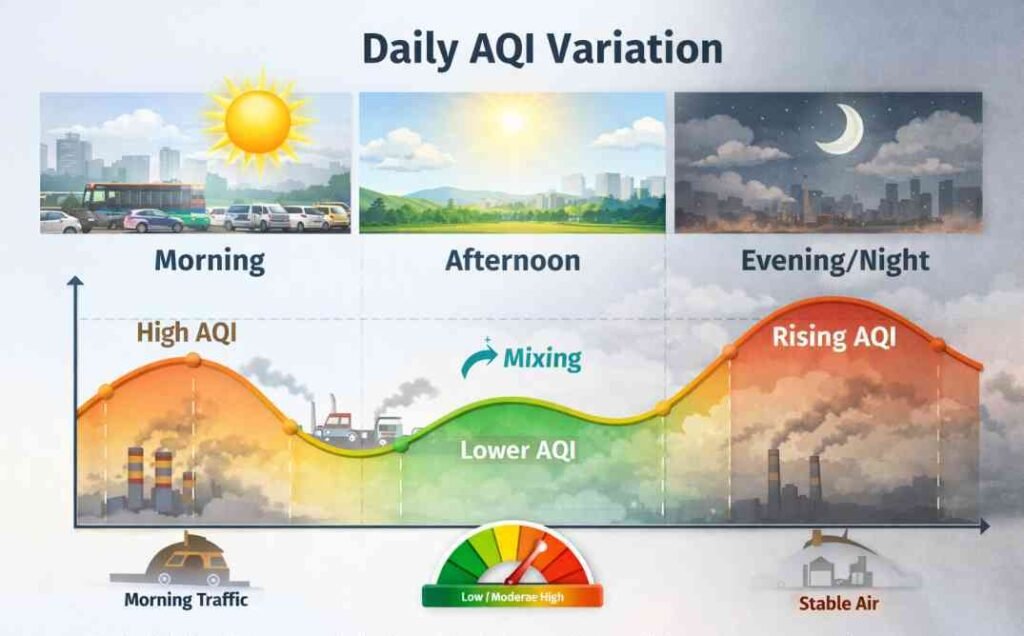
Morning traffic increases emissions during a time when atmospheric mixing is still weak, allowing pollutants to accumulate near the ground more easily. Evening traffic often coincides with cooler and more stable atmospheric conditions, which can further increase AQI levels.
Certain seasonal or temporary events can also cause rapid pollution spikes. For example, firecracker emissions during festivals such as Diwali or local biomass burning can sharply increase PM2.5 concentrations within a short period.
Industrial operations, power generation, and construction activity also contribute to daily AQI fluctuations, especially in densely populated urban regions.
Seasonal Influences (India Context)
Seasonal conditions strongly affect how pollution behaves across India.
During winter, weaker winds, colder temperatures, and temperature inversions trap pollutants near the ground, causing AQI levels to rise sharply in many North Indian cities. In summer, stronger sunlight and better air circulation usually improve dispersion, although dust storms can still increase PM10 pollution.
Seasonal activities such as crop residue burning after the monsoon also contribute to severe pollution episodes, especially across Delhi NCR and nearby regions.
Why Pollution Is Worse in Winter (India Example)
Winter is the most polluted season in many Indian cities, especially across North India. During colder months, atmospheric conditions become less favorable for pollution dispersion, allowing pollutants to remain concentrated near the ground for longer periods.
One major reason is temperature inversion, where a layer of warm air traps cooler polluted air near the surface. Weak winds and a shallow mixing layer further reduce dispersion, causing AQI levels to rise rapidly even during periods of stable urban emissions.
Higher humidity and fog also worsen winter pollution by increasing haze and smog formation. Seasonal activities such as crop residue burning and biomass fuel use can intensify these conditions further, especially across Delhi NCR and nearby regions.
Why AQI Can Change Within Hours
AQI levels can rise or fall significantly within just a few hours due to changes in sunlight, temperature, traffic activity, and atmospheric mixing.
During mornings and late evenings, cooler and more stable atmospheric conditions allow pollutants to remain concentrated near the ground. Morning traffic can further increase pollution levels during this period.
By afternoon, stronger sunlight heats the surface and improves vertical air mixing, helping pollutants disperse more effectively. As a result, AQI levels often improve temporarily before rising again later in the evening.
In many North Indian cities, especially during winter, overnight AQI increases of 100–250+ points are commonly observed under stagnant atmospheric conditions.
How to Predict Daily AQI Changes (Simple Guide)
Daily AQI changes often follow visible weather patterns. Cold mornings, weak wind, fog, and calm evenings usually allow pollution to build up more quickly, especially during winter.
In contrast, sunny afternoons and stronger winds often improve air quality by increasing atmospheric mixing and pollutant dispersion.
In many Indian cities, observing basic weather conditions can provide a simple idea of whether AQI levels are likely to improve or worsen during the day.
The Three-Part Formula
Air pollution at any moment can be understood as:
Air Pollution = Emissions + Weather + Atmospheric Behavior
- Emissions determine how much pollution is released from vehicles, industries, dust, and burning sources.
- Weather affects how air moves through wind, temperature, and humidity.
- Atmospheric behavior determines whether pollutants disperse or remain trapped near the ground.
This explains why cities with similar pollution sources can still experience very different AQI levels under changing atmospheric conditions.
Practical Note
During severe AQI conditions, reducing outdoor exposure, avoiding intense physical activity near traffic-heavy areas, and checking real-time AQI updates can help reduce short-term pollution exposure.
In India, AQI levels can change quickly depending on weather and atmospheric conditions, especially during winter and stagnant air conditions.
Conclusion
Air pollution changes daily because the atmosphere is constantly changing. Weather conditions such as wind, temperature, humidity, and atmospheric mixing determine whether pollutants disperse or remain concentrated near the ground.
As a result, pollution often becomes much worse during winter, calm weather, and low-dispersion conditions across many Indian cities.
Frequently Asked Questions (FAQs)
Why does AQI change every day?
AQI changes daily because weather conditions such as wind, temperature, humidity, and atmospheric mixing affect how pollutants disperse or accumulate near the ground.
Why is pollution worse in winter in India?
Winter conditions often include weak winds, temperature inversion, fog, and shallow atmospheric mixing, which trap pollutants close to the surface and increase AQI levels.
Can AQI change within a few hours?
Yes. Changes in sunlight, traffic activity, wind speed, and atmospheric stability can cause AQI levels to rise or fall significantly within a short period.
Does weather affect pollution more than emissions?
In the short term, weather conditions can strongly influence pollution levels by controlling how pollutants disperse. However, long-term air quality still depends heavily on reducing emissions.
Does rain reduce air pollution?
Rain can temporarily reduce pollution by removing particles from the air, although the effect often depends on rainfall intensity and duration.
References
- Central Pollution Control Board (CPCB) – National Air Quality Index Framework
- World Health Organization (WHO) – Global Air Quality Guidelines
- Council on Energy, Environment and Water (CEEW) – Understanding Delhi Air Pollution
- NCBI – Atmospheric Boundary Layer and Air Pollution
- Nature Scientific Reports – Atmospheric Stagnation and Pollution Events