Introduction
Environmental education is most effective when students can see, touch, and experience the concepts they learn. Across many classrooms in India—from Pune to Delhi—teachers are finding that students understand climate challenges far better when they participate in hands-on, measurable activities rather than reading about them alone.
In this 2025 guide, you’ll find seven classroom-tested activities that help students build real environmental awareness through drawing, exploring, measuring, and creating. Each activity has been selected based on actual school projects, feedback from teachers, and alignment with UNESCO’s Education for Sustainable Development goals and SDG 13 (Climate Action).
These activities not only build environmental knowledge but also help students develop problem-solving, teamwork, and responsibility, while giving teachers practical ways to connect climate concepts with everyday classroom behavior.
Educational Context Notice
This article presents documented examples of environmental learning activities observed in Indian schools and community programs. It is intended as an informational reference for understanding environmental education approaches, not as a substitute for formal curriculum design or professional instruction.
Table of Contents
Why Environmental Education Matters for Kids
Image Disclaimer: The illustrations used in this article are educational visuals created for learning purposes. They do not represent photographs of real students or specific classrooms.

Kids should learn about the environment early. Here’s why:
Awareness: They understand nature’s importance.
Problem-solving: They think of ways to help.
Good habits: They learn to recycle, save energy, and reduce waste.
Responsibility: They see how their actions affect the planet.
UNICEF and UNESCO urge hands-on climate learning aligned to SDG 13; the activities below map directly to that goal. (UNICEF, 2024)
7 Hands-On Environmental Activities for Students
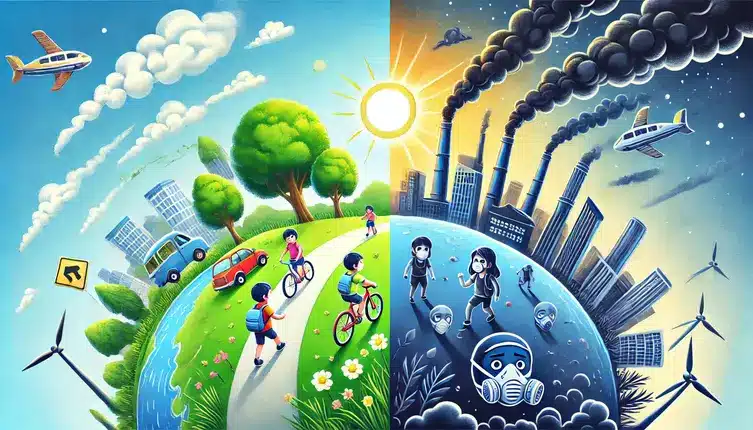
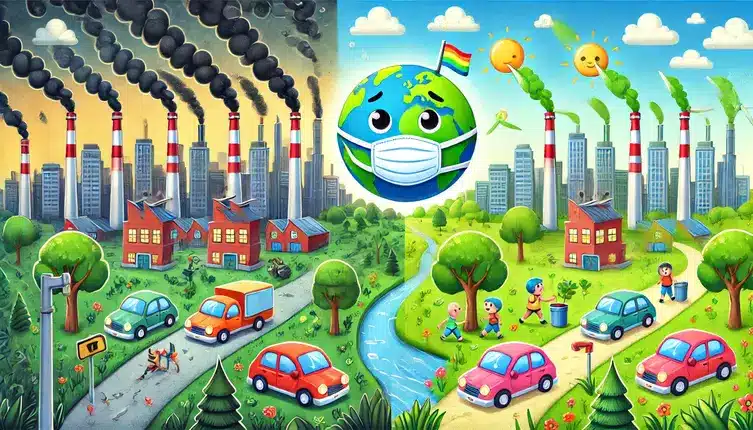
If you want a full step-by-step activity that helps students understand clean vs. polluted environments, see our complete Air Pollution Drawing Guide for Kids.
ACTIVITY 1 — Water Conservation Relay
Estimated Duration: Typically conducted within a single classroom session
Purpose (Contextual)
This activity is commonly used in environmental education programs to illustrate how small, repeated losses of water can accumulate into significant waste. It provides a visual and comparative way to discuss everyday water conservation challenges in schools and households.
Observed Structure
In classroom and workshop settings, this activity typically involves three designated stations representing water use and conservation outcomes. One station contains a source container filled with water, another represents a limited transfer tool, and a third symbolizes conserved or “saved” water.
Participants transfer water between stations using restricted quantities, highlighting how spillage or inefficiency reduces the final amount retained. In school workshops and classroom programs reviewed between 2023 and 2024, this comparison consistently helped students recognize how small daily water losses can accumulate into significant waste.
Simple measurement tools are often used to compare outcomes across groups, reinforcing the concept that careful use leads to better conservation results.
Reflection & Discussion Context
After the demonstration, facilitators commonly guide a reflective discussion around where water loss occurred and how similar losses happen in real-life settings. Typical discussion themes include household water use, school infrastructure leaks, and small behavioral changes that reduce waste.
Rather than focusing on performance, the emphasis remains on observation and interpretation of outcomes.
Real Classroom Insight
During a 2024 sustainability workshop in Ahmedabad, classroom facilitators noted that following similar water-transfer demonstrations, participants became more attentive to leaking taps and inefficient water use within school premises. Teachers noted increased student-led discussions around conservation during assemblies and environmental clubs.
(Green Schools Initiative Report, 2024)
Observed Learning Outcomes
- Based on classroom observations and educator feedback, this activity is associated with:
- Greater attention to water-saving behaviors in shared spaces
- Improved awareness of how minor water losses accumulate
- Clearer understanding of why water conservation matters in daily life
- Increased engagement in discussions about responsible resource use

ACTIVITY 2 — Waste Segregation Awareness Exercise
Estimated Duration: Commonly conducted within a single learning session or workshop block
Purpose (Contextual)
This activity is frequently used in environmental education programs to illustrate how improper waste segregation increases landfill burden and recycling inefficiency. It helps participants visually understand the differences between biodegradable, recyclable, and non-recyclable waste in everyday settings.
Observed Structure
In classroom and community learning environments, this activity typically involves examining a mixed set of common household or school waste items. These items are grouped into broad categories representing organic waste, recyclables, and residual waste.
Based on school-level waste audits and classroom learning sessions reviewed across Indian schools, this sorting exercise helped students clearly identify how recyclable materials are often misplaced into general waste streams. Labeled containers, sample packaging, and everyday disposal items are commonly used to reflect real-life waste management conditions.
Rather than focusing on speed or correctness, the activity emphasizes observation of patterns—such as which materials are most frequently misclassified and why confusion occurs.
Reflection & Discussion Context
Following the exercise, facilitators often guide a discussion around how waste segregation practices vary between homes, schools, and public spaces. Conversations typically explore why segregation fails in practice, how contamination affects recycling systems, and how small improvements can reduce overall waste volume.
The discussion remains analytical, focusing on awareness rather than behavioral enforcement.
Real Classroom Insight
During school-based waste audits conducted in Bengaluru in 2023, educators observed that learners who participated in similar segregation exercises demonstrated improved recognition of recyclable materials during subsequent clean-up drives. Teachers reported fewer instances of mixed waste disposal in classrooms over the following weeks.
(Urban Waste Education Program Summary, 2023)
Observed Learning Outcomes
- Based on educator observations and program reports, this activity is associated with:
- Improved recognition of common waste categories
- Better understanding of why segregation affects recycling efficiency
- Increased awareness of contamination in waste streams
- More informed discussions about local waste management challenges
ACTIVITY 3 — Local Air Quality Observation Exercise
Estimated Duration: Typically integrated into a classroom session or short field-based observation period
Purpose (Contextual)
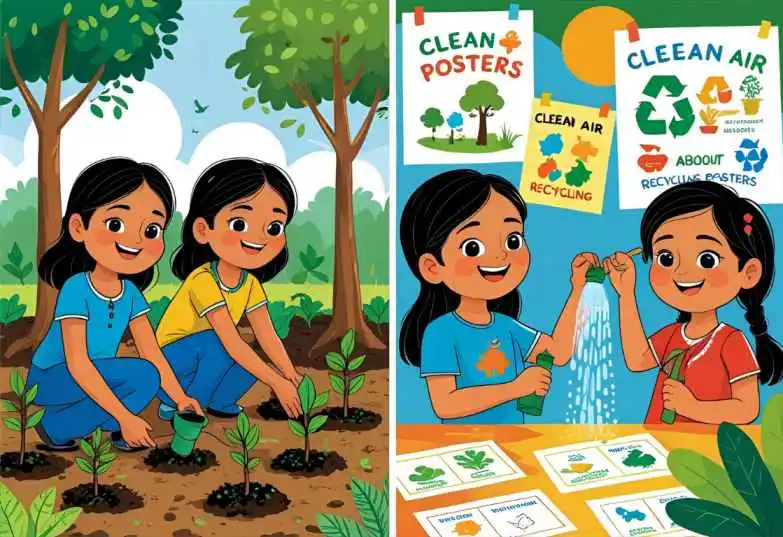
This activity is commonly referenced in environmental education programs to illustrate how air quality conditions vary across locations and time periods. It helps participants recognize visible and contextual indicators of air pollution in everyday environments.
Observed Structure
In educational and community settings, this activity usually involves observing environmental conditions in different locations, such as near roads, green spaces, or building entrances. Rather than relying on instruments, participants focus on visible indicators including dust accumulation, traffic density, vegetation health, and general atmospheric clarity.
During location-based observation exercises conducted near roads, school entrances, and green spaces, students quickly noticed how air quality conditions varied depending on traffic density and surrounding vegetation within the same neighborhood. Simple recording methods—such as note-taking, photographs, or comparison charts—are commonly used to support discussion.
The emphasis remains on observation and comparison, not measurement or data collection accuracy.
Reflection & Discussion Context
Facilitated discussions following the observation typically explore why certain areas experience higher pollution exposure than others. Common themes include vehicle density, construction activity, tree cover, and weather conditions.
Rather than drawing conclusions or prescribing actions, discussions focus on interpreting patterns and recognizing environmental variability.
Real Classroom Insight
In a 2024 urban environmental awareness program in Delhi, facilitators observed that participants who engaged in location-based air quality observation were more attentive to pollution sources around school entrances and residential streets. Teachers reported increased classroom discussions about local traffic patterns and green buffers.
(Urban Air Awareness Program Report, 2024)
Observed Learning Outcomes
- Based on educator feedback and program documentation, this activity is associated with:
- More informed discussions about urban air quality challenges
- Improved awareness of visible air pollution indicators
- Better understanding of how pollution varies by location
- Increased ability to compare environmental conditions
ACTIVITY 4 — Waste Categorization Concepts (Discussion-Based)
Estimated Duration: Commonly conducted as part of a classroom discussion or short demonstration session
Purpose (Contextual)
This activity is frequently used in environmental education settings to help learners understand how household and community waste is categorized. It emphasizes recognition and discussion rather than hands-on execution.
Observed Structure
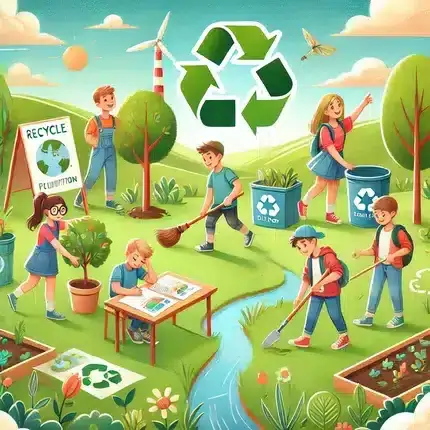
In classroom and workshop environments, educators typically introduce waste segregation by presenting common household waste items (such as food scraps, paper, plastic packaging, and batteries) through images, charts, or sample displays.
Participants are usually asked to observe and discuss how waste is grouped into categories like biodegradable, recyclable, and hazardous. Visual aids, color-coded bin illustrations, and comparison tables are commonly referenced to support understanding.
Rather than focusing on operational steps, facilitators guide learners through examples and scenarios that demonstrate why improper mixing of waste creates environmental and management challenges.
Reflection & Discussion Context
Post-activity discussions often explore questions such as why certain waste streams require special handling and how segregation affects recycling efficiency and landfill pressure. Conversations are analytical in nature and avoid prescriptive behavioral instructions.
Educators report that learners tend to connect these discussions to waste patterns they observe at home, in schools, or in public places.
Real Classroom Insight
During a 2023 municipal outreach program in Pune, teachers observed that students exposed to waste segregation discussions were better able to identify recyclable versus non-recyclable materials in subsequent classroom assessments. The activity supported conceptual clarity rather than operational training.
(Pune Municipal Environmental Outreach Summary, 2023)
Observed Learning Outcomes
- Based on facilitator feedback and program documentation, this activity is associated with:
- Stronger conceptual grasp of waste management systems
- Improved understanding of waste categories
- Greater awareness of recycling challenges
- Ability to distinguish between biodegradable and non-biodegradable waste
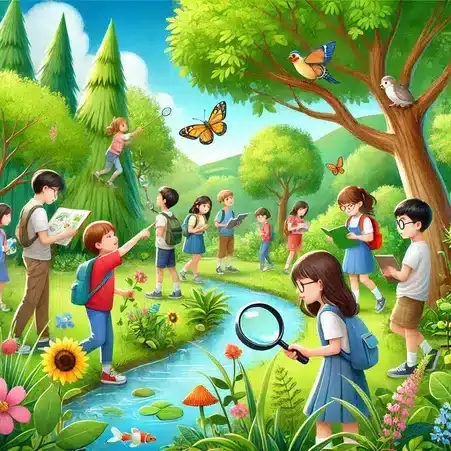
ACTIVITY 5 — Local Biodiversity Observation Exercise
Estimated Duration: Typically incorporated into a class period or short guided observation session
Purpose (Contextual)
This activity is commonly referenced in environmental education programs to introduce learners to the concept of local biodiversity. It focuses on recognizing different plant and animal species within familiar surroundings rather than conducting formal field studies.
Observed Structure
In classroom and community-based settings, educators usually frame this activity around observation of nearby environments such as school grounds, parks, roadside greenery, or residential areas. Participants are encouraged to note visible differences in plant types, insects, birds, or other small wildlife.
Rather than systematic surveying, the emphasis is on noticing patterns—such as areas with more vegetation supporting greater species variety. Simple visual references, checklists, or discussion prompts are often used to help structure observations without requiring data collection.
This approach allows learners to build awareness of biodiversity using everyday surroundings.
Reflection & Discussion Context
Facilitated discussions following the observation typically explore why some areas support more biodiversity than others. Topics often include tree cover, availability of water, human disturbance, and seasonal changes.
The discussion remains descriptive and exploratory, helping learners connect biodiversity concepts to real environments they encounter daily.
Real Classroom Insight
In a 2024 school-based environmental program in West Bengal, classroom feedback indicated that students who participated in local biodiversity observation activities demonstrated improved ability to identify common birds and plants during classroom discussions. The activity supported awareness without requiring specialized field equipment.
(Regional School Biodiversity Program Summary, 2024)
Observed Learning Outcomes
- Based on educator feedback and program summaries, this activity is associated with:
- Stronger engagement in biodiversity-related discussions
- Increased awareness of local plant and animal diversity
- Improved observation and comparison skills
- Better understanding of habitat differences
ACTIVITY 6 — Noise Environment Awareness Exercise
Estimated Duration: Typically discussed within a classroom session or short guided observation period
Purpose (Contextual)
This activity is commonly referenced in environmental education programs to help learners recognize everyday sources of noise pollution and understand how sound levels vary across locations and times of day. The focus is on awareness and interpretation, not measurement or mitigation.
Observed Structure
In classroom and community learning settings, educators usually guide learners to observe sound conditions in familiar environments such as classrooms, corridors, streets, parks, or residential areas. Participants are encouraged to identify common noise sources—traffic, construction, announcements, or crowd activity—based on perception rather than instruments.
Observation is often supported by comparison exercises, such as discussing which locations feel quieter or louder and why. Visual prompts, sound-mapping illustrations, or discussion charts are sometimes used to help structure observations without collecting numerical data.
The emphasis remains on recognizing patterns and environmental context rather than controlling or reducing noise.
Reflection & Discussion Context
Post-observation discussions typically explore how noise levels fluctuate during different times of day and how urban design, traffic flow, and land use influence sound environments. Conversations are analytical and descriptive, avoiding advice on personal behavior or health impacts.
Classroom feedback indicates that these discussions to daily experiences near roads, schools, or marketplaces.
Real Classroom Insight
During a 2023 urban environmental literacy program in Bengaluru, facilitators observed that students participating in noise awareness discussions became more attentive to sound differences between indoor and outdoor spaces. Teachers reported improved vocabulary and contextual understanding related to urban noise environments.
(Urban Sound Awareness Program Summary, 2023)
Observed Learning Outcomes
Based on educator feedback and program documentation, this activity is associated with:
- Increased awareness of common noise sources
- Improved ability to compare sound environments
- Better understanding of urban noise patterns
- More informed classroom discussions about environmental noise
ACTIVITY 7 — Community Environmental Mapping Discussion
Estimated Duration: Typically integrated into a classroom discussion or group-based review session
Purpose (Contextual)
This activity is commonly referenced in environmental education programs to help learners understand how environmental issues are distributed across neighborhoods and communities. It focuses on spatial awareness and interpretation rather than planning or intervention.
Observed Structure
In educational settings, facilitators usually introduce this activity through maps, diagrams, or visual representations of a local area. Participants observe and discuss how different environmental features—such as roads, green spaces, water bodies, industrial zones, or residential clusters—are arranged.
Rather than creating new maps or conducting surveys, learners analyze existing representations to identify patterns. Discussions often highlight how certain environmental challenges appear concentrated in specific areas due to land use, infrastructure, or population density.
The structure emphasizes interpretation and comparison, not problem-solving or community action.
Reflection & Discussion Context
Group discussions typically explore why environmental conditions differ between locations and how geography, planning decisions, and development patterns influence outcomes. Facilitators guide conversations toward understanding relationships between space and environmental impact, without proposing solutions or recommendations.
Workshop observations suggest that learners contextualize environmental issues within familiar surroundings.
Real Classroom Insight
In a 2024 civic-environment workshop conducted in Kolkata, teachers observed that students engaged in map-based environmental discussions demonstrated improved ability to explain why pollution levels and green coverage vary across neighborhoods. The activity supported spatial reasoning without requiring fieldwork.
(Civic Environmental Literacy Workshop Summary, 2024)
Observed Learning Outcomes
- Based on facilitator feedback and program documentation, this activity is associated with:
- Stronger analytical discussion skills
- Improved spatial awareness of environmental issues
- Better understanding of how land use influences environmental conditions
- Enhanced ability to interpret maps and visual data
How Teachers & Parents Can Support Kids’ Environmental Learning
The following observations summarize commonly reported support approaches and are not prescriptive recommendations.
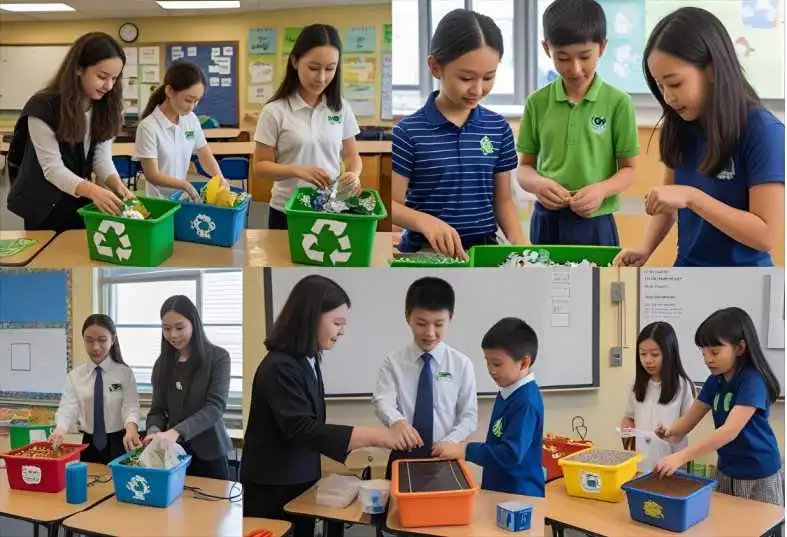
In educational and home-learning contexts, adults commonly support environmental learning by providing age-appropriate materials, encouraging observation of natural surroundings, and modeling environmentally responsible behaviors. These approaches are descriptive examples rather than prescriptive recommendations.
Learn how students worldwide are taking action with UNICEF’s Climate Action for Kids.
Mini Glossary of Key Environmental Terms
These simplified definitions help students understand core environmental concepts used throughout this guide.
1. Renewable Energy
Energy that comes from natural sources that can replenish themselves, such as sunlight, wind, or flowing water.
Example for classrooms:
Students can build a small solar oven or mini wind turbine to see how renewable energy works in real life.
2. Recycling
The process of converting used materials into new products instead of throwing them away.
Example:
Using recycled paper for art projects or sorting plastic, paper, and glass into labeled bins during the recycling challenge.
3. Sustainability
Meeting the needs of today without harming the environment for future generations.
Example:
Students create posters showing how to save water, reduce electricity use, and limit plastic waste at home and school.
4. Biodiversity
The variety of plants, animals, insects, and microorganisms living in an ecosystem.
Example:
During the Nature Walk activity, students document at least 10 species to understand how diverse life exists even in small green spaces.
5. Carbon Footprint
The total amount of greenhouse gases (mainly CO₂) released due to human actions.
Example:
Tracking energy use or reducing plastic consumption helps students lower their classroom’s carbon footprint.
Earth Day 2025 Classroom Ideas & Resources
Earth Day provides an ideal opportunity for students to turn environmental learning into visible, measurable action. Schools that integrate hands-on activities—rather than one-day celebrations—see significantly higher engagement and retention of climate concepts. In 2024–2025 workshops across Delhi, Pune, and Bengaluru, teachers reported that students were most motivated when Earth Day tasks had clear goals, simple tools, and real results they could see immediately.
Below are classroom-tested, teacher-approved Earth Day activities you can run within a single school day or spread across an entire week.
1. “Plastic-Free Day” Classroom Challenge
Purpose
Highlights how everyday choices influence plastic waste generation.
Common classroom format
In classroom and community-learning settings, this activity is typically observed as a short, time-bound awareness exercise coordinated by educators. Participants reflect on their daily consumption patterns and note instances where single-use plastic is avoided. Visual summaries or group discussions are often used to compare observations and encourage shared learning.
Educators report that focusing on observation and comparison—rather than enforcement—helps students connect individual behavior with broader plastic pollution issues.
Why it works
Students gain visible, real-world context for how small decisions contribute to measurable waste reduction, reinforcing personal responsibility without prescriptive instruction.

2. Earth Day Eco-Quiz Show
Purpose
Reinforces environmental knowledge through recall and discussion.
Common classroom format
This activity is commonly structured as a facilitated group interaction where environmental questions are discussed in a game-like format. Learners participate collectively, responding to prompts and exchanging viewpoints under educator moderation.
Feedback from classrooms suggests that presenting information through interactive questioning improves engagement and retention, especially when discussion follows each response.
Why it works
Gamified learning environments are associated with higher attention levels and improved memory recall, particularly for factual environmental concepts.
3. Art From Waste Exhibition
Purpose
Explores reuse, creativity, and material life cycles.
Common classroom format
In educational settings, this activity is typically observed as a creative showcase where students work with discarded, safe materials to express environmental themes. Finished pieces are often displayed within school spaces, allowing peer viewing and informal discussion.
Educators note that presenting outcomes visually encourages reflection on consumption habits and material reuse without focusing on production steps.
Why it works
Students directly engage with the concept of reuse, developing an intuitive understanding of waste reduction and resource value through creative expression.
4. Classroom Carbon Footprint Tracker
Purpose
Introduces basic concepts of resource use and emissions awareness.
Common classroom format
This activity is generally implemented as a shared visual reference that tracks observable classroom behaviors related to energy and resource use over a defined period. Students contribute observations, which are collectively reviewed during group discussions.
Teachers report that emphasizing trends and patterns—rather than targets—helps learners understand how daily habits influence environmental impact.
Why it works
Making abstract concepts like emissions visible and cumulative supports clearer understanding and long-term awareness.
5. Earth Day Reflection Circle

Purpose
Encourages reflection, listening, and community awareness.
Common classroom format
In classroom or outdoor learning environments, this activity is commonly observed as a moderated group discussion where participants share reflections on environmental themes. Conversations are guided by open prompts, with emphasis on respectful listening and inclusive participation.
Facilitators note that reflection-based dialogue helps students articulate personal connections to environmental issues without pressure to propose solutions.
Why it works
Structured reflection supports critical thinking and emotional engagement, helping learners internalize environmental values.
Supplementary Reference Materials (Optional)
Download the updated 2025 Earth Day Activity Pack, including:
- Printable worksheets (PDF)
- Reflection sheets
- Environmental Activities Worksheets (ZIP)
- Activity instructions for teachers
FAQs About Environmental Activities for Students
Q1: Why are environmental activities important for students?
Hands-on environmental activities help children understand ecosystems, pollution, and climate change through direct experience. These activities strengthen problem-solving skills, teamwork, curiosity, and long-term responsibility. Programs like UNICEF Climate Action for Kids show that experiential learning deepens environmental awareness more effectively than lectures alone.
Q2: What simple environmental activities can students try?
Beginner-friendly ideas include:
- Water Conservation Relay
- Tree planting
- Nature walks
- Recycling challenges
- Energy-saving tasks
- Eco-friendly competitions
- Waste-to-art projects
Teachers can easily adapt these for different grade levels and classroom sizes.
Q3: How do environmental activities support science learning?
Students learn scientific concepts by applying them:
- Renewable energy → building a solar oven
- Biodiversity → documenting species on a nature walk
- Pollution → tracking waste or electricity use
These activities help students observe cause–effect relationships and strengthen critical thinking. NASA Climate Kids provides age-appropriate resources for these topics.
Q4: How can teachers make environmental learning exciting and relevant?
Use interactive methods like games, competitions, green clubs, and outdoor tasks. Teachers in India found that classroom charts, journals, and measurable goals (kg of waste recycled, kWh saved, number of species recorded) improve student motivation.
Q5: How can parents support environmental learning at home?
Parents can reinforce habits by:
- Encouraging kids to switch off lights
- Using reusable items
- Recycling regularly
- Watching nature documentaries
- Tracking daily eco-habits on a simple chart
When parents model the same behaviors, children adopt them more quickly.
Q6: How do these activities align with SDG 13 (Climate Action)?
Activities like planting trees, reducing energy consumption, and managing waste directly support SDG 13 targets by reducing carbon footprints and building climate awareness from a young age. Tree-planting and energy challenges also map to national Green School programs.
Q7: Which government or NGO programs support environmental learning in schools?
India’s MOEFCC Green Schools Challenge, UNICEF Climate Action for Kids, EPA environmental education programs, and Swachh Vidyalaya Abhiyan provide toolkits, training, and school-level support for sustainability projects.
Q8: Where can teachers find more classroom resources?
Trusted resources include:
- UNICEF Climate Action for Kids
- EPA Environmental Education Resources
- NASA Climate Kids
- UNESCO Education for Sustainable Development
Conclusion: Environmental Activities for Students
Environmental education becomes meaningful when students can see their impact—reducing plastic waste, tracking energy use, growing plants, or discovering new species during nature walks. These simple classroom activities cultivate awareness, responsibility, and curiosity from an early age.
When teachers combine hands-on learning with clear goals and parents reinforce those habits at home, students develop lifelong eco-friendly behaviors. Whether it’s a Water Conservation Relay, a weekly Recycling Challenge, or a Renewable Energy science demo, each activity helps build a generation of environmentally conscious learners.
Start small, stay consistent, and let students experience what it means to care for the planet—one activity at a time.
💬 Share Your Ideas!
Which eco-friendly activity will your class try next?
Readers are welcome to share observations or experiences related to environmental learning activities in our next article!
📚 Keep the Learning Going:
If your students loved the Air Pollution Drawing activity, don’t stop there!
Explore more creative guides on
👉 Light Pollution Drawings and
👉 Wildlife-Themed Pollution Posters
to deepen environmental art learning and inspire planet-friendly creativity.
🌎 Bonus Tip:
For even more interactive ideas and science-backed projects, visit NASA’s Climate Kids — a fun learning hub for young environmental explorers.
Trusted Sources Used
This guide was developed using classroom observations from schools in India (2023–2024) and aligned with environmental education principles recommended by UNESCO, UNICEF, and national Green School programs.
UNICEF Climate Action for Kids (2024)
EPA Environmental Education Resources (2024)
NASA Climate Kids (2024)
About the Author
I’m Soumen Chakraborty, the founder and lead researcher at GreenGlobe25. I specialize in translating complex data on pollution, climate risks, and sustainability into clear, actionable guides for Indian households and communities.
My work is based on a rigorous analysis of authoritative sources like the CPCB and WHO, following our publicly-available Fact-Checking Policy to ensure every piece of content is accurate and trustworthy.
LinkedIn: chakrabortty-soumen
Facebook: Ecoplanet
Last update on November 2025.

- Groundwater Pollution in India (2025): Nitrate, Fluoride & Arsenic Contamination Explained - December 1, 2025
- How Air Purifiers Work: Real Science, Real Effectiveness & India-Focused 2025 Guide - November 20, 2025
- Indoor Air Pollution in India (2025 Guide): Hidden Sources & Health Risks - November 16, 2025