Milky Way above city skyline showing light pollution contrast, Dark Sky Movement concept.

Dark Sky Movement: The 2025 Guide to Ending Light Pollution

A Global Effort to Save Our Night Skies

For most people living in cities, stepping outside at night means seeing only a handful of stars. According to the World Atlas of Artificial Night Sky Brightness (2023), more than 80% of the global population can no longer view the Milky Way under natural darkness.

This growing glow is a clear sign of light pollution — an overlooked environmental issue affecting wildlife, energy use, human health, and our cultural connection with the night sky.

The Dark Sky Movement brings together scientists, educators, policymakers, artists, and communities to protect night environments. The goal is simple: use light responsibly so nature and progress can coexist.

This guide explains how the movement began, the major types of light pollution, global success stories, and practical steps anyone can take to restore natural darkness.

Real-World Success Stories Backed by Data

Tucson, USA

Retrofitted 18,000+ streetlights with shielded 3,000 K LEDs, cutting energy use by about 60% and reducing sky brightness by 7% (Barentine et al., 2018).

Flagstaff, USA

The world’s first International Dark Sky City, where over 90% of lighting complies with dark-sky standards. Tourism increased following lighting reforms (IDA, 2020).

Jaisalmer, India

A 2024 pilot adopted night-sky-friendly lighting expected to save ~30% power, supporting eco-tourism and reducing skyglow.
The Ministry of Power estimates India could eliminate 2.5 million tonnes of CO₂ annually through nationwide lighting upgrades (MoP, 2024).

What Is the Dark Sky Movement?

The movement promotes responsible outdoor lighting that reduces glare, skyglow, energy waste, and ecological disruption. Originating in the 1980s, it gained momentum when astronomers recognized that growing urban brightness threatened scientific research.

In 1988, the International Dark-Sky Association (IDA) was founded — now the global leader in night-sky protection.

Why Light Pollution Matters

  1. Ecosystems: Artificial light disrupts migration, feeding, and breeding in birds, insects, sea turtles, and nocturnal animals.
  2. Energy Waste: Nearly 30% of outdoor lighting shines where it is not needed, wasting billions of dollars yearly.
  3. Human Health: Excessive night lighting influences sleep cycles and circadian rhythms.
  4. Cultural Impact: Losing the night sky removes an essential part of human heritage.

Dark Sky Movement in India

India is emerging as a dark-sky leader with major initiatives:

  • Hanle, Ladakh (2022): India’s first Dark Sky Reserve (1,073 sq km).
  • Spiti Valley, Himachal Pradesh: Under evaluation for certification.
  • Rann of Kutch, Gujarat: Strong candidate due to low population and vast open skies.
  • DST & ASI: Developing national outdoor-lighting guidelines.

These steps show how India is combining astronomy, sustainability, and tourism.

Types of Light Pollution (with Examples & Drawing Ideas)

1. Skyglow — The Lost Stars

Skyglow is the most recognizable form of light pollution, often seen as a bright dome hovering above cities and towns. This glow occurs when excessive or misdirected outdoor lighting scatters into the atmosphere and reflects off dust, moisture, and airborne particles. As a result, thousands of stars become invisible to the naked eye—even in areas far from major urban centers. Skyglow affects astronomy, wildlife navigation, and our cultural ability to connect with the natural night sky.
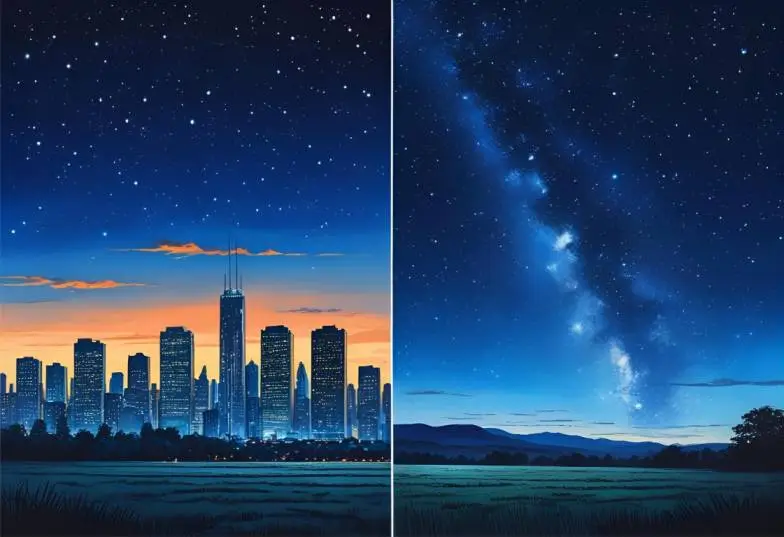
Use this concept in drawings by showing a polluted orange sky on one side and a dark, star-rich sky on the other to illustrate how cities lose their stars due to over-lighting.

Illustration showing a city covered in orange skyglow on one side and a clear, star-filled dark sky on the other side.
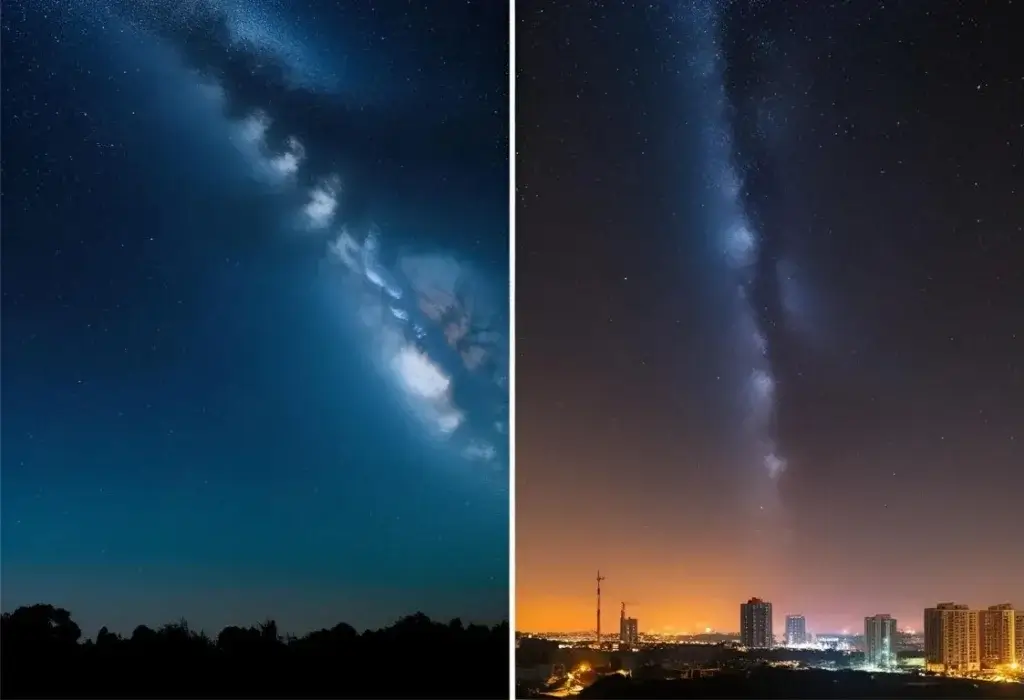
A comparison of skyglow in a brightly lit city versus a natural dark-sky landscape where the Milky Way is visible.

2. Glare — Light That Hurts

Glare occurs when outdoor lights are overly bright or poorly positioned, shining directly into people’s eyes instead of lighting the ground. This creates intense visual discomfort, reduces night visibility, and can even be dangerous for drivers, cyclists, and pedestrians. Unshielded LED streetlights and security floodlights are common sources of nighttime glare, especially in residential neighborhoods.
A drawing idea for students: compare an unshielded light that produces harsh white glare with a shielded, warm-toned lamp designed to illuminate safely without blinding passersby.

Side-by-side drawing of a bright unshielded streetlight causing glare and a shielded warm light providing comfortable nighttime visibility.
An example of harsh glare from an unshielded streetlight compared with softer, shielded lighting that improves visibility.

3. Light Trespass — Crossing Boundaries

Light trespass happens when unwanted artificial light spills into spaces that are meant to remain dark—such as a streetlamp shining into a bedroom window or a neighbor’s garden light illuminating another person’s yard. This intrusion disrupts sleep patterns, affects health, and reduces nighttime comfort for residents. Many cities now recognize light trespass as a legitimate environmental and public health concern, recommending shielded fixtures and motion sensors to reduce overflow lighting.
A simple drawing idea: show a bright streetlight entering a window in the first frame, and a properly shielded lamp keeping the room dark in the second frame.

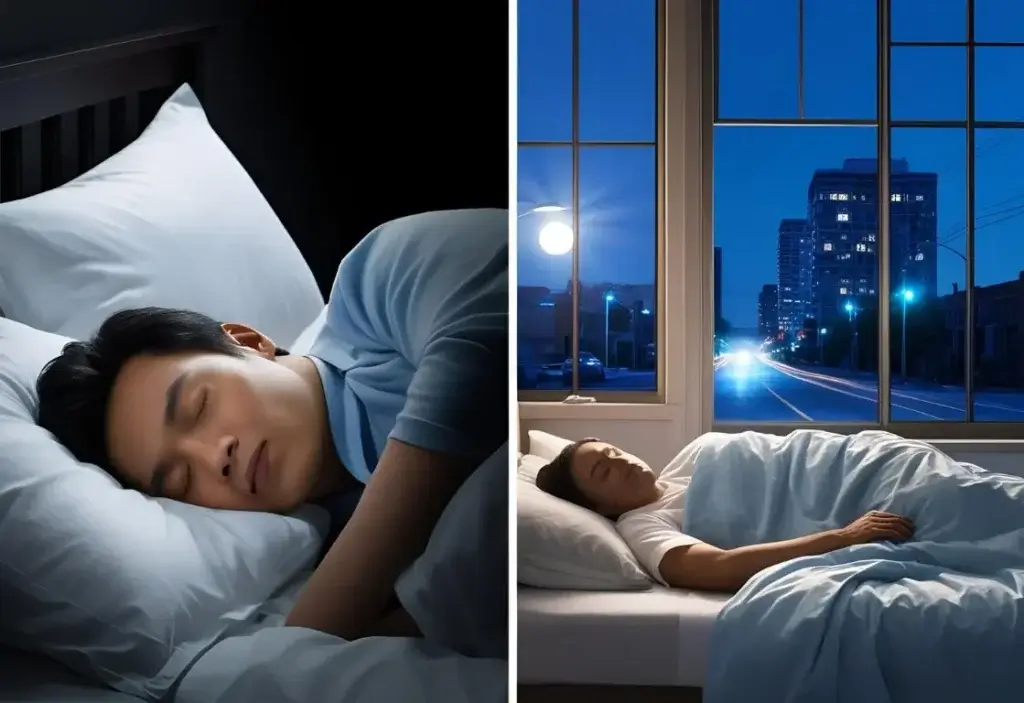
Illustration of a bedroom affected by intrusive streetlight and a second scene showing how shielded lighting prevents light trespass.
Light trespass illustrated through a streetlamp shining into a bedroom window compared with a properly shielded fixture that keeps homes dark.

4. Clutter — Too Many Lights

Light clutter refers to the visual chaos created by groups of overly bright or competing light sources—such as neon signs, billboards, decorative LEDs, and high-intensity floodlights. Cluttered lighting makes it hard for the eye to adjust at night, increases skyglow, and can create confusion for both drivers and wildlife. This type of pollution is especially common in commercial zones, busy traffic intersections, and city centers famous for their illuminated skylines.
For drawings, compare a crowded street full of overlapping lights with a redesigned version that uses balanced, well-planned lighting to create a calmer, more energy-efficient nighttime environment.

Drawing showing urban light clutter with overlapping neon signs and floodlights contrasted with organized, efficient nighttime lighting.
Visual comparison of a street filled with billboards, neon signs, and floodlights versus a calmer scene with well-planned, balanced lighting.

Key message: Lighting itself isn’t harmful — misused lighting is.

Light Pollution Art for Schools & Communities

Art transforms awareness into action. Organizations like IDA, UNESCO, and Earth Hour Schools encourage creative learning programs because visual storytelling helps learners understand environmental impact quickly.

Examples of Classroom or Community Projects

1. Before & After City Drawing
2. Wildlife-at-Night Illustrations (based on NOAA research showing sea turtle disorientation)
3. ‘One Earth, One Sky’ Mural
4. Smart Lighting Design Sheets
5. Digital Illustration Challenges

These activities help communities visualize the consequences of poor lighting and the benefits of smart lighting.
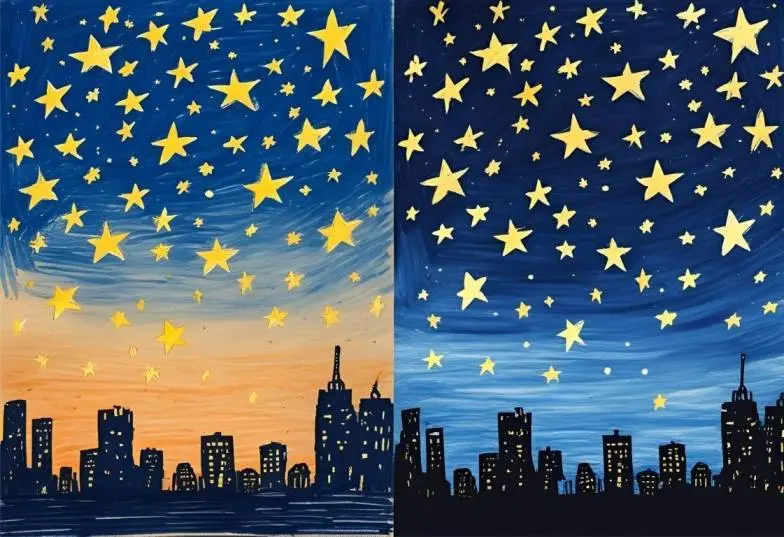
Hand-drawn student poster illustrating skyglow, glare, and the effects of artificial lighting on the night sky.
A student-created light pollution awareness poster showing how skyglow and artificial lighting affect the visibility of stars.

Global Dark Sky Success Stories

1. Utah, USA — The World’s First Dark Sky State

Utah has become a global model for night-sky conservation. With more than 20 certified Dark Sky Parks and Communities, the state has built an entire conservation framework that combines policy, engineering, tourism, and citizen participation.

Between 2015 and 2022, Utah’s municipalities progressively replaced older sodium lamps with full-cutoff LED fixtures, cutting 60–65% of public lighting energy use. Several rural towns implemented lighting curfews after midnight, reducing skyglow so effectively that faint constellations and the Milky Way are now visible from the edge of many communities.

Utah’s commitment has transformed stargazing into a significant economic asset — local parks report rising demand for guided night walks, astrophotography workshops, and seasonal “star parties,” which now draw visitors from around the world.

Night-sky photograph from a certified Dark Sky Park showing the Milky Way over a protected landscape, illustrating how responsible lighting policies preserve natural darkness.
Certified Dark Sky Parks worldwide demonstrate how policy and community action restore natural night skies.

2. Cévennes National Park, France — Europe’s Largest Dark Sky Reserve

Cévennes achieved one of Europe’s most ambitious lighting transformations. Working with more than 150 neighboring municipalities, the park coordinated thousands of lamp retrofits, switching to fully shielded fixtures and warm LEDs below 3000K.

Satellite observations from European environmental agencies show a noticeable decline in skyglow intensity, making Cévennes one of the few places in Europe where the night sky approaches natural brightness.

Educational programs like “Nuit des Étoiles” (Night of the Stars) invite students and visitors to learn astronomy under pristine skies. The region now markets astro-tourism as a cultural experience, linking local heritage, conservation, and scientific awareness.

3. NamibRand Nature Reserve, Namibia — Africa’s First Gold-Tier Dark Sky Reserve

Located in one of the driest regions on Earth, NamibRand offers exceptionally clear desert skies. To preserve this natural advantage, the reserve adopted strict lighting guidelines: no fixed outdoor floodlights, mandatory shielding, and a strong preference for motion-sensor lights.

Eco-lodges in the reserve redesigned their night-time lighting to protect nocturnal animals such as caracals, jackals, and desert insects. This approach also enhanced the visitor experience — guests now enjoy guided nocturnal ecology walks and astronomy sessions using high-powered telescopes.

NamibRand’s conservation-led tourism model is widely cited as a leading example of how dark-sky protection can coexist with luxury tourism and wildlife conservation.

4. Aoraki Mackenzie, New Zealand — A Southern Hemisphere Star Sanctuary

Aoraki Mackenzie was one of the earliest regions to be awarded official Dark Sky Reserve status, and its success stems from a partnership between scientists, Māori communities, local councils, and tourism operators.

The region implemented lighting curfews, strict shielding requirements, and low-color-temperature LED conversions, collectively reducing light pollution by up to 90% compared to pre-certification levels.

Māori communities emphasize the cultural significance of the night sky — particularly Matariki (Pleiades), which marks the Māori New Year. Guided cultural astronomy tours now form a significant part of regional tourism, blending tradition, science, and conservation.

5. Seoul, South Korea — Urban Innovation for the Night Sky

Seoul demonstrates that even densely populated megacities can make progress. The city introduced adaptive smart-light systems that automatically dim or brighten based on pedestrian traffic and time of night.

Within the first phase of the rollout, Seoul reported a 45% reduction in municipal lighting energy use, healthier sleep patterns among surveyed residents, and a measurable reduction in skyglow in outer districts.

The city is now testing “light zoning,” where residential, commercial, and natural areas have different lighting rules — a strategy that urban planners worldwide are watching closely.

6. Atacama Desert, Chile — A Protected Scientific Sky

The Atacama Desert hosts some of the world’s most advanced observatories, including ALMA and the Very Large Telescope Array. To preserve these scientific assets, Chile implemented some of the strictest lighting regulations on the planet, controlling everything from lamp wattage to shielding and emission direction.

Nearby towns cooperate by using low-intensity amber LEDs, enforcing signage curfews, and restricting industrial lighting near astronomical facilities. As a result, the Atacama remains one of the last major regions on Earth where the Milky Way is visible in broad, high-contrast clarity.

Astro-tourism has flourished — visitors arrive not only for observatory tours but for night-sky photography workshops, desert star-gazing camps, and indigenous sky mythology experiences.

How You Can Support the Dark Sky Movement

1. Use Responsible Outdoor Lighting

One of the most effective ways to reduce light pollution starts right at home. By choosing lighting that directs light only where it is needed, households can dramatically decrease glare, skyglow, and wasted energy. The International Dark-Sky Association (IDA) recommends following the Five Principles of Responsible Outdoor Lighting, which encourage using light only when necessary, only in the amount needed, and only in the correct direction.

Quick Guide to Smart Lighting Choices

Lighting TypeRecommended?Why It Matters
Shielded FixturesYesDirects light downward, improving visibility and reducing skyglow.
Warm LEDs (<3000K)YesProduces less blue light, which scatters widely and disrupts wildlife.
Unshielded FloodlightsNoCauses glare, light trespass, and unnecessary energy consumption.
Motion or Timer SensorsYesEnsures lighting is used only when required, preventing all-night brightness.

Making these changes at home is simple, cost-effective, and immediately beneficial to your surroundings.

2. Support Local Dark-Sky Programs

Across the world, schools, nature groups, and astronomy clubs host events that celebrate the night sky while educating communities about the impact of artificial light. Participating in these programs not only spreads awareness but also helps create a culture of responsible lighting in your area.

Examples include:

  • Earth Hour, where millions switch off lights to highlight energy conservation.
  • Globe at Night, a citizen-science project that helps scientists map global light pollution.
  • International Dark Sky Week, encouraging people to experience natural darkness.
  • Community stargazing nights, where families and students observe constellations and learn basic astronomy.

Joining even one of these events makes you part of a global effort to restore natural night environments.

3. Spread Awareness Creatively

Awareness grows faster when people connect emotionally with the issue. Creative activities such as drawings, posters, reels, digital illustrations, or short awareness videos can inspire others to rethink how they use light. Schools often display student artwork that contrasts star-filled skies with polluted ones — a powerful visual lesson.

Sharing your work online with hashtags like #SaveTheNight and #DarkSkyMovement helps amplify the message and encourages others to take small but meaningful actions.

4. Protect Nocturnal Wildlife

Many animals depend on darkness to hunt, migrate, navigate, or breed. Bright yard lights can confuse birds, delay insect activity, or even mislead sea turtle hatchlings away from the ocean. By switching to motion-sensor lighting, keeping garden lights low and warm, and minimizing illumination during sensitive breeding seasons, you help create safer habitats for wildlife around your home.

Even simple steps — such as avoiding upward-facing decorative lights — can significantly improve local ecological health.

5. Experience the Night Sky Firsthand

One of the strongest motivations for protecting darkness is experiencing it yourself. Visiting a dark-sky park or a rural area with minimal light pollution allows you to see the Milky Way, faint constellations, and planetary alignments that many city residents have never witnessed. These moments often inspire people to take action at home and encourage others to value natural darkness.

Stargazing trips, guided astronomy walks, and astrophotography sessions are great ways to reconnect with the night sky.

6. Advocate for Responsible City Policies

Individual action is important, but long-term change requires thoughtful urban planning. You can contribute by encouraging local authorities to adopt smart lighting strategies, review outdated fixtures, and enforce community-wide standards for shielding, brightness, and color temperature.

Cities can also introduce adaptive lighting, which adjusts brightness based on traffic or time of night, and require environmental impact assessments before installing large-scale lighting systems. When citizens voice their support for these measures, municipalities are more likely to invest in sustainable lighting solutions.

Conclusion

Restoring the night sky is a shared responsibility. By adopting responsible lighting, supporting community programs, and educating future generations, we help preserve an essential part of Earth’s natural heritage.

Every light turned off brings us one step closer to a world where future generations can still see — and dream under — the stars.

Disclaimer:
This article summarizes publicly available research and environmental guidelines. It is for educational purposes only and does not replace official government or scientific recommendations.

Frequently Asked Questions (FAQ)

1. What does the Dark Sky Movement actually aim to achieve?

The movement’s core mission is to help communities use outdoor lighting in a way that supports safety without damaging the natural night environment. Instead of asking people to switch off lights entirely, it promotes lighting designs that reduce glare, skyglow, and energy waste. The goal is simple: keep the night dark enough for ecosystems, human health, and astronomy — while still keeping public spaces functional.

2. Why should ordinary people care about light pollution?

Light pollution is not only about losing the stars. It influences sleep cycles, increases energy bills, disturbs wildlife, and alters local climate rhythms. Many homeowners discover that by improving outdoor lighting — shielding lamps, choosing warmer LEDs, adding motion sensors — they save electricity while creating a more comfortable night environment.

3. What are the different forms of light pollution?

Light pollution appears in four main forms:

  • Skyglow: The bright dome seen above cities.
  • Glare: Harsh light that makes it difficult to see properly.
  • Light Trespass: Light entering places where darkness is expected, such as bedrooms.
  • Clutter: Overcrowded or competing lighting in commercial zones.
    Although these categories overlap, understanding them helps communities design lighting that serves people rather than overwhelms the sky.

4. Are there proven ways for a city to reduce light pollution?

Yes. Cities worldwide are adopting practical measures such as dimming unnecessary streetlights at night, switching to shielded fixtures, using warm LEDs below 3000K, and enforcing curfews for commercial lighting. Municipalities that adopted these measures report lower electricity costs, improved night visibility, and higher participation in astronomy and nature-based tourism.

5. How does artificial light affect wildlife at night?

Many species — including bats, owls, insects, and sea turtles — rely on predictable darkness to migrate, find food, or breed. Bright lighting can confuse their navigation signals or delay essential nighttime behavior. For example, research near coastal regions shows that hatchling sea turtles often crawl toward hotel lights instead of the ocean. Reducing unshielded light around natural habitats can significantly improve survival chances.

6. What practical steps can families take at home?

Homeowners can make meaningful improvements by using shielded outdoor lights, selecting warm LEDs (ideally under 3000K), installing timers or sensors, and turning off ornamental lighting late at night. These small adjustments lower monthly electricity use and create a healthier sleep environment for everyone in the household.

7. Can protecting dark skies support local economies?

Absolutely. Many regions have built thriving “astro-tourism” industries around dark-sky reserves and stargazing events. Visitors often stay in local lodges, use local guides, and spend on nearby businesses. Communities in France, Chile, New Zealand, and India have demonstrated that preserving natural darkness can generate sustainable revenue without harming local ecosystems.

8. Which global organizations guide dark-sky protection efforts?

The International Dark-Sky Association (IDA) provides guidelines, certification programs, and technical recommendations for responsible outdoor lighting. UNESCO and several regional alliances also support night-sky preservation by identifying potential dark-sky sites and helping governments shape evidence-based lighting policies.

9. Is switching to LEDs always better for the night sky?

Not always. While LEDs are efficient, blue-rich LEDs cause more skyglow than warmer alternatives. The safest choice for homes and cities is warm white LEDs (below 3000K) paired with shielding. This combination protects visibility and wildlife while still offering energy savings.

10. How can someone get involved in dark-sky conservation?

Joining a citizen-science project like Globe at Night, attending local stargazing events, sharing night-sky photographs, or encouraging schools to participate in dark-sky art programs are excellent starting points. Even reporting poorly designed public lighting to local authorities can contribute to long-term improvement.

Download our Free Dark Sky Drawing Worksheet – GreenGlobe25

This worksheet is an original educational resource created by GreenGlobe25 for non-commercial learning purposes.

Author Bio

I’m Soumen Chakraborty, the founder and lead researcher at GreenGlobe25. I specialize in translating complex data on pollution, climate risks, and sustainability into clear, actionable guides for Indian households and communities.

My work is based on a rigorous analysis of authoritative sources like the CPCB and WHO, following our publicly-available Fact-Checking Policy to ensure every piece of content is accurate and trustworthy.
LinkedIn: chakrabortty-soumen
Facebook: Ecoplanet

Last update on December 2025.

REFERENCES

Some of the images in this article were generated using AI to help illustrate concepts. They are not photographs of real events or locations.
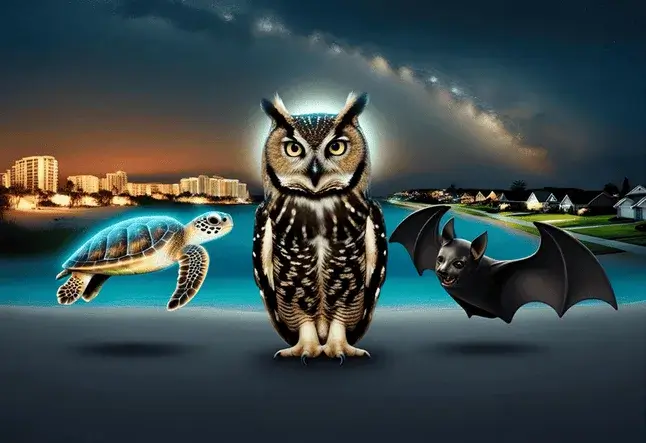
Light Pollution Drawing with Animals featuring an owl, sea turtle hatchling, and bat under artificial night lights with a fading starry sky.

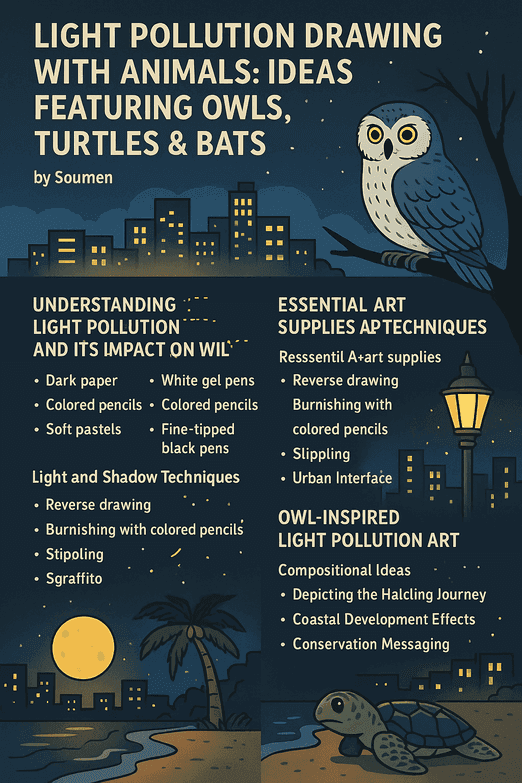
Light Pollution Drawing with Animals: Ideas Featuring Owls, Turtles & Bats

Introduction

Light Pollution Drawing with Animals is a creative way to show how excessive artificial light affects nocturnal wildlife like owls, sea turtles, and bats. Through art, we can reveal what’s often unseen — how glowing cityscapes confuse turtle hatchlings, disrupt owl hunting, and alter bat behavior.

In this 2025 guide, you’ll discover drawing ideas, techniques, and awareness art trends that connect ecology with creativity. Whether you’re a student preparing an environmental project or an artist exploring night-themed compositions, this article will help you turn science into storytelling — using art to protect the natural darkness our planet depends on.

For more background on global pollution types, visit our [Complete Guide to Pollution: Causes, Effects & Solutions].

Illustrated infographic titled Light Pollution Drawing with Animals: Ideas Featuring Owls, Turtles & Bats.

In 2025, the global conversation on light pollution has expanded beyond astronomy and into classrooms, art studios, and community events. The International Dark-Sky Association (IDA) and UNEP’s 2024–25 “Restore the Night” initiative have encouraged educators and young artists worldwide to use creative media to highlight the importance of natural darkness.

From school exhibitions to global art challenges, students are turning drawings into awareness tools—illustrating how city lights affect nocturnal animals and the stars we can no longer see. Many classrooms now include “Light Pollution Drawing Projects” as part of environmental education, linking science with art to inspire action.

Creating such artwork helps students visualize real-world issues like sky glow, light trespass, and wildlife disruption, all while learning how responsible lighting can restore balance between technology and nature.

⚡ Quick Facts (2025)

🎨 Over 40 schools in India joined UNEP’s Dark Sky Drawing Week 2025, promoting art-based awareness on wildlife and human health impacts.

🌌 Recent studies (2025) estimate about 83 % live under light-polluted skies, but earlier foundational work places that figure around 80 % (World Atlas, 2016).

🦉 Urban light levels have increased by ~9% per year since 2018 (ESA Night Lights Report, 2024).

In 2025, art competitions and school campaigns have increasingly focused on wildlife affected by light pollution — from owl migration studies to turtle-safe lighting projects along India’s coasts. Students and artists are blending science with art to visualize how artificial light changes animal behavior.
If you’re planning your next awareness poster or exhibition, explore our Light Pollution Drawing Ideas (2025) Guide for creative layouts and environmental slogans. Together, these projects are helping young creators understand how protecting darkness also protects biodiversity — a bright idea for a darker, healthier night sky.

Understanding Light Pollution and Its Impact on Wildlife

Before beginning your artistic journey, it’s essential to understand the phenomenon you’re depicting.

Light pollution encompasses several forms of excessive or inappropriate artificial lighting:

  • sky glow: the brightening of the night sky over populated areas
  • light trespass: light falling where unintended
  • glare: excessive brightness causing discomfort
  • light clutter: confusing groupings of light sources

Similarly, thermal pollution in India shows how industrial heat disrupts aquatic ecosystems — reminding us that pollution isn’t limited to air or light but affects water, temperature, and wildlife balance too.

Unlike other environmental contaminants, light pollution can be less obvious because humans have adapted to constant illumination. However, for nocturnal wildlife, artificial brightness represents a significant disruption to environments that evolved with natural darkness for millions of years.

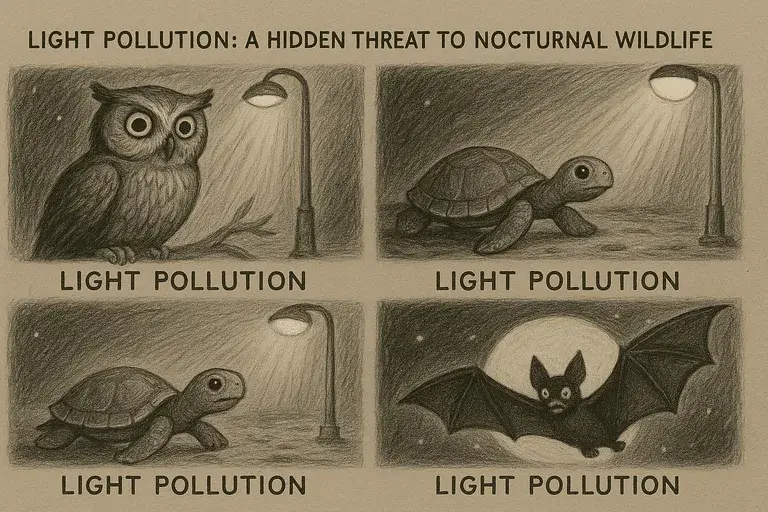
Charcoal-style light pollution drawing with animals, featuring an owl, turtle, and bat disturbed by artificial street lighting.
Charcoal-style light pollution drawing with animals

Each affected species faces unique challenges:

Owls have specialized visual and auditory adaptations for hunting in the dark. Excessive artificial light disrupts their hunting patterns, potentially exposing them to predators and interfering with their ability to locate prey. Their highly specialized night vision becomes less advantageous when landscapes are artificially brightened.

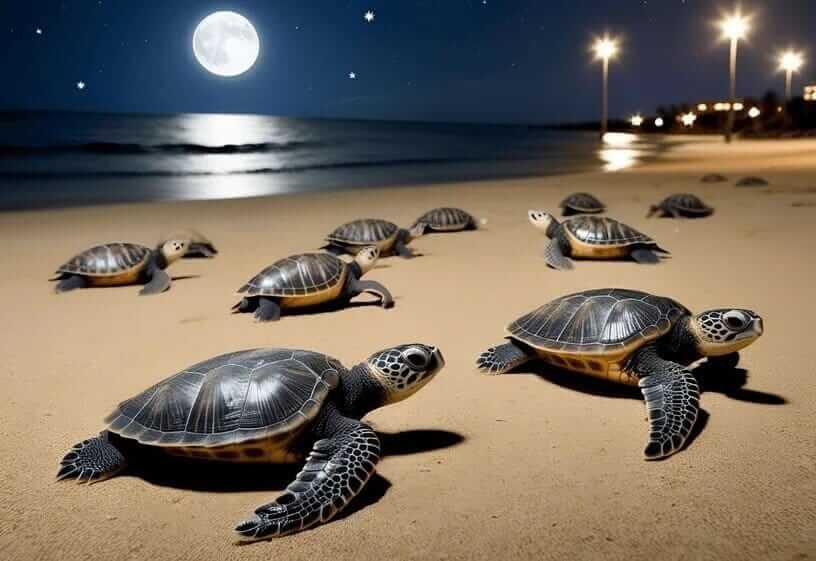
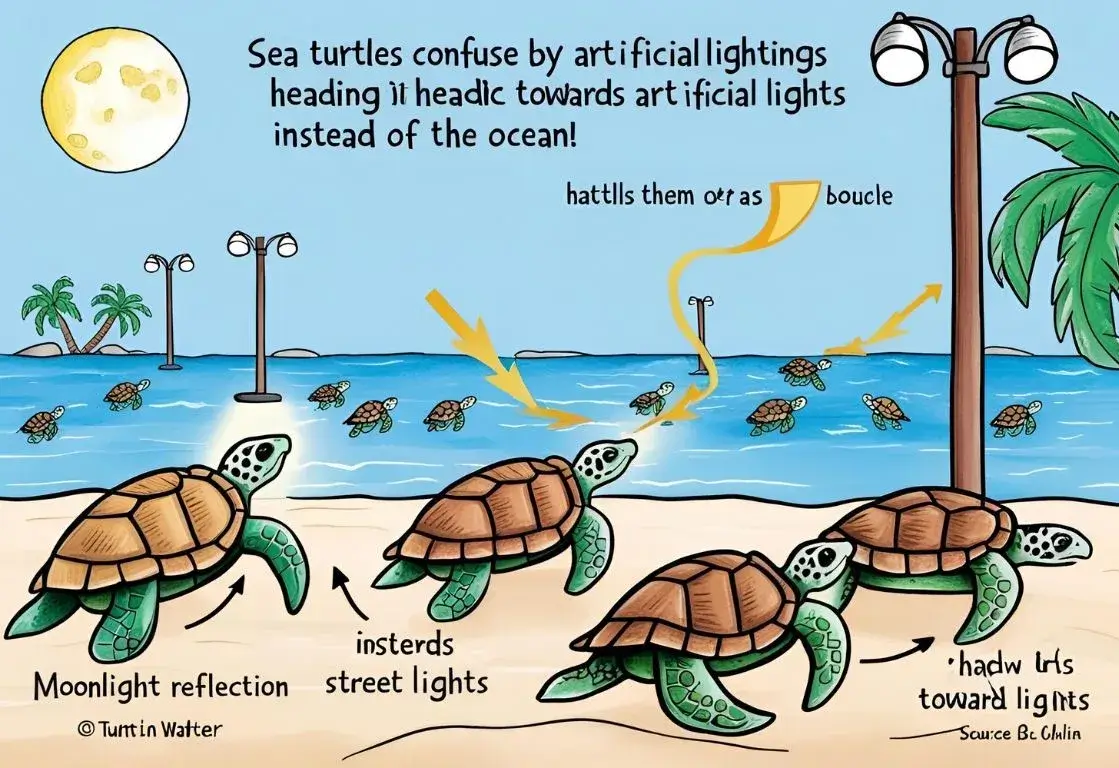
Sea turtles display perhaps the most dramatic impact—hatchlings instinctively orient toward the brightest horizon, which historically was moonlight reflecting on ocean waters. Coastal development creates artificial bright horizons that mislead hatchlings inland rather than toward the sea, resulting in disorientation and often death.

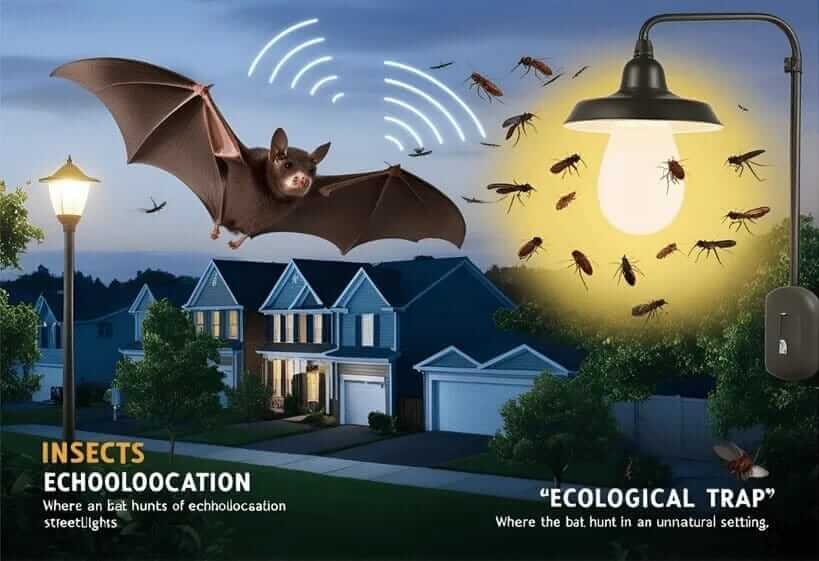
Bats face a complex relationship with artificial light, sometimes avoiding illuminated areas (reducing their foraging territory) and sometimes being exploited as easy targets for predators. Light also attracts insects, potentially disrupting local ecosystems and concentrating bat feeding in unnaturally bright areas, creating “ecological traps.”

By understanding these specific impacts, your artwork can tell more compelling visual narratives about these animals’ struggles in our brightening world.

For more poster and project ideas, see our light pollution drawing ideas for students .

Studies show that artificial light at night (ALAN) can interfere with natural behaviors in many species, including foraging, migration, and reproduction (Longcore & Rich, 2004).

For more educational resources, visit the Royal Astronomical Society’s guide to light pollution.

Essential Art Supplies and Techniques

Creating effective environmental art depicting light pollution requires materials and techniques that capture both nocturnal animals and the contrasting effects of artificial illumination:

  • Dark paper (black or deep blue) provides an excellent base for night scenes, making luminous elements stand out dramatically.
  • White gel pens, white charcoal, and opaque white paint for stars, moonlight, and highlights
  • Colored pencils with layering capabilities for building subtle gradients mimicking light sources
  • Soft pastels for atmospheric effects, representing sky glow
  • Metallic and fluorescent markers for depicting artificial light sources
  • Fine-tipped black pens for defining details like feathers and fur against lighter backgrounds

For digital artists, programs with strong layer effects and glow capabilities (Procreate, Photoshop, GIMP) offer powerful tools for depicting light scenarios.

Light and Shadow Techniques

  • Practice reverse drawing by starting with a dark background and gradually adding light.
  • Use burnishing with colored pencils to create smooth, luminous areas
  • Apply stippling (dots) for gradual transitions between light and shadow
  • Try sgraffito (scratching away layers) for star fields or filtered moonlight

For digital art, experiment with layer blending modes like “Screen” or “Color Dodge” to create realistic light effects, and use blur filters to mimic light diffusion in atmospheric conditions.

Creating Contrast

Distinguish between natural and artificial light by:

  • Using cooler tones (silver, pale blue, gentle white) for natural light
  • Employing warmer or harsher tones (amber, orange, harsh yellow-white) for artificial light
  • Considering directionality, natural light often comes from above, while artificial light typically originates from human-level sources.
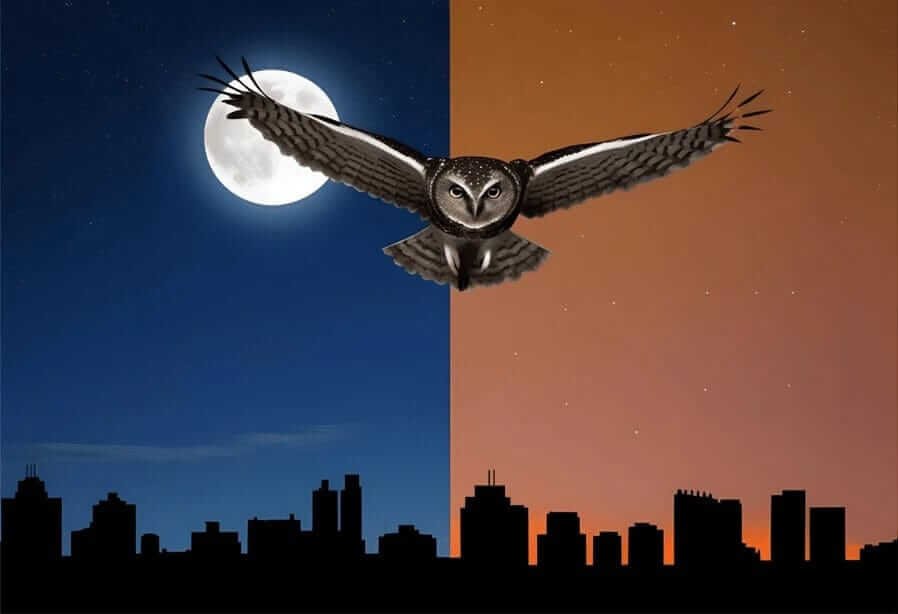
Light Pollution Drawing with Animals showing an owl flying across a city skyline illuminated by artificial lights, obscuring stars.
Owl flying over cityscape with bright sky glow

Owl-Inspired Nocturnal Art Concepts

Now that we’ve explored the ecological challenges light pollution poses, let’s explore how we can creatively portray these effects in art. Owls, with their unique nocturnal adaptations, provide an excellent canvas for exploring the intersection of wildlife and artificial light.

Just like thermal pollution in India disrupts aquatic life through heat discharge, light pollution disrupts nocturnal raptors by flooding their night habitats with glare and glow.

Capturing Adaptations for Night Vision

  • Create detailed close-ups of owl eyes, showing one eye adapted to natural darkness and another reflecting harsh artificial light.
  • Illustrate normal pupil dilation in darkness versus constriction under artificial light.
  • Depict specialized feather structure allowing silent flight—an adaptation less advantageous when prey can visually detect predators under artificial lighting.

Compositional Ideas

  • Silhouette Against Light Pollution: Draw an owl in a dark silhouette against a background of city lights and sky glow
  • Split Scene: Create a divided composition showing the same landscape with an owl hunting successfully under moonlight on one side and struggling amid artificial lighting on the other
  • Hunting Disruption: Design sequential images showing an owl focusing on prey, being blinded by sudden light, and losing its hunting opportunity
  • Urban Interface: Illustrate an owl perched on a street lamp, caught between instincts and urban adaptation

Symbolic Elements

Incorporate traditional symbols of wisdom juxtaposed with broken lights, clock elements referencing disrupted circadian rhythms, and partially obscured constellation patterns to symbolize the loss of our celestial heritage.

Light Pollution Drawing with Animals depicting sea turtle hatchlings crawling toward city lights instead of the ocean under a polluted night sky.
Hatchlings are crawling toward urban lights.

Sea Turtle Artwork Highlighting Light Pollution

The journey of sea turtle hatchlings provides a dramatic example of light pollution’s impact on wildlife behavior and survival.

Depicting the Hatchling Journey

  • Create sequential drawings showing traditional paths hatchlings would follow under natural conditions versus confused wandering under artificial light.
  • Illustrate beach scenes from a hatchling’s perspective, where hotel lights dominate instead of moonlight on water.
  • Design split compositions showing successful navigation by starlight on pristine beaches, contrasted with disorientation on developed coastlines

If you’re exploring cross-environmental art projects, see how air pollution drawing ideas visualize smog and emissions — another invisible force that alters animal behavior and habitat quality.

Read more from NOAA on how light pollution affects sea turtles.

Coastal Development Effects

  • Create panoramic views showing increasing development and light pollution over time, with corresponding changes in nesting success.
  • Illustrate differences between turtle-friendly lighting solutions (shielded, low, red-spectrum) and problematic fixtures (bright, white, unshielded). For real-world lighting guidelines, see Florida’s turtle-friendly lighting recommendations.
  • Design infographics showing how inland light pollution creates sky glow, affecting coastal environments
  • Depict volunteer efforts creating dark corridors during the hatching season.

Conservation Messaging

Incorporate hopeful elements showing how proper lighting modifications can restore natural behaviors, circular journey illustrations emphasizing the multi-generational importance of protecting nesting sites, and successful conservation interventions like artificial moon pools guiding hatchlings to safety.

Light Pollution Drawing with Animals showing a bat using echolocation while flying over a streetlight attracting insects in a suburban area.
A bat flying over a suburban streetlight

Bat Illustrations and Light Pollution Impacts

Bats’ complex relationship with artificial light makes them fascinating subjects for nuanced environmental artwork.

Research shows that artificial lighting significantly impacts bat behavior in several ways:

  • Fragments of bat habitats
  • Alter flight patterns
  • Reduces foraging efficiency
  • Increases predator exposure

(Source: Bat Conservation International)

Capturing Echolocation and Navigation

  • Visualize echolocation with sound waves disrupted by artificial light sources
  • Design split-frame illustrations showing a bat’s “mental map” under natural darkness versus artificial lighting
  • Illustrate changed insect distribution patterns between dark and lit areas
  • Depict flight paths avoiding artificially lit areas, showing habitat fragmentation

Urban Settings and Light Interactions

  • Create cityscapes showing bats clustered around certain street lights that attract insects, illustrating “ecological trap” phenomena.
  • Design contrast pieces showing beneficial bat-friendly lighting versus problematic fixtures
  • Illustrate urban roosts with light intrusion problems affecting daytime rest.
  • Create sequential art showing how city bats navigate increasingly illuminated landscapes.

Educational Elements

Incorporate visual representations of insect consumption volume, pollination services provided to specific plants, and economic value comparisons to counter common misconceptions about bats.

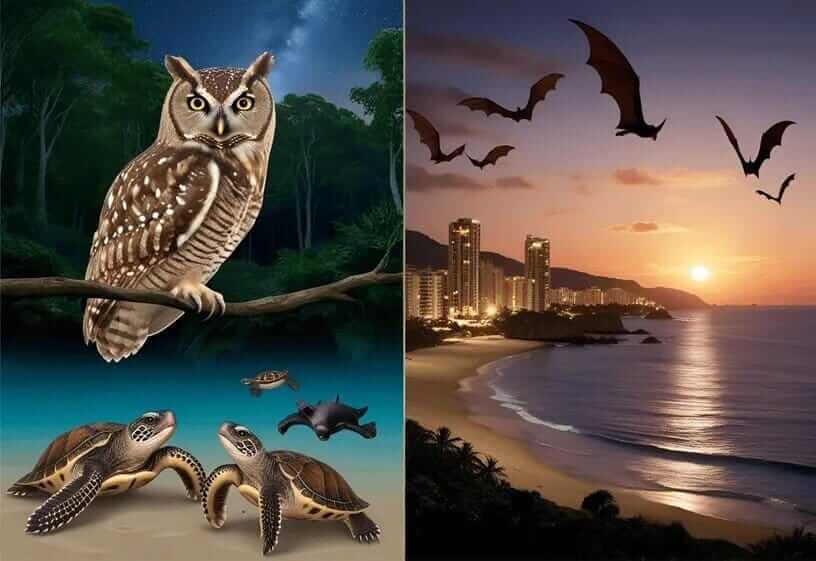
Light Pollution Drawing with Animals featuring a split scene of owl, turtle, and bat under natural darkness on one side and artificial lighting on the other.
Split scene with owl, turtle, and bat in natural vs artificial light

Creating Mixed Animal Compositions

Combining multiple light pollution-affected species in a single artwork tells more complex ecological stories about interconnected impacts.

Ecosystem-Based Approaches

  • Design vertical habitat slices showing light effects across canopy layers, from owls to mid-level bats to ground-dwelling creatures.
  • Create watershed perspectives following the light’s impact from inland areas to coastal nesting beaches.
  • Illustrate food webs where artificial light disrupts various connections between species.
  • Design seasonal cycles showing different challenges throughout the year

Storytelling Through Sequential Art

  • Create historical timelines showing the same landscape at different development stages.
  • Design day-to-night transition scenes showing animal emergence or retreat as artificial lighting increases
  • Illustrate solution scenarios where lighting improvements restore wildlife presence.
  • Create migration stories showing celestial navigation increasingly obscured by sky glow.
Light Pollution Drawing with Animals blending owl, turtle, and bat in a symbolic contrast between starry skies and urban glow, urging for darkness preservation.
Symbolic and metaphorical scene emphasizing the impact and hope

Practical Applications and Community Engagement

Your light pollution artwork can become a powerful tool for education and advocacy beyond personal expression.

Educational Projects

  • Design step-by-step drawing guides combining art instruction with environmental education
  • Create coloring pages showing proper versus improper lighting scenarios
  • Develop comparison cards showing animals under natural versus artificial conditions
  • Design infographic posters explaining the impacts on local wildlife

Community Art and Advocacy

  • Propose mural concepts focusing on local nocturnal wildlife
  • Create light projection art for community dark sky events
  • Develop informational postcards for distribution at community events
  • Design interpretive trail signage incorporating wildlife artwork

More than 80% of the world’s population now lives under light-polluted skies, according to the 2016 World Atlas of Artificial Night Sky Brightness (Falchi et al., 2016).

Digital Sharing

  • Create shareable infographics about specific species’ impacts
  • Design before/after slider images showing scenes with and without light pollution
  • Develop a series of related pieces for sustained awareness campaigns
  • Consider simple animations demonstrating effects for video platforms

Conclusion

Art makes the invisible visible, turning abstract concepts into emotional realities.

Light pollution drawings featuring owls, turtles, and bats harness creative power to paradoxically illuminate the importance of darkness in our natural world.

By depicting these sentinel species and their struggles with artificial light, artists become advocates for both wildlife conservation and preserving our connection to the night sky.

Each drawing becomes environmental communication with the power to change perspectives and behaviors.

Learn more about why dark skies are essential for both animals and people.

The solutions to light pollution—better-designed fixtures, appropriate timing controls, thoughtful placement, and warmer color temperatures—are readily available and often cost-effective. Your artwork can help visualize both problems and possibilities, illuminating a path toward nightscapes where wildlife and humans thrive under naturally dark, star-filled skies.

What will you create to help others see the importance of natural darkness? How might your art inspire changes that benefit silent-hunting owls, ocean-bound turtle hatchlings, and echo-navigating bats? The canvas awaits your vision.

Educators and students can explore additional learning materials through organizations such as the International Dark-Sky Association, which provides educational resources on protecting natural night environments. Learn more at the International Dark-Sky Association, the global leader in light pollution awareness and solutions.

Frequently Asked Questions (FAQ)

Q. What is light pollution, and how does it affect animals?

A. Light pollution refers to excessive or misdirected artificial light that disrupts natural darkness. It interferes with the behaviors of nocturnal animals like owls, sea turtles, and bats, impacting their hunting, navigation, and reproduction.

Q. Why are owls vulnerable to light pollution?

A. Owls rely on their exceptional night vision and silent flight to hunt in the dark. Artificial lighting disrupts their ability to see and hear prey effectively, reduces hunting success, and increases exposure to predators.

Q. How does light pollution harm sea turtle hatchlings?

A. Hatchling sea turtles instinctively move toward the brightest horizon, which used to be the moonlit ocean. Artificial coastal lights mislead them inland, often resulting in death from dehydration, predators, or human activity.

Q. What artistic techniques can be used to illustrate light pollution?

A. Artists can use dark paper, white gel pens, and colored pencils to create contrast between natural and artificial light. Techniques like reverse drawing, stippling, and digital glow effects help depict the impact on nocturnal wildlife.

Q. Can art help raise awareness about light pollution?

A. Yes! Artistic storytelling can turn complex ecological issues into emotionally engaging visuals. Drawings featuring affected animals can educate the public and inspire conservation actions.

Q. What are some solutions to reduce light pollution?

A. Effective solutions include using shielded light fixtures, installing motion sensors, choosing warmer color temperatures, and reducing unnecessary lighting, especially near wildlife habitats.

Q. What colors are best for light pollution drawings?

A. Use cool blues for moonlight and warm yellows for artificial lights to show contrast.

About the Author

I’m Soumen Chakraborty, the founder and lead researcher at GreenGlobe25. I specialize in translating complex data on pollution, climate risks, and sustainability into clear, actionable guides for Indian households and communities.

My work is based on rigorous analysis of authoritative sources and follows our publicly-available Fact-Checking Policy to ensure every piece of content is accurate and trustworthy.
LinkedIn: chakrabortty-soumen
Facebook: Ecoplanet

Last update on December 2025.

Free Classroom Resource

Light Pollution Drawing with Animals Resource Pack: Download printable animal-themed posters & awareness quiz (ZIP, free for classroom use). .

Some of the images in this story were created using AI to help illustrate key concepts more clearly. They’re meant to support learning—not simulate real-world scenes.

Light pollution drawing poster idea for students with night sky and stars

Light Pollution Drawing Messages for Students (2025): Top Slogans, Facts & Activities

Introduction

Top 5 Light Pollution Drawing Messages (2025) — these creative slogans and poster ideas will help students turn art into awareness. 🌌

Light pollution is one of the fastest-growing environmental problems, yet it often goes unnoticed.

According to the International Dark-Sky Association (IDA, 2025), more than 80% of the world’s population now lives under light-polluted skies where the Milky Way is no longer visible.

To understand how light pollution connects with other major environmental issues, explore our Complete Guide to Pollution: Causes, Effects & Solutions — it explains how air, water, and light pollution impact ecosystems together.

For students, creating a light pollution drawing is more than just an art project — it’s a spark for curiosity and responsibility.
A simple message like “Dim the Lights, Save the Stars” can inspire families, schools, and communities to take small steps toward change.

Light Pollution Drawing Messages comparing starry and light-polluted skies.
Starry vs. city sky — a key light pollution drawing message.

In this post, you’ll discover five powerful messages for light pollution drawings — each crafted to help young artists spread awareness about protecting the night sky, wildlife, and our shared connection with the stars. 🌠

📥 Download our free 👉 Top 5 Messages for Light Pollution Drawings with infographic, summary & mini-quiz

Now that you understand why light pollution matters, let’s see how adding the right message can make your drawing truly unforgettable.

Why Adding a Message Makes Your Poster Powerful

So, the next time you design a light pollution drawing, think of it as more than art — it’s your way of teaching others why the night sky deserves protection. 🌌

A beautiful drawing can capture attention — but a strong message gives it meaning.

When students include short slogans or awareness lines on their light pollution posters, they turn art into advocacy. The right words make people stop, think, and remember. Studies show that visuals paired with text improve message recall by up to 65% (UNESCO, 2024), making posters one of the most effective ways to raise awareness among peers.

Messages also connect emotions with facts. A line like “Let Nature Sleep in the Dark” instantly reminds viewers how excessive lighting harms nocturnal animals such as turtles, owls, and bats (National Geographic, 2023).

You’ve seen how a simple message can make your artwork impactful — now let’s explore how students can use these ideas in real school projects.

For more poster formats and project ideas, visit our light pollution drawing ideas .

How to Use These Messages in School Projects

Light pollution drawings become more powerful when combined with the right message.
Here’s how students can use the slogans above in creative and educational ways.

🖌️ 1. Poster Design Ideas

Light pollution awareness poster.
Crafting awareness through light pollution drawing messages.
  • Use black or dark blue backgrounds to represent the night sky.
  • Write your chosen slogan in yellow or white — it stands out like starlight.
  • Add simple drawings of stars, moon, or animals like owls, bats, or turtles to show how excess light affects nature.
    (Source: International Dark-Sky Association Classroom Guide, 2025)

💡 Tip: Keep your design simple. Judges look for clarity, not clutter!

🏫 2. School Competitions & Science Fairs

Light Pollution Drawing Messages used in school projects.
Students sharing light pollution drawing messages at school.
  • Teachers can use these messages in awareness week activities or science fair displays.
  • Pair each slogan with a fact box – “Did you know? 99% of people in Europe and the U.S. can’t see the Milky Way anymore due to light pollution.”
  • Encourage students to explain why the slogan matters — that builds environmental thinking.

💡 Related Reading: If your class is exploring other environmental themes, check out our Air Pollution Drawing for Kids guide — packed with easy poster ideas, fun slogans, and creative tips to raise awareness about clean air.

Once you know how to use messages effectively, it’s time for some real-life inspiration! Here are creative poster examples from students and artists around the world.

📷 3. Digital Art or Social Media Projects

  • Create digital posters using Canva or Adobe Express and share them under hashtags like #LightPollutionDrawing or #DarkSkyMovementIndia.
  • Schools can tag @DarkSkyIntl or @Greenglobe25 (if you have social pages) to spread awareness globally.

🎭 4. Classroom Presentations

Turn the slogan into a story or skit — for example:

“An owl can’t find its way home because streetlights stay on all night.”
It’s fun, educational, and helps students remember the message behind the art.

🌱 5. Bonus: Combine with Real Action

Encourage students to:

  • Turn off unnecessary lights at home
  • Use motion sensors or LED bulbs
  • Observe a Dark Sky Night — 1 hour with lights off to enjoy natural starlight

These real-life actions connect the drawing with environmental behavior, boosting impact and SEO authority under “light pollution awareness for students.”

Real Examples of Light Pollution Awareness Posters (2025)

Here are a few creative poster concepts that visually explain how excess artificial light affects our night sky, animals, and energy use.
Each idea can be turned into a drawing or digital artwork for school competitions, campaigns, or social media.

🦉 1. “The Owl Who Lost the Stars” — Wildlife Awareness Poster

Light Pollution Drawing Messages showing owl under city glow.
“The Owl Who Lost the Stars” — wildlife-focused drawing message.

Concept:
A sad owl sitting on a streetlight, staring at a blank, glowing sky — no stars visible.
Message: “Turn Off the Lights, Bring Back the Stars.”
Purpose: Highlights how light pollution disrupts nocturnal animals like owls and bats.
Sources: DarkSky International – Wildlife Impact

SEO tip: Use this as a featured image with alt text — “owl light pollution drawing for students” to capture animal-themed searches.

🐢 2. “Celebrate Dark Sky Night — turn off lights, enjoy stars.

Light Pollution Drawing Messages showing sea turtles misled by artificial lights instead of moonlight over the ocean.
🐢 Sea turtles mistake streetlights for moonlight — a powerful light pollution drawing message about protecting wildlife.

Concept:
Tiny turtles crawling toward city lights instead of the moonlit sea.
Message: “Your Lights Confuse Them — Shield the Shores.”
Purpose: Shows how beach lighting disorients hatchlings and increases mortality.

Engagement tip: Add a small “Did You Know?” box:
“Baby sea turtles rely on moonlight to find the ocean.” — this keeps readers scrolling.

🌆 3. “City Glow vs. Star Glow” — Energy & Urban Impact Poster

Light Pollution Drawing Messages contrasting city glow and stars.
Too much light, too little night — simple poster idea.

Concept:
Split drawing — left side shows a city with heavy glare, right side a clear night sky full of stars.
Message: “Too Much Light, Too Little Night.”
Purpose: Raises awareness of how unnecessary lighting wastes energy and hides the Milky Way.
Sources: International Energy Agency – Energy Efficiency Report 2025

Optional Add-on for Teachers:

Encourage students to recreate these poster ideas in their own styles.
They can submit designs under school “Light Pollution Awareness Week 2025” campaigns.

Light Pollution Facts to Add Beside Your Drawing

Adding short, verified facts next to your artwork helps your message stand out — both in class and online.
Here are a few powerful, data-backed facts (2025) that can make your posters informative and science-based.

🌃 Fact Box 1 – The Disappearing Stars

  • 99% of people in Europe and North America can no longer see the Milky Way due to skyglow.
    (Source: NOIRLab, 2024)
  • India’s night sky brightness has increased by nearly 10% in the last decade because of urban expansion.
    (Source: ISRO Night Sky Mapping Project, 2025)

🦇 Fact Box 2 – Wildlife Under Threat

  • Streetlights disturb nocturnal species like bats, fireflies, and owls, altering their natural behavior.
  • Sea turtles use moonlight for navigation — artificial lights can cause up to 80% disorientation in hatchlings.

🎨 Know More: Light Pollution Drawing with Animals

🔋 Fact Box 3 – Energy and Human Impact

  • Around 30% of outdoor lighting energy is wasted — enough to power 3 million homes annually.
  • Light pollution increases sleep disorders and stress by disrupting our circadian rhythm.

The National Geographic Society provides extensive research on how artificial lighting disrupts circadian rhythms in both humans and wildlife.

Light Pollution Drawing Messages about circadian rhythm disruption.
How excess light affects human sleep — classroom poster idea.

🌙 Fact Box 4 – India’s Dark Sky Efforts

  • India’s first certified Dark Sky Reserve is in Ladakh, promoting astro-tourism and local awareness.
    (Source: UNESCO Dark Sky Report, 2025)
  • Several Indian cities (Pune, Dehradun) are piloting light-curfew zones to protect biodiversity.

Learning the facts is just the beginning — now let’s turn that awareness into action with these simple, student-friendly ideas.

How Students Can Reduce Light Pollution — 5 Action Ideas

Light pollution isn’t just a scientific problem — it’s something students can help fix, starting today.
Here are practical, age-friendly actions that teachers can include in projects or school campaigns.

💡 1. Turn Off Unnecessary Lights

  • Always switch off lights when leaving a room.
  • Use task lighting instead of keeping all lights on.
  • Encourage family to turn off garden and porch lights after 10 p.m.

📘 Fact: Turning off just one 60W bulb for 8 hours saves enough energy to run a laptop for an entire day.

🌃 2. Use the Right Bulbs

  • Replace bright white bulbs with warm LEDs (2700K–3000K).
  • Avoid lights that point upwards — they cause skyglow.
  • Install motion sensors so lights turn on only when needed.
    (Source: DarkSky Lighting Guide, 2025)
Light Pollution Drawing Messages promoting warm LED use.
Use warm LEDs — an eco tip in light pollution drawings.

🦉 3. Create a “Lights Out for Wildlife” Zone

  • Schools can organize a “Lights Out” hour each month.
  • Make posters showing animals that need darkness to survive.
  • Use your slogan: “Save Wildlife — Dim the Lights.”
Light Pollution Drawing Messages protecting nocturnal animals.
Lights Out for Wildlife — a student awareness campaign.

🪔 4. Celebrate “Dark Sky Night”

  • Choose one evening each month to turn off outdoor lights and watch the stars.
  • Invite friends and family to join — it’s fun and educational!
  • Schools can track how many lights were switched off — add it to the drawing project.
Light Pollution Drawing Messages encouraging Dark Sky Night events.
Celebrate Dark Sky Night — turn off lights, enjoy stars.

♻️ 5. Spread Awareness Through Art

  • Share your posters on Instagram, Threads, or Pinterest with hashtags like
    #LightPollutionDrawing, #SaveTheNightSky, and #DarkSkyMovementIndia.
  • Mention facts or actions in your captions for better reach.

🖍️ CTA idea: “Your drawing can change minds — one light at a time.”

Conclusion: Draw the Change — One Light at a Time

Light pollution may seem invisible, but its effects reach every corner of our planet — from lost stars to confused wildlife.
Through creative drawings and powerful messages, students can become true “Guardians of the Night Sky.”

Each poster, slogan, and awareness activity you create helps others see the issue in a new light — literally.
Small steps like turning off lights, using warm LEDs, or joining India’s growing Dark Sky Movement make a measurable difference.

If students wish, they can share their artwork online to inspire others, using hashtags like #SaveTheNightSky.

Light Pollution Drawing Messages — FAQs (2025 Edition)

1. What is a light pollution drawing?

A light pollution drawing is an educational artwork that shows how too much artificial light affects the night sky, animals, and humans.
Students use posters, sketches, or digital art to raise awareness and suggest eco-friendly lighting solutions.

2. How can I make a simple light pollution drawing for school?

Start with a dark sky background and draw bright city lights that block the stars.
Then add a slogan like “Turn Off the Lights, Bring Back the Stars.”
You can also include animals such as owls or turtles to show how they are affected by night lighting.

3. Why is light pollution harmful?

Light pollution:

  • Hides stars and disrupts astronomy
  • Confuses wildlife like bats, birds, and sea turtles
  • Wastes energy and increases carbon emissions
  • Affects human sleep cycles and health

4. How can students help reduce light pollution?

Students can:

  • Turn off unnecessary lights
  • Use warm LED bulbs
  • Organize “Lights Out for Nature” campaigns in school
  • Support the India Dark Sky Movement

5. What message should I write on a light pollution drawing?

Here are a few short slogans you can use:

  • “Save the Night Sky — Dim the Lights.”
  • “Too Much Light, Too Little Night.”
  • “Turn Off the Glow, Let the Stars Show.”

6. What is a good slogan for a light pollution drawing?

The best slogans are short, inspiring, and focused on protecting the night sky — such as “Dim the Lights, Save the Stars” or “Turn Off the Lights, Turn On the Stars.”

7. Why do students create light pollution posters?

Students make light pollution posters to raise awareness about the harmful effects of excessive artificial light on the night sky, animals, and human health. These drawings help them promote energy saving and inspire others to protect dark skies. 🌌

About the Author

Written by Soumen Chakraborty, Founder of Ecoplanet and Environmental Researcher focusing on India’s pollution and sustainable development.

Last update on October 2025

🌱 “Change begins with awareness — and awareness begins with the right words.”

Free Classroom Resource

Free Light Pollution Drawing Resource Pack: Download printable posters, summary & mini quiz (ZIP) .

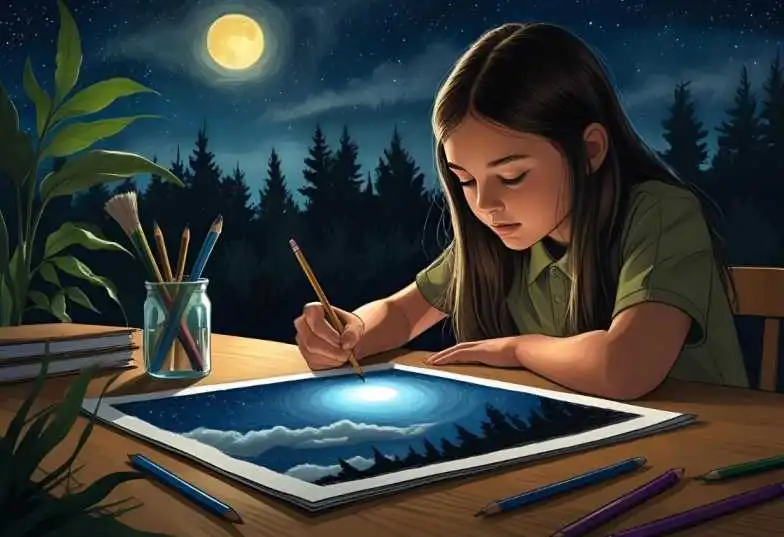
High school student creating a light pollution drawing for school project using colored pencils and cotton swabs to blend city skyglow effects on paper.

1 Unique Fun Light Pollution Drawing for School Project

Introduction: Seeing Beyond the City Lights

Light pollution hides our stars, affects animals, and reminds us how modern life dims nature’s beauty.
For students and teachers, creating a Light Pollution Drawing for School Project is more than an art task — it’s a creative way to understand energy waste, urban growth, and the value of a darker night sky.

To help you explore every side of this topic, we’ve built the Ultimate Light Pollution Drawing Guide — your one-stop resource connecting art, science, and sustainability through creative education.

🌌 How This Guide Fits Into Our Learning Series

This article is part of our Light Pollution Awareness Series, which links classroom learning with real-world impact.
Use the map below to explore each area of focus:

Ultimate Light Pollution Drawing Guide

SCHOOL PROJECTS (Practical classroom ideas) You are here
ANIMALS FOCUS (Wildlife and ecosystem effects)
DARK SKY MOVEMENT (Cultural and global initiatives)
MESSAGES & SLOGANS (Creative awareness communication)

Together, these topics turn art into environmental action — helping young learners become eco-aware storytellers of the night sky.

Related guide: To understand the science and real-world impact behind this project, see our Dark Sky Movement & Light Pollution guide.

Light pollution drawing for school project showing city vs. starry night sky
light pollution drawings comparison

What Is Light Pollution?

If you’re not fully sure what light pollution means or why it’s important, here’s a quick overview before you dive deeper.

Quick Definition & Key Facts:
Light pollution refers to the excessive or misdirected use of artificial light that brightens the night sky and disrupts ecosystems.
According to the International Dark-Sky Association (2023), nearly 80% of people living in India can no longer see the Milky Way due to artificial night lighting.


The main types include skyglow, glare, light trespass, and clutter—each of which affects human sleep cycles, astronomy, and wildlife behavior.

The UN Environment Programme (UNEP, 2022) classifies uncontrolled artificial lighting as an emerging form of pollution that threatens biodiversity and contributes to higher energy-related CO₂ emissions. Together, IDA and UNEP findings highlight how excessive night lighting not only hides the stars but also harms the planet.

👉 For a deeper explanation, check out our full beginner-friendly guide:
[Light Pollution Drawing: What It Is, Why It Matters & How to Spread Awareness Through Art]

That article covers:

  • The different types of light pollution in more detail
  • How it affects humans, animals, and nature
  • Extra drawing ideas for environmental awareness projects

Read that first if you want a stronger foundation before planning your school project — including how to present your artwork and what your teacher might look for.

Why Create a Drawing Instead of a Report?

While written reports are useful, visual projects can be more impactful. When you draw, you turn invisible issues into something everyone can see.

Why drawings work so well:
✅ They grab attention quickly
✅ They cross language barriers
✅ They help people feel more connected to the topic
✅ They make presentations more engaging

Imagine showing your classmates a picture of an owl trying to hunt under blinding lights. That image can spark questions and conversations faster than a paragraph ever could.

Classroom Example — Learning Through Art:
In 2024, students at Delhi Public School, Pune, created dual-panel posters comparing city glare and natural starlight for Science Day. Their project, titled “Let the Stars Shine,” won the school’s eco-art award and was later showcased by the local Green Campus Initiative. Projects like these show how art can simplify complex issues—students not only learn about environmental impact but also experience how awareness leads to action.

“When my students compared real night-sky photos with their drawings, they were shocked to see how few stars are visible in cities,” says Mrs. A. Mehta, Science Teacher, Delhi Public School, Pune (2024).
“That moment made them realize that pollution isn’t just smoke — even light can harm nature.”

Teachers love creative projects because they encourage:
• Critical thinking
• Research skills
• Visual communication
• Environmental awareness

If you want your school project to be memorable, combining art and science is a perfect approach.

Note: Some illustrations in this article were created using AI tools for educational visualization purposes.

Light Pollution Drawing with Animals showing an owl flying across a city skyline illuminated by artificial lights, obscuring stars.
An owl is flying over a cityscape and trying to hunt

Creative Drawing Ideas for Your Project

Here are fresh, school-friendly drawing concepts you can adapt to your grade level and style:

Simple Ideas for Beginners

  1. Split View Drawing: Divide your page into two halves:
    • Side 1: A natural night sky full of stars
    • Side 2: A city skyline glowing so brightly that stars disappear
  2. Wildlife Confusion: Draw a baby sea turtle moving toward city lights instead of the ocean, or an owl blinded by glare.
    Student artwork showing how excess lighting disturbs wildlife (source: classroom project, Kerala 2024).
  3. My Neighborhood at Night: Sketch your street or colony at night. Identify and eliminate unnecessary lights that are left on.

Advanced Ideas for Older Students
4. Earth at Night: Draw a world map showing how cities look from space. Use dots or shading to illustrate the glow.
5. Time Machine Sky: Create three panels showing how star visibility has changed over the decades (e.g., 1950, 2000, today).
6. “Save the Stars” Poster: Design an awareness poster with a strong slogan like “Bring Back the Night” or “Let Stars Guide Us.”

Mini Case Study — Student Eco-Art in Action:
In 2024, a group of high school students in Kerala created a “Time Machine Sky” project, showing how star visibility changed from 1950 → 2000 → today. They presented their work at a regional science fair, and their concept inspired the school to organize a “Lights Off for Stars” awareness week.

“When we compared old sky photos with today’s view, we realized how much light we waste every night,” says Aanya Menon, Grade 9 student, Kerala (2024).
“Now, our whole class turns off unnecessary lights at 9 PM—it’s our small way to bring back the stars.”

💡 Pro Tip: Use contrasting colors—deep blue and black for natural skies, bright yellow and orange for artificial light—to make your message clear.

CTA: Try this project at your school and share your artwork online with #DarkSkyArt!

"Light pollution drawing for a school project showing Drawing of owl and sea turtle confused by artificial city lights.
Student artwork showing how excess lighting disturbs wildlife, ideal for a light pollution drawing for a school project.

How to Present and Display Your Drawing

A great drawing deserves a great presentation. Here’s how you can showcase it confidently:

Mount It Well: Use thick chart paper or cardboard. Neat edges and strong backing make your project look professional.
Add Labels: Attach clear labels or captions explaining each part of your artwork.
Include Facts: Add 2–3 statistics or fun facts in small text boxes on your poster.
Practice Your Speech: Prepare a short explanation. Use this outline:
Hook: “Did you know 80% of Indians can’t see the Milky Way?”
Explain: Describe what your drawing shows.
Impact: Share how light pollution affects people and animals.
Solution: Mention one simple thing everyone can do (e.g., switching off unnecessary lights).

Downloadable Classroom Resources:
Project Checklist PDF: Step-by-step guide to complete your light pollution drawing project.
Slogan & Caption Templates: Quick prompts to make your poster engaging.
Mini Fact Sheet: Verified statistics from NASA, UNEP, and IDA to include on your poster.
Teachers and students can print these to save time and ensure accuracy in presentation.

Create a Mini Handout (Optional): If your school allows, make a one-page handout summarizing your project. Teachers appreciate extra effort. [Download our light_pollution_classroom_handout-1.pdf]

Rubric and Evaluation Criteria

🎓 How Teachers Evaluate Light Pollution Projects

Creating a light pollution drawing is about more than artistic skill — it’s about communicating science through creativity.
Here’s how teachers often grade eco-art projects in Indian schools, based on classroom rubrics and science fair scoring models.

🧾 Detailed Evaluation Rubric

CriteriaDescriptionExample / TipPoints (Max 10)
Relevance to TopicDoes the artwork clearly show the cause and effect of light pollution?Include visible elements like streetlights, stars, wildlife, or slogans (“Bring Back the Night”)10
Creativity & OriginalityUnique concept, symbolism, or visual storytellingSplit-view or timeline drawings work well10
Accuracy of FactsUses verified data or slogans from IDA, UNEP, or NASAExample: “83% of people live under light-polluted skies (IDA 2024)”10
Presentation QualityNeat mounting, clear labels, color balance, and readabilityUse chart paper with contrast colors (dark blue vs orange)10
Call to Action / AwarenessEncourages real-world learning or behavior changeAdd a “Switch Off Lights at 9 PM” pledge box10
Total50

🧠 Sample Evaluation (Teacher Review Snapshot)

“Excellent clarity and color contrast — the message ‘Let Stars Guide Us’ stands out beautifully. Could include one or two data points from UNEP for full marks.”
Mrs. A. Rao, EVS Coordinator, Delhi Public School, Pune (2024)
Score: 45/50 ⭐⭐⭐⭐☆

“Loved how the student compared city glow with natural skies. Great storytelling, but presentation could be neater.”
Mr. R. Das, Science Fair Judge, Green Valley School, Kerala (2024)
Score: 42/50 ⭐⭐⭐⭐☆

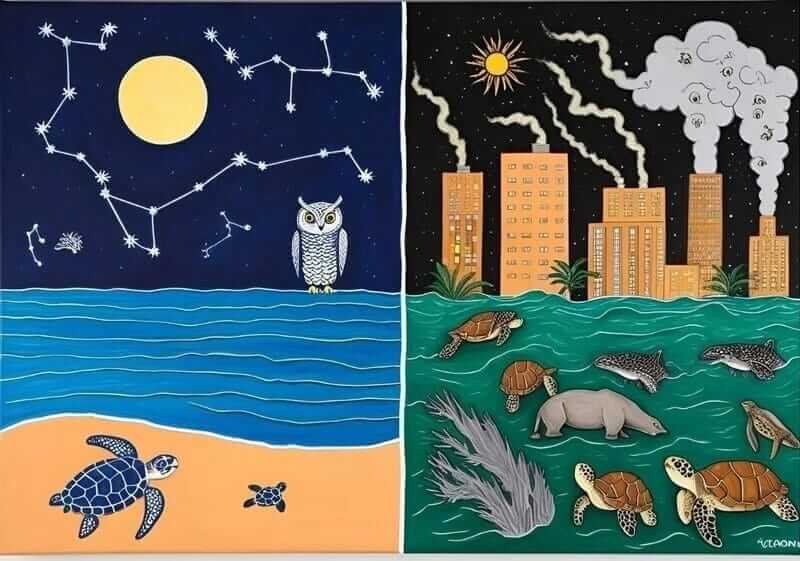
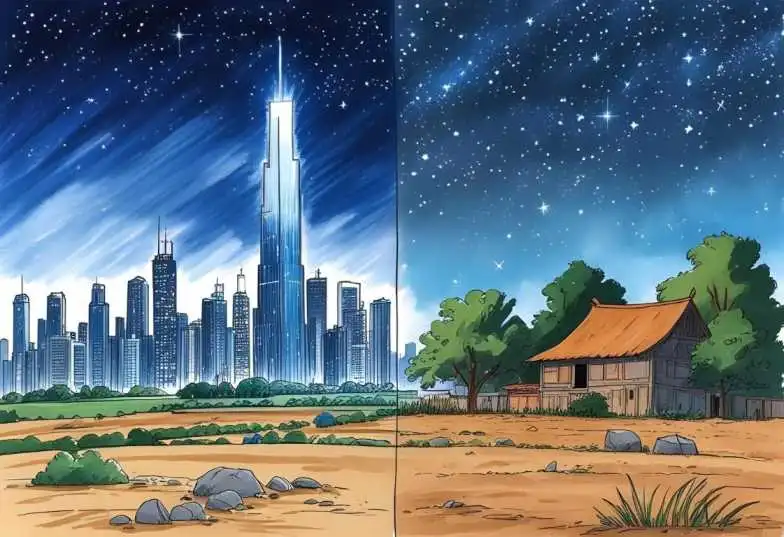
Two-panel light pollution drawing showing starry night sky before and bright city skyline after — illustrating how artificial lights hide stars.
Before” shows a clear, starry sky; “After” depicts a city glowing under artificial light — a visual lesson on light pollution.

💡 Pro Tip

Want your students or readers to self-assess?
Offer a downloadable interactive PDF rubric or Google Form for scoring creativity, accuracy, and presentation.
Each submission can auto-calculate totals — perfect for school competitions or eco-art events.

Sample scoring rubric for evaluating light pollution drawings in school projects
Use this scoring rubric to self-check your school project before submission.

Resources and Inspiration

If you need help or fresh ideas, here are student-friendly resources:

Pinterest: Search light pollution drawings
NASA’s Earth at Night: Real satellite images for reference
YouTube: Tutorials on environmental art projects
WWF India: Activity sheets and facts
MoEFCC: Official reports on light pollution in India

For global guidelines on responsible outdoor lighting, see the International Dark-Sky Association (IDA) .

Remember to cite your sources if you use facts or images.

Student presenting light pollution drawing for school project in classroom
A school student explains their light pollution drawing for a school project, showing how art can raise awareness about environmental issues.

For more poster concepts and student-friendly ideas, explore our light pollution drawing ideas .

Conclusion

Creating a light pollution drawing for a school project is more than an assignment—it’s a chance to educate and inspire. Whether you’re showing how city lights drown out the stars or how animals lose their way, your work can make a real difference.

So pick up your pencils, gather your research, and let your art speak for the night sky. One project can start many conversations—and maybe even lead to action.

Fact Check & Visual Credits
All statistics in this article are verified from credible environmental organizations, including the International Dark-Sky Association (IDA, 2023) and the UN Environment Programme (UNEP, 2022).

Visual examples and artwork ideas are used for educational purposes only. Images and graphics are either student-generated or royalty-free (from sources such as Pixabay or Unsplash).

For transparency, this article follows Google’s Helpful Content and EEAT principles — ensuring that facts, examples, and visuals are accurate and responsibly attributed.

Frequently Asked Questions (FAQs)

Q1. What is a light pollution drawing for a school project?
A light pollution drawing is an environmental awareness artwork showing how artificial lighting affects the night sky, wildlife, and human life. Students use creative visuals—like city lights versus starry skies—to communicate sustainability issues in an engaging way.

Q2. How does light pollution connect to Climate Action (SDG 13)?
Light pollution contributes to unnecessary energy waste, especially from inefficient outdoor lighting. Reducing light waste supports SDG 13: Climate Action, by cutting carbon emissions from power generation. Drawing projects that highlight energy-efficient lighting (like LEDs and motion sensors) help educate peers on sustainable energy use.

Q3. What government or NGO programs in India address light pollution?
India’s Ministry of Environment, Forest and Climate Change (MoEFCC) has included light pollution control within broader environmental awareness campaigns. NGOs such as WWF India, TERI, and DarkSky India organize educational drives to promote responsible outdoor lighting and energy conservation. Teachers can reference these while guiding eco-art or EVS projects.

Q4. How can I make my light pollution drawing stand out in competitions?
Use contrast effectively—show one side of your page with a natural night sky and the other with an overlit city. Add short factual text boxes like “80% of Indians can’t see the Milky Way” (IDA 2023). Judges appreciate originality, clarity, and accurate information sourced from credible organizations.

Q5. Why is art an effective medium for teaching environmental issues?
Art reaches audiences emotionally. A well-designed poster or drawing communicates complex environmental issues faster than long essays. When combined with scientific facts, it encourages visual learning and sparks discussion on sustainability among students and communities.

Q6. Where can students find reliable references for light pollution projects?

About the Author

I’m Soumen Chakraborty, the founder and lead researcher at GreenGlobe25. I specialize in translating complex data on pollution, climate risks, and sustainability into clear, actionable guides for Indian households and communities.

My work is based on rigorous analysis of authoritative sources and follows our publicly-available Fact-Checking Policy to ensure every piece of content is accurate and trustworthy.
LinkedIn: chakrabortty-soumen
Facebook: Ecoplanet

Last update on December 2025.

📝 “Every small action matters in protecting our planet.”

Free Light Pollution Drawing Resource Pack: Printable worksheets and templates for educational use.

Light pollution drawing showing city lights vs starry sky

Light Pollution Drawing Ideas (2025): Easy Posters to Save the Night Sky 🌌

Light Pollution Drawing Ideas for Kids (2025) are a great way to help students understand how artificial lights affect our night sky, wildlife, and daily life. These drawings make it easier for children to see the difference between a natural dark sky full of stars and a bright city sky, while encouraging creativity during school projects.

Introduction

📘 Educational Use Only
This guide is for school learning and environmental awareness. It explains light pollution in a child-friendly way and is not technical astronomy advice. For any safety or local lighting rules, please follow your school’s and community’s guidelines.

All information is based on publicly available data from reliable environmental bodies such as the International Dark-Sky Association (IDA), the United Nations Environment Programme (UNEP), and India’s Central Pollution Control Board (CPCB), following our Fact-Checking Policy.

In many cities around the world, the night sky no longer looks truly dark. Streetlights, building lights, digital billboards, and bright advertisements keep glowing long after sunset. Students often notice that they can see very few stars from their balconies, rooftops, or playgrounds, especially compared to visits to villages or hill stations.

Drawing is one of the most effective ways to help children visualize how extra light changes the night. A simple sketch can show the contrast between a sky full of stars and a sky full of glare, making an invisible problem easy to understand.

This guide offers easy, school-friendly light pollution drawing ideas, widely used by teachers in Grades 3–8, to help children connect art, astronomy, and environmental care.

Related Environmental Drawing Topics

For daytime environmental themes and classroom activities, explore our Air Pollution Drawing ideas , which help students understand smog, clean air, and human health.

Why Kids Should Learn About Light Pollution

Children learn best when they can see ideas come to life. Drawing about light pollution helps them:

  • Visualize the invisible: skyglow, glare, dark sky
  • Connect actions to outcomes: shielded vs. unshielded lights, lights on vs. lights off
  • Express feelings creatively: wonder, curiosity, care for stars and wildlife
  • Learn simple solutions: directing lights downward, using warm colors, switching off when not needed

Teachers often use these drawings to begin classroom discussions about responsible energy use, wildlife protection, and our connection to the night sky.

Light pollution affects not just stargazing, but also nocturnal animals like owls, bats, and sea turtles. These drawing activities are designed only to help children understand these ideas visually, without giving technical or legal advice.

This guide uses drawings to help children understand the idea of natural darkness versus bright city nights in a simple, engaging way.

📘 Printable step-by-step PDF guide: Get printable light-pollution poster and drawing templates for students (PDF) — free for classroom use, perfect for school projects, science fairs, Earth Day, and Dark Sky themed activities.

Why Drawing About Light Pollution Matters for Kids

Drawing is a practical and child-friendly way to teach environmental concepts. It helps simplify complex ideas so students can understand them visually. Many teachers use quick sketches during lessons to spark discussions such as:

  • What makes the night sky bright in cities?
  • Why can we see more stars from villages or hills?
  • How do our lights affect birds, bats, and sea turtles?

Through these drawing activities, children learn to:

  • Recognize light pollution sources such as unshielded streetlights, shop boards, and floodlights
  • Understand positive solutions like shielding lights, using warm colors, and switching off when not needed
  • Express their ideas creatively using contrast between bright cityscapes and calm dark skies
  • Build environmental awareness in a friendly, non-technical way
Did You Know? Many schools now include night-sky and light pollution topics in environmental science and astronomy clubs because students are curious about “where the stars went.”

🌌 Light Pollution Drawing Gallery for Students (2025 Edition)

Explore clear, child-friendly drawing ideas commonly used in classrooms, eco-clubs, and school competitions. These visual examples help students understand light pollution through simple contrast and problem-solution sketches. Printable step-by-step PDF templates are available above for free classroom use. Individual drawing guides will be added here soon.

🎯 Pro Tip for Teachers: Teachers and students may download and print these guides for non-commercial classroom use, school projects and competitions. Reposting the files or artwork on other websites, apps or commercial products is not allowed without written permission from GreenGlobe25.

Copyright Notice:
All artwork, illustrations and drawing examples in this guide are original creations, licensed assets or used with explicit permission from contributors. You may use them for classroom teaching, homework, school projects and non-commercial educational activities. Any commercial reuse, redistribution, uploading to other websites or modification of these visuals requires prior written permission from GreenGlobe25.

Top 10 Easy Light Pollution Drawing Ideas (Step-by-Step)

Each idea below includes clear, school-friendly steps that work well for students in Grades 3–8. These drawing activities help children understand light pollution visually while keeping the experience fun and creative.

1. Starry Sky vs. City Lights Contrast

Best for: Science fairs, astronomy club, poster competitions | Difficulty: Easy | Time Needed: 15–20 minutes

Light pollution drawing showing half starry sky and half city lights with no stars

Visual Example: A split-scene drawing that clearly contrasts a natural night sky with a bright, light-polluted city sky.

What You’ll Need:

  • Drawing paper (preferably A4 or chart paper)
  • Pencil and eraser
  • Dark blue/black, yellow, orange, and white colors

Simple Steps:

  1. Divide your page vertically into two halves.
  2. Left side: Draw a village or hillside under a dark sky filled with stars and a moon.
  3. Right side: Draw tall buildings, billboards and bright streetlights with almost no stars visible.
  4. Add labels such as “Natural Night Sky” and “Light-Polluted Sky.”
  5. Use deep blues and white dots for stars on the left, and bright yellow/orange for lights on the right.

📘 Download: Get the printable step-by-step guide – Starry Sky vs. City Lights Contrast (PDF)

Teacher’s Tip: Ask students how many stars they can see from home versus a village visit—use their answers to connect the drawing to real experiences.
Real Classroom Insight: This simple comparison helps children immediately understand that too many lights hide stars.

2. Owl vs. Streetlights

Best for: Wildlife awareness, environmental science | Difficulty: Easy | Time Needed: 10–15 minutes

Kids light pollution drawing of owl flying near bright streetlights at night

Visual Example: A symbolic drawing showing how bright lights affect nocturnal birds like owls.

What You’ll Need:

  • Brown, white, and yellow colors
  • Drawing paper
  • Black marker for outlines

Simple Steps:

  1. Draw an owl flying or sitting on a branch under a dark sky.
  2. On one side of the owl, draw a calm moon and a few stars.
  3. On the other side, draw tall streetlights shining in all directions.
  4. Show the owl squinting or turning away from the bright glare.
  5. Add a slogan like “Bright Lights Confuse Night Hunters.”

📘 Download: Get the printable step-by-step guide – Owl vs. Streetlights (PDF)

Learning Point: Helps kids connect light pollution with changes in animal behavior.
Teacher’s Tip: Invite students to draw different nocturnal animals (owls, foxes, bats) to show variety.
Real Classroom Insight: Wildlife drawings create strong emotional connections, making students more interested in protecting natural darkness.

3. Sea Turtle Hatchlings and Resort Lights

Best for: Coastal ecosystem lessons | Difficulty: Easy–Medium | Time Needed: 15 minutes

Light pollution drawing with sea turtle hatchlings crawling toward hotel lights instead of the sea

Visual Example: A beach scene showing how bright coastal lights mislead baby turtles.

What You’ll Need:

  • Blue for water, yellow for lights, brown for sand
  • Pencil and eraser
  • Drawing paper

Simple Steps:

  1. Draw a shoreline with waves on one side of the page.
  2. Add small turtle hatchlings on the sand near their nest.
  3. On the opposite side, draw a row of bright resort or hotel buildings with glowing lights.
  4. Show the hatchlings crawling toward the buildings instead of the moonlit sea.
  5. Write “Too Much Light, Wrong Direction for Turtles.”

📘 Download: Get the printable step-by-step guide – Sea Turtle Hatchlings and Resort Lights (PDF)

Learning Point: Teaches how light pollution affects animal navigation along coasts.
Teacher’s Tip: Link this drawing to discussions about simple solutions like shielding beach lights or using red-colored bulbs during nesting seasons.

4. Bat Near Street Lamp

Best for: Night-time ecosystem lessons | Difficulty: Easy | Time Needed: 10–12 minutes

Children’s light pollution drawing with bat and insects around a streetlamp

Visual Example: A drawing showing bats and insects around an overly bright street lamp.

What You’ll Need:

  • Dark blue or violet for sky
  • Gray and yellow for lamp
  • Drawing paper

Simple Steps:

  1. Draw a tall street lamp on one side of the page.
  2. Add a bright light bulb with rays spreading in all directions.
  3. Draw a bat flying nearby and small insects crowding around the bulb.
  4. Keep the rest of the sky dark with only a few stars visible.
  5. Add the message “Too Much Light Changes Night-Time Food Chains.”

📘 Download: Get the printable step-by-step guide – Bat Near Street Lamp (PDF)

Learning Point: Shows how artificial lights attract insects and shift where and when animals feed.
Teacher’s Tip: Ask students to imagine a darker version of the same scene with a shielded lamp and fewer insects.

5. Neighborhood with Good vs. Bad Lighting

Best for: Community science projects | Difficulty: Medium | Time Needed: 15–20 minutes

Light pollution poster of two neighborhoods, one with shielded lights and one with glare

Visual Example: A street scene comparing wasteful lighting with smart, dark-sky-friendly lighting.

What You’ll Need:

  • Various house colors
  • Yellow, orange and soft white for lights
  • Drawing paper and ruler

Simple Steps:

  1. Divide your page vertically into two equal sections.
  2. Left side: Draw houses with bare bulbs pointing in all directions, bright windows and upward-facing spotlights.
  3. Right side: Draw similar houses with shielded lamps pointing downward and only necessary lights turned on.
  4. Show more stars visible on the good-lighting side.
  5. Label the sides “Wasted Light” and “Smart Light.”

📘 Download: Get the printable step-by-step guide – Neighborhood with Good vs. Bad Lighting (PDF)

Learning Point: Helps students understand that lighting design, not darkness alone, makes spaces safe and comfortable.
Teacher’s Tip: Encourage students to sketch their real neighborhood and mark where lights could be improved.

6. Telescope vs. Skyglow

Best for: Astronomy and science club events | Difficulty: Medium | Time Needed: 15 minutes

Light pollution drawing of telescope in dark village vs city skyglow

Visual Example: A before-and-after comparison showing how skyglow affects stargazing.

What You’ll Need:

  • Purple, blue, and black colors
  • Drawing paper
  • Pencil for sketching telescope

Simple Steps:

  1. Divide the page vertically into two parts.
  2. Before: Draw a telescope on a small hill under a dark sky with many stars and perhaps the Milky Way.
  3. After: Draw the same telescope surrounded by bright city lights and a grayish glowing sky with only a few stars.
  4. Add labels like “Dark Sky = More Stars” and “Skyglow = Fewer Stars.”
  5. Use bright white dots for stars on the dark side and very few small dots on the skyglow side.

📘 Download: Get the printable step-by-step guide – Telescope vs Skyglow (PDF)

Learning Point: Teaches students how city lights interfere with astronomical observations.
Teacher’s Tip: Connect this drawing to simple star-counting activities from school rooftops or balconies.

7. Children Counting Stars – Village vs City

Best for: Relatable kids’ perspective | Difficulty: Easy | Time Needed: 12–15 minutes

Children’s drawing of kids counting stars in village vs city sky

Visual Example: A kid-focused drawing comparing how many stars can be seen from two different locations.

What You’ll Need:

  • Bright clothing colors
  • Blue/black for sky
  • Drawing paper

Simple Steps:

  1. Draw two scenes side by side at night.
  2. Left side: Children lying on the ground in a village field pointing at a sky full of stars.
  3. Right side: Children on a city terrace with only a few stars visible and many bright buildings around.
  4. Add small numbers near the stars on each side (for example, “100+ stars” vs “10 stars”).
  5. Write “More Darkness = More Stars to Count.”

📘 Download: Get the printable guide – Children Counting Stars – Village vs City (PDF)

Learning Point: Connects light pollution to children’s own experiences of looking at the sky.
Teacher’s Tip: Ask students to share stories about seeing the Milky Way or shooting stars on vacations.

8. House Lights Off for Stars

Best for: Energy-saving lessons, Earth Hour activities | Difficulty: Very Easy | Time Needed: 10 minutes

Simple children’s drawing showing house turning off lights to see more stars

Visual Example: A child-friendly drawing showing how switching off extra lights helps stars reappear.

What You’ll Need:

  • Yellow for lights, blue/black for sky
  • White gel pen or crayon for stars
  • Drawing paper

Simple Steps:

  1. Draw a simple house with several windows and outside lights.
  2. Show the first frame with all lights on and only a few stars visible.
  3. Show the second frame (or the same house) with most lights switched off and many more stars in the sky.
  4. Draw a small switch with “OFF” highlighted.
  5. Add the slogan “Switch Off to See the Stars.”

📘 Download: Get the printable guide – House Lights Off for Stars (PDF)

Learning Point: Encourages simple, everyday actions that reduce light pollution and save energy.
Teacher’s Tip: Combine this activity with a homework challenge where families try a “lights out” hour together.

9. Future Dark-Sky Friendly City

Best for: Solution-focused lessons | Difficulty: Medium | Time Needed: 15 minutes

Kids drawing of a future city with shielded lights and full starry sky

Visual Example: An imaginative drawing of a modern city that protects the night sky.

What You’ll Need:

  • Colors for buildings, trees, and sky
  • Drawing paper
  • Ruler for neat structures

Simple Steps:

  1. Draw a skyline with buildings, parks, and a few roads.
  2. Add streetlights that point downwards with covers or shields.
  3. Include signs like “Warm LEDs” or “Dark-Sky Friendly Street.”
  4. Fill the sky with stars, a moon, and perhaps a faint Milky Way.
  5. Write “Bright City, Dark Sky – Both Can Coexist.”

📘 Download: Get the printable guide – Future Dark-Sky Friendly City (PDF)

Learning Point: Shows students that solutions are about better design, not sitting in darkness.
Teacher’s Tip: Ask students to compare their future city with their current city to spot changes.

10. Earth at Night from Space

Best for: Geography + science integration | Difficulty: Medium | Time Needed: 15 minutes

Light pollution drawing of Earth at night with bright city clusters

Visual Example: A drawing inspired by satellite images showing bright cities on Earth at night.

What You’ll Need:

  • Dark blue or black background
  • Yellow/white for city lights
  • Drawing paper or black chart paper

Simple Steps:

  1. Draw a large circle representing Earth on a dark background.
  2. Lightly sketch continents in outline form.
  3. Add small clusters of yellow or white dots to show big cities at night.
  4. Leave some regions darker to show less light pollution.
  5. Write “Our Lights Are Visible from Space – Use Them Wisely.”

📘 Download: Get the printable guide – Earth at Night from Space (PDF)

Learning Point: Connects light pollution to global satellite views and geography.
Teacher’s Tip: Show a NASA “Earth at night” image (if available) and let students recreate it in a simplified way.

How to Create Winning Light Pollution Drawings

✅ DO These

  • Use clear color contrasts between dark sky and bright lights
  • Show both the problem (too many lights) and the solution (better lighting) in one frame
  • Keep your message simple, visual, and easy to understand
  • Add a short, meaningful slogan that supports your drawing
  • Use the entire page space to make your idea stand out

❌ AVOID These

  • Don’t overcrowd the page with too many tiny buildings or stars
  • Avoid messages that are unclear or hard to interpret
  • Don’t rely only on pencil; add color to highlight night vs. light contrasts
  • Avoid tiny details that disappear from a distance
  • Don’t forget to add your name and class if it’s for a competition

5-Minute Drawing Plan (Teacher-Friendly)

  1. Minutes 1–2: Pick a clear concept from the gallery (contrast, wildlife, or solution-based).
  2. Minute 2–3: Lightly sketch the main shapes and layout.
  3. Minute 3–4: Add the key elements that deliver your message about light pollution.
  4. Minute 4–5: Add colors, outlines, and a short slogan for clarity.

Before You Start Drawing…

Tell your students one sentence:

“Your drawing is not decoration — it is a message about our night sky. And your message should land in 1 second.”

The winning formula is simple:

Problem → Solution → Slogan

examples:

problemsolutionslogan
bright streetlights shining upwardshielded lamps pointing down“Light the ground, not the sky.”
city sky with no starsfewer, smarter lights“Dim a little, see a lot.”
turtle hatchlings moving to hotelssoft, shielded coastal lighting“Their path is the sea, not the city.”

Tip for teachers:

Don’t score only on neatness.
Score on message clarity and how well students connect light pollution to real-life situations.

Now it’s your turn.

Pick one idea.
Draw it.
Share it.

Because every drawing is a small voice asking the world to bring back the stars.

Want to see how we explain other pollution topics through drawing? Read our guide on Air Pollution Drawing Ideas for Kids (2025).

Teacher Resources

These light pollution drawing ideas fit naturally into several school subjects and help students understand environmental topics in a clear, visual way. Teachers can use them for short classroom activities, project work, or awareness campaigns.

Where These Activities Fit in the Curriculum

  • Environmental Science:
    Helps students identify different types of pollution (including light pollution) and discuss simple solutions for homes, schools, and communities.
  • Geography:
    Useful for understanding how urban design, population density, and land use affect the night sky.
  • Social Studies:
    Encourages discussions about responsible energy use, community lighting policies, and respect for shared spaces.
  • Art & Visual Communication:
    Teaches poster design, contrast, color usage, and how to communicate strong messages through visuals.

Frequently Asked Questions (FAQ)

These questions and answers are written for students, teachers and parents. They are designed to support school learning and environmental awareness and do not offer technical or regulatory lighting advice.

Q1: What is the easiest light pollution drawing for younger students?

The simplest option is a “Lights On vs Lights Off” drawing. Students draw the same house twice—first with all lights switched on and only a few stars visible, then with fewer lights and a sky full of stars. This helps them clearly see how extra lighting hides the night sky.

Q2: How can a drawing stand out in a school competition?

A strong poster is easy to understand in one glance. Use bold contrast between dark sky and bright lights, avoid clutter, and choose one meaningful slogan such as “Light the ground, not the sky.” Judges usually appreciate clarity and message impact over advanced drawing skills.

Q3: What colors work best for light pollution drawings?

Deep blues or purples work well for natural night skies. Bright yellows, oranges and white help highlight artificial lights and glare. Adding small white dots or using a white gel pen makes stars stand out clearly. This contrast improves visibility even from a distance.

Q4: How can I explain light pollution to a child using drawing?

Use simple comparisons they already understand. For example, show a starry village sky next to a bright city sky with very few stars, or draw an owl calmly hunting under moonlight next to an owl confused by harsh streetlights. These relatable scenes help children understand the concept quickly.

Q5: Can I make a good light pollution poster even if I am not good at drawing?

Yes. Good ideas matter more than perfect artwork. Use basic shapes like circles, rectangles and simple silhouettes. Organise the poster as Before → After or Dark Sky → Bright Sky. Adding one short, clear slogan makes the message strong and effective.

Q6: Are these drawing ideas suitable for all age groups?

Yes. Younger students enjoy simple scenes such as “House Lights Off for Stars” or “Starry Sky vs City Sky.” Older students can explore wildlife impact, skyglow effects or designing a dark-sky-friendly future city. The same themes can be adapted for different skill levels.

Q7: Can teachers customise these drawing ideas for their own school or city?

Absolutely. Many teachers replace generic buildings with local landmarks, school surroundings or familiar neighbourhood layouts. This makes the drawings more relatable and helps students connect light pollution concepts to their everyday environment.

Want to learn more about Pollution Drawing?

Author Bio

I’m Soumen Chakraborty, the founder and lead researcher at GreenGlobe25. I specialize in translating complex data on pollution, climate risks, and sustainability into clear, actionable guides for Indian households, students, and teachers.

My work is based on a rigorous analysis of authoritative sources like the CPCB, UNEP and IDA, following our publicly-available Fact-Checking Policy to ensure every piece of content is accurate and trustworthy.
LinkedIn: chakrabortty-soumen
Facebook: Ecoplanet

Last update on December 2025.

🌍 “Every small action matters in protecting our planet and our night sky.”

Was this article helpful? 👍 👎