
Introduction
Light pollution occurs when excessive artificial lighting brightens the night sky and reduces natural darkness.
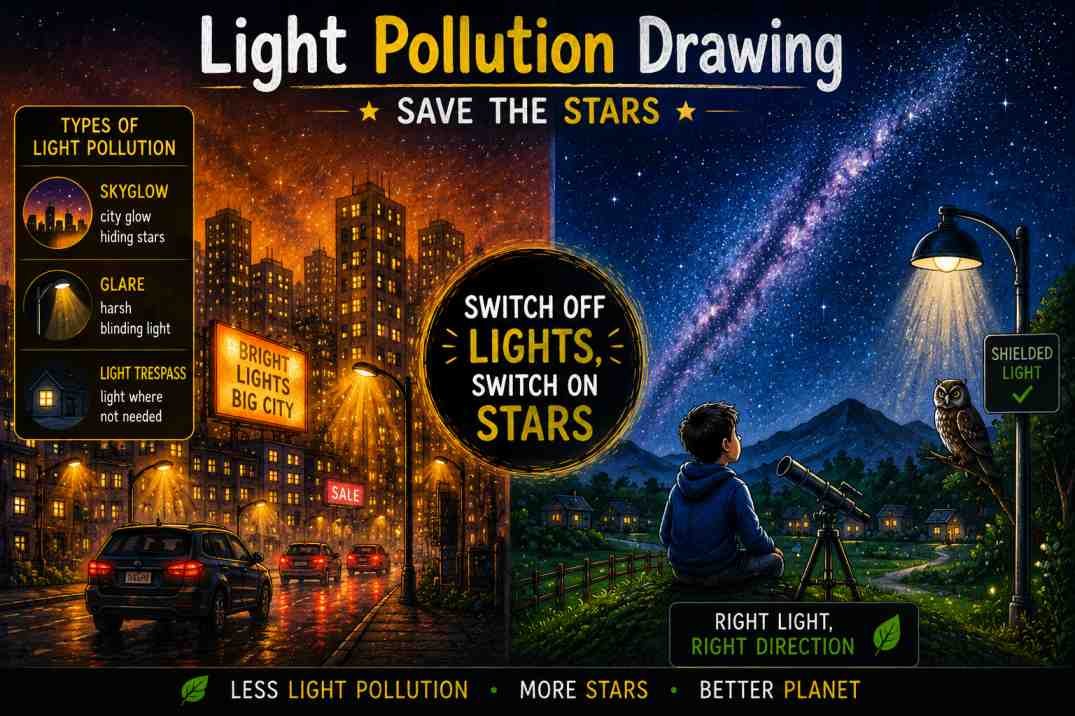
This guide includes easy light pollution drawing ideas for school projects, EVS activities, and environmental awareness competitions—from simple switch-off-light drawings to skyglow, wildlife, sleep, and shielded-lighting posters.
Quick Answer
What should a light pollution drawing show?
A good light pollution drawing should show an artificial light source, a visible effect such as skyglow, glare, or light trespass, and one clear environmental message. For an easy school project, a city-at-night scene with bright lights and fewer visible stars is a simple option.
What is Light Pollution?
Light pollution is excessive, misdirected, or unnecessary artificial light at night that brightens the sky, reduces natural darkness, and can interfere with the visibility of stars.
Planning a poster? [Download the free Planning Worksheet (PDF)] to choose your theme and plan your drawing before you start.
Main Effects of Light Pollution
- Reduces the visibility of stars and the Milky Way
- Creates skyglow, glare, and light trespass
- Can disrupt wildlife behavior and natural sleep patterns
- Can waste electricity when outdoor lighting is unnecessary or poorly directed
Light Pollution Drawing Ideas for Students
The ideas below are designed for students looking for easy light pollution drawings and school poster concepts. Each one focuses on a clear visual message that can be explained through the drawing.
Which Light Pollution Drawing Should I Choose?
| Need | Recommended Drawing | Suitable For |
|---|---|---|
| Easiest drawing | Light Switch Action | Classes 1–4 |
| Simple school poster | Urban Skyglow Contrast | Classes 3–6 |
| Wildlife theme | Sea Turtle Confusion | Classes 4–8 |
| Science/environment theme | Sleep Disruption | Classes 6–10 |
| Advanced poster | Shielded vs Unshielded Streetlights | Classes 7–10 |
Choosing a drawing: Pick the idea that matches your class level, assignment theme, and the message you want your poster to communicate.
1. Easy Light Pollution Drawing: Light Switch Action
Best for: Classes 1–4
Difficulty: Easy
Main message: Reduce unnecessary outdoor lighting
Draw a hand switching off an unnecessary outdoor light while stars gradually reappear in the night sky. This simple before-and-after concept shows how reducing unnecessary lighting helps restore natural darkness and improve the visibility of stars.
How to Draw
- Draw a hand reaching toward a switch.
- Show a bright outdoor light turning off.
- Draw stars becoming visible in the night sky.
- Add the slogan “Switch Off Lights, Save the Stars.”
Educational Message:
Reducing unnecessary lighting helps restore natural darkness and improve night-sky visibility.
2. Urban Skyglow Contrast Poster
Best for: Classes 3–6
Difficulty: Easy–Moderate
Main message: Show how urban lighting creates skyglow
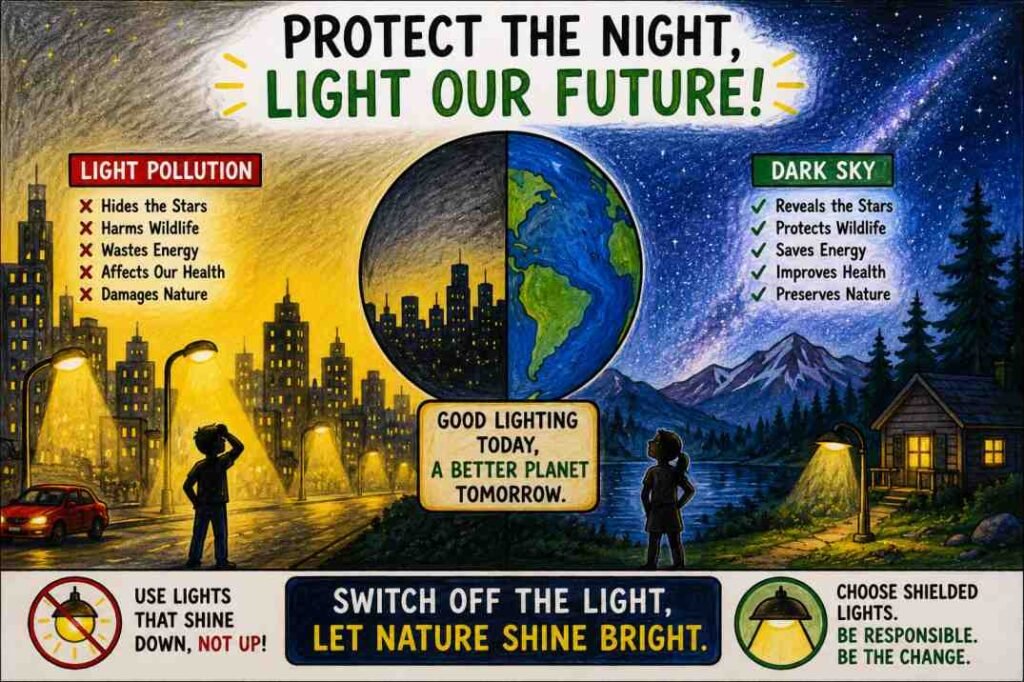
Create a split poster comparing a brightly lit city with a dark rural landscape. The city side should show skyglow and only a few visible stars, while the rural side highlights a naturally dark sky filled with stars.
How to Draw
- Divide the poster into two sides: a brightly lit city and a dark rural landscape.
- On the city side, draw buildings and artificial lights.
- Show a bright glow above the city to represent skyglow.
- Draw only a few visible stars above the brightly lit city.
- On the rural side, show a naturally dark night sky with more visible stars.
- Keep the contrast between the two sides clear so the difference in night-sky brightness is easy to see.
Educational Message: Excessive urban lighting creates skyglow, reducing the visibility of stars and the natural beauty of the night sky.
3. Sea Turtle Confusion
Best for: Classes 4–8
Difficulty: Moderate
Main message: Show how artificial light can affect wildlife
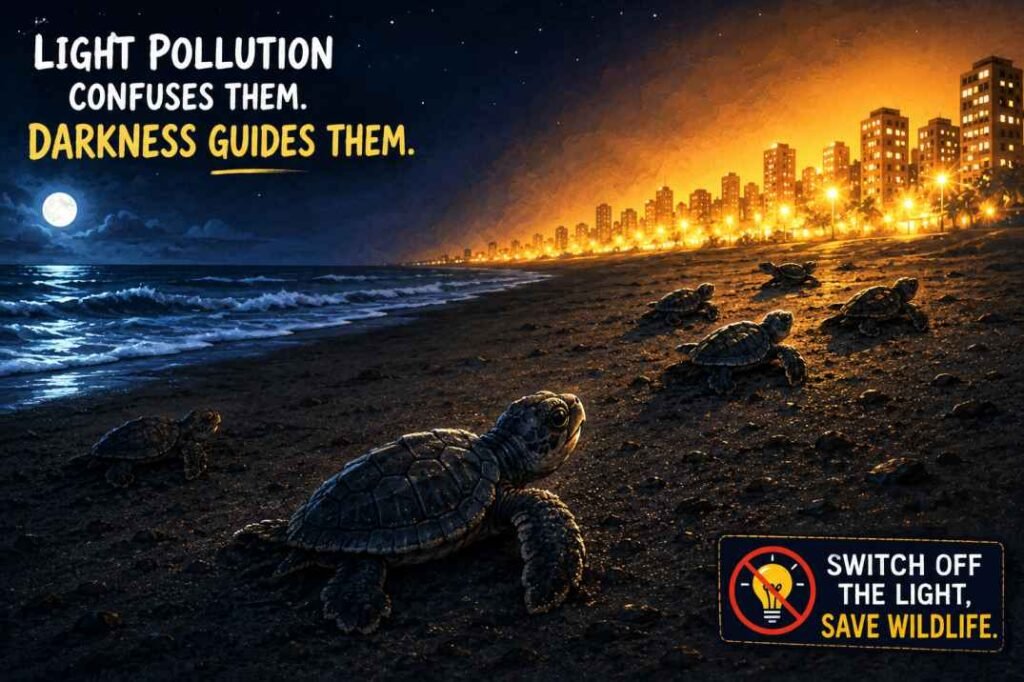
Draw baby sea turtles moving toward bright artificial lights instead of the ocean. This poster demonstrates how coastal lighting can interfere with wildlife navigation and natural behavior.
How to Draw
- Draw a beach with the ocean in the background.
- Sketch baby sea turtles moving across the sand.
- Show bright buildings or artificial lights near the beach.
- Draw the turtles moving toward the lights instead of the ocean.
- Add the slogan “Protect Wildlife from Light Pollution.”
Educational Message:
Artificial lighting near beaches can confuse baby sea turtles and disrupt their natural movement toward the ocean.
4. Sleep Disruption from Artificial Light
Best for: Classes 6–10
Difficulty: Moderate
Main message: Show how nighttime light can affect sleep
Illustrate a student trying to sleep while bright streetlight rays shine through a bedroom window. The contrast between darkness and artificial light clearly shows how nighttime lighting can interfere with healthy sleep.
How to Draw
- Draw a bedroom at night with a student trying to sleep.
- Add a window beside the bed.
- Draw bright streetlight rays entering through the window.
- Keep the rest of the room relatively dark to make the contrast with the artificial light clear.
- Show the unwanted light reaching the sleeping area.
- Add a short message explaining that nighttime artificial light can interfere with sleep.
Educational Message:
Artificial light at night can interfere with the natural light-dark cycle that helps regulate sleep.
5. Shielded vs Unshielded Streetlights
Best for: Classes 7–10
Difficulty: Moderate–Advanced
Main message: Show how directing light downward can reduce unwanted light
How to Draw
- Divide the page into two sections.
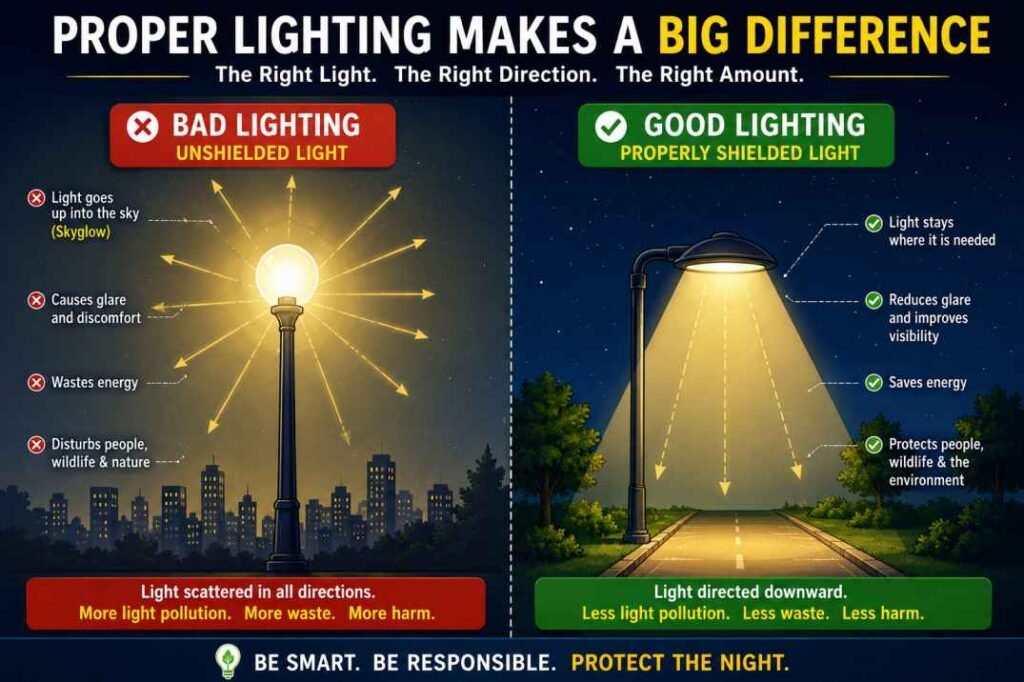
- Draw an unshielded streetlight spreading light in all directions on one side.
- Draw a shielded streetlight directing light downward on the other side.
- Show fewer stars and more skyglow around the unshielded light.
- Add the slogan “Light Where Needed, Not Everywhere.”
Educational Message:
Shielded lighting directs light toward the area where it is needed and can reduce unwanted upward and sideways light, glare, and skyglow.
What Makes a Good Light Pollution Drawing?
A strong light pollution drawing should make three things easy to identify:
- The artificial light source — such as a streetlight, floodlight, billboard, or illuminated building.
- The effect of the light — such as skyglow, glare, light trespass, reduced star visibility, or an effect on wildlife.
- The environmental message — such as reducing unnecessary lighting or directing light where it is needed.
The drawing does not need to show every effect. One clear cause-and-effect relationship is usually more effective than a crowded poster.
Class-Wise Strategy for Students
Choose a drawing topic that matches your class level and understanding of environmental science. Simpler concepts work best for younger students, while older students can explore scientific, environmental, and health-related effects of light pollution.
For younger students, choose a simple visual action or comparison; older students can use more detailed scientific concepts and labels.
| Class | Recommended Poster Idea | Awareness Focus |
|---|---|---|
| Class 1–3 | Stars, moon, and switching off lights | Understanding natural darkness and unnecessary lighting |
| Class 4–6 | Skyglow, wildlife, and city lighting | Understanding how lighting affects stars, wildlife, and the environment |
| Class 7–10 | Sleep disruption, energy waste, and shielded lighting | Exploring scientific and environmental effects |
Understanding Light Pollution
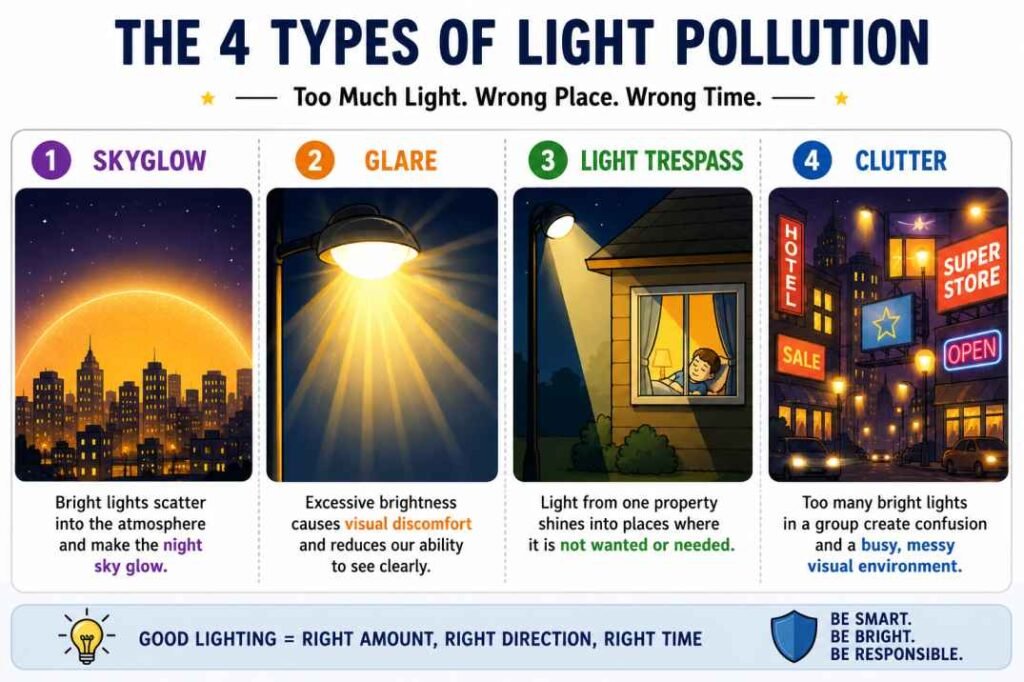
The four types of light pollution below are useful concepts for student drawings and posters. Each type can be represented with a simple real-world scene.
The 4 Types of Light Pollution
1. Skyglow
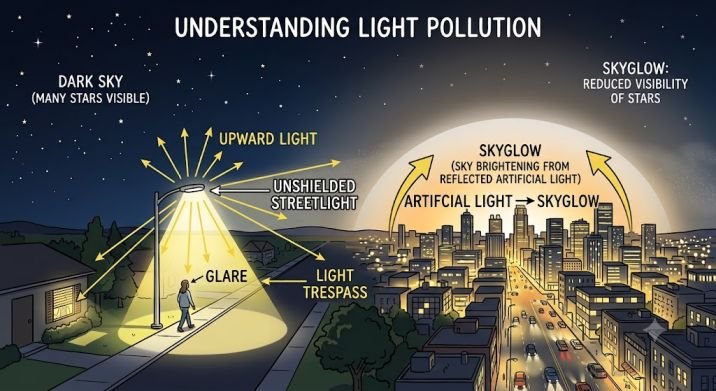
Skyglow is the orange or whitish glow visible above cities at night. It occurs when artificial light scatters through dust, water vapor, and other particles in the atmosphere, brightening the night sky and making stars difficult to see.
Drawing Idea:
Draw a bright city skyline with a yellow, orange, or white glow spreading above the buildings and only a few visible stars.
2. Glare
Glare is excessively bright light that causes visual discomfort and can temporarily reduce visibility. It is commonly produced by unshielded LED lights, vehicle headlights, and powerful outdoor floodlights.
Drawing Idea:
Draw a person covering their eyes while facing a very bright streetlight or floodlight, with strong rays showing the uncomfortable glare.
3. Light Trespass
Light trespass occurs when unwanted artificial light spills into areas where it is not needed, such as through a bedroom window or into natural wildlife habitats.
Drawing Idea:
Draw a bedroom at night with unwanted light from a nearby streetlight entering through the window and illuminating the room.
4. Clutter
Light clutter refers to a dense concentration of bright lights in one area, such as busy commercial streets, shopping districts, or advertising zones. Too many closely grouped lights can create visual confusion and increase nighttime glare.
Drawing Idea:
Draw a busy city street with several bright signboards, advertisements, shop lights, and closely grouped light sources creating a visually crowded scene.
Materials Needed for Your Drawing
- Black or dark blue chart paper
- White drawing paper
- Oil pastels, crayons, or sketch pens
- Pencil, eraser, and ruler
Plan your poster before you start drawing. Use this free 2-page worksheet to choose a theme, plan the light source and effect, and check your poster before submission.
[Download the Light Pollution Poster Planning Worksheet (PDF)]
Drawing Tip:
Use a dark background and bright colors for artificial lights to create strong contrast.
How to Draw a Light Pollution Poster
Step 1: Build the scene — Use a dark nighttime background and add the main artificial light source.
Step 2: Show the effect — Add skyglow, glare, light trespass, reduced star visibility, or another relevant effect.
Step 3: Add context — Include stars, wildlife, people, or buildings where they help explain the effect.
Step 4: Label the concept — Use terms such as “Skyglow,” “Glare,” or “Light Trespass” where appropriate.
Step 5: Add one clear message — Finish with a short environmental slogan or takeaway.
Simple Light Pollution Diagram
The labeled diagram below shows how an unshielded outdoor light can produce upward light and contribute to glare, light trespass, and skyglow. Use the diagram as a reference when labeling the light source, upward light, glare, light trespass, and skyglow in your own poster.
Looking for a broader city-level theme? See our Pollution-Free City Drawing Ideas guide.
Common Mistakes Students Should Avoid
Overcrowding the Poster
Avoid filling your poster with too many buildings, lights, slogans, and decorative elements. Focusing on one clear environmental message makes your drawing easier to understand and more visually effective.
Using Bright Backgrounds
Avoid using white or very bright backgrounds for your poster. Dark blue, purple, or black backgrounds create stronger contrast, making skyglow, stars, and artificial lighting easier to distinguish.
Missing Scientific Labels
Label important features using scientific terms such as “Skyglow,” “Glare,” “Light Trespass,” or “Clutter.” Clear labels help viewers understand the environmental concept behind your drawing.
Weak Contrast Between Dark and Bright Areas
When comparing natural darkness with brightly lit urban areas, use strong contrast so the difference is immediately visible. A clear visual comparison makes your environmental message easier to understand, even from a distance.
Ignoring Accuracy
Make sure your drawing matches real examples of light pollution. For instance, skyglow should appear above cities, while light trespass should show unwanted light entering homes or natural habitats. Accurate illustrations make your poster more educational and scientifically correct.
Light Pollution in India
In Indian cities and towns, students may encounter sources of artificial nighttime lighting such as illuminated signboards, floodlights, decorative lighting, and outdoor streetlights. These examples can be used to identify light-pollution concepts in a local setting.
Students can identify signs of light pollution by observing:
- Areas where only a few stars are visible
- Overly bright streetlights
- Artificial light entering homes at night
- Excessive decorative lighting during festivals
Using shielded lighting and reducing unnecessary outdoor illumination can help save energy and protect natural darkness.
This article provides educational information and does not represent official monitoring data or regulatory guidance.
Tips for Creating an Effective Light Pollution Poster
- Use strong contrast between dark skies and bright artificial lights.
- Focus on one clear environmental message.
- Add labels such as Skyglow, Glare, or Light Trespass where they help explain the drawing.
Common Questions About Light Pollution
Why can’t we see many stars in cities?
Bright artificial lighting creates skyglow by scattering light into the atmosphere. This brightens the night sky, making faint stars difficult to see, especially in heavily populated urban areas.
How does light pollution affect wildlife?
Artificial lighting can affect birds, insects, sea turtles, and other nocturnal animals by interfering with natural movement, migration, navigation, or other behaviors that are influenced by darkness.
What is the easiest light pollution drawing for kids?
One of the easiest ideas is to draw a bright streetlight with only a few visible stars and a child switching off the light. Add a simple slogan such as “Switch Off Lights, Save the Stars” to clearly communicate the environmental message.
What should a light pollution poster include?
A good light pollution poster should include a clear illustration of excessive artificial lighting, visible effects such as skyglow or glare, natural elements like stars or wildlife, scientific labels where appropriate, and one simple environmental message.
Simple Poster Checklist
Prefer a printable version of this checklist? [Download the Planning Worksheet (PDF)] — it includes this checklist plus a theme-planning page.
- ✓ Did I include at least one scientific term such as “Skyglow,” “Glare,” “Light Trespass,” or “Clutter”?
- ✓ Does the poster communicate one clear environmental message?
- ✓ Is the contrast between the dark sky and artificial lighting easy to see?
- ✓ Are the main elements, such as stars, streetlights, or wildlife, clearly visible?
- ✓ Does the drawing show the light source and its effect clearly?
- ✓ Are terms such as “Skyglow,” “Glare,” and “Light Trespass” used for the correct visual examples?
Conclusion
Light pollution drawings can help students explain how excessive artificial lighting affects the night sky, wildlife, sleep, and the nighttime environment. A simple poster with one clear visual message—such as skyglow, unnecessary lighting, or shielded streetlights—can make the topic easier to understand.
Using strong contrast, clear scientific labels, and a focused message can help students create a more informative light pollution poster.
Related Guides:
- Air Pollution Drawing Ideas for Students
- Causes and Types of Air Pollution
- AQI Explained for Beginners
Sources & References
GreenGlobe25 uses educational, scientific, institutional, and environmental sources to explain environmental topics.
Learn more about our source methodology: Sources & References →
The references below were used for educational background and general scientific context.
- International Dark-Sky Association (IDA) — Educational resources on skyglow, glare, shielded lighting, and light pollution awareness.
- National Park Service – Night Skies Program — Educational information about night skies, artificial lighting, and natural ecosystems.
- World Health Organization (WHO) — Information on sleep, circadian rhythms, and health effects associated with nighttime light exposure.
- Journal of Environmental Management — Peer-reviewed research on urban skyglow and artificial nighttime lighting.
- Globe at Night — Citizen-science project for observing and measuring night-sky visibility.
About the Author
Soumen Chakraborty is the Founder & Editorial Lead of GreenGlobe25. His work focuses on environmental education, air pollution, AQI systems, environmental monitoring, and public environmental data in India.
View Author Profile →