

This article focuses on how air pollution standards are defined and interpreted in India, with specific reference to CPCB National Ambient Air Quality Standards (NAAQS) and WHO Global Air Quality Guidelines (2021). The discussion is presented for institutional and educational understanding and does not evaluate policies or provide exposure-reduction guidance. It does not constitute medical advice, diagnosis, or treatment guidance.
Last Updated: March 2026
Introduction
Indian pollution standards are often discussed through numerical indicators such as particulate matter concentrations, annual averages, and Air Quality Index (AQI) values reported through monitoring platforms. These numbers are widely cited in public reporting, but the standards and institutional frameworks behind them are not always clearly understood.
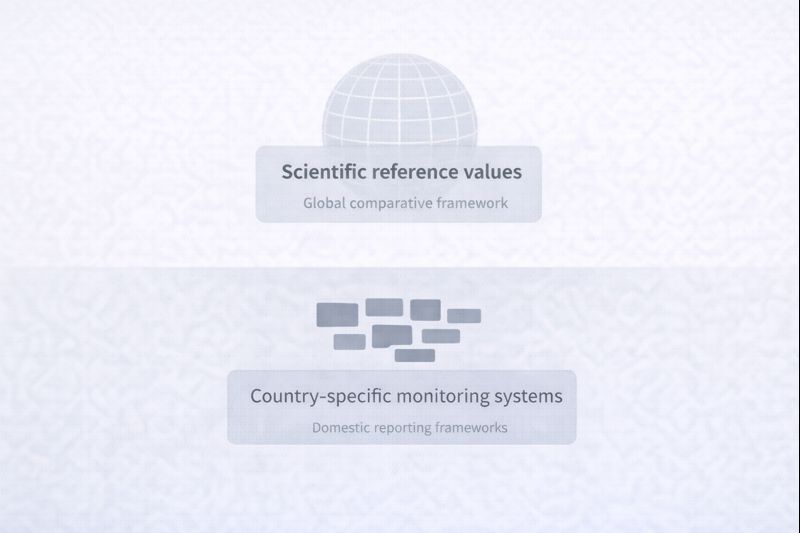
Two major reference frameworks are commonly discussed in this context: India’s Central Pollution Control Board (CPCB) standards and the World Health Organization (WHO) guideline values. CPCB standards function as national institutional benchmarks that guide monitoring and reporting within India. WHO guidelines, by contrast, are global scientific reference values developed through international evidence review and are intended for comparative understanding across regions.
This article explains how CPCB standards and WHO guidelines are structured, how they differ conceptually, and how they influence the interpretation of air pollution data reported in India, see the main air pollution overview.
Why Indian Pollution Standards Exist

Air pollution standards exist to provide a shared reference framework for describing atmospheric pollutant concentrations in a consistent and comparable way. Many air pollutants are not directly perceptible without monitoring instruments, and standards help translate measurements into defined categories that can be recorded, summarised, and communicated across time and location.
In India, air pollution standards define how pollutant concentrations are measured, averaged, and reported in official datasets. At the international level, WHO guideline values summarise evidence from scientific literature and provide global reference points for comparing air pollution indicators across countries.
Standards are therefore best understood as tools for structured interpretation rather than as guarantees of safety or direct predictions of individual health outcomes. Their values reflect scientific assessment, monitoring capability, institutional design, and reporting requirements.
CPCB Air Pollution Standards in India (NAAQS)
In India, ambient air pollution standards are defined through the National Ambient Air Quality Standards (NAAQS) framework coordinated by the Central Pollution Control Board (CPCB), a statutory body operating under the Ministry of Environment, Forest and Climate Change (MoEFCC).
CPCB standards provide institutional reference values for key ambient air pollutants such as:
- PM₂.₅
- PM₁₀
- Nitrogen dioxide (NO₂)
- Sulphur dioxide (SO₂)
- Ozone (O₃)
- Carbon monoxide (CO)
These values are expressed using standardized averaging periods such as annual averages and short-term averages. The purpose of these standards is to support consistency in monitoring and reporting across India’s diverse geographic and urban contexts.
CPCB standards also define measurement conventions, reporting categories, and aggregation rules that influence how monitoring data is organised within institutional datasets. In this way, NAAQS functions as a national framework for structured environmental reporting rather than as an isolated set of numerical limits.
How CPCB Standards Are Used in Monitoring and Reporting

CPCB air pollution standards are applied within national monitoring systems to structure how air quality data is collected, processed, and presented. Measurements recorded at monitoring stations are aggregated using defined averaging rules before being published in datasets or summarised into commonly used reporting formats.
In public reporting contexts, raw concentration data is often converted into categories or index values. This process is shaped by CPCB reference frameworks, which provide consistency in how observed pollution conditions are described.
These systems are designed to support comparability across regions and time periods rather than to provide individual-level interpretation of exposure or risk.
CPCB standards are periodically reviewed in relation to evolving scientific assessment practices, monitoring infrastructure, and data availability. Revisions typically involve changes in reporting conventions, averaging structures, or pollutant inclusion, reflecting institutional monitoring priorities.
WHO Global Air Quality Guidelines (2021) as International Reference Values
The World Health Organization publishes guideline values intended to function as global scientific reference points. WHO guideline values are derived through structured reviews of international scientific literature and summarize evidence reported in environmental and epidemiological research.
The WHO Global Air Quality Guidelines (2021) provide reference levels for major ambient air pollutants, including particulate matter and selected gaseous pollutants. These guideline values are framed as advisory reference tools and are not legally enforceable within national regulatory systems.
WHO guidelines are designed to support comparative understanding across regions and are not tailored to the monitoring frameworks, reporting conventions, or institutional structures of any single country.
Importantly, WHO guideline values are intended for population-level interpretation and are not designed for individual diagnosis, medical assessment, or personal risk prediction.
CPCB vs WHO: Understanding Differences Without Ranking
Comparisons between CPCB standards and WHO guideline values are common, but numerical differences are often interpreted without sufficient institutional context. CPCB standards and WHO guidelines are designed to serve different purposes.
CPCB standards are structured to operate within India’s domestic monitoring and reporting systems. They function as institutional reference benchmarks that support consistent description of observed pollution conditions across diverse geographic settings.
WHO guideline values, by contrast, are designed as global scientific reference points derived from international evidence synthesis. They are not embedded within national monitoring systems and do not carry institutional or legal authority within India.
Because these frameworks serve different functions, differences in numerical values do not automatically indicate that one system is more accurate, more protective, or more appropriate than the other. Differences reflect variations in institutional design, averaging conventions, monitoring context, and policy objectives.
CPCB vs WHO Standards at a Glance
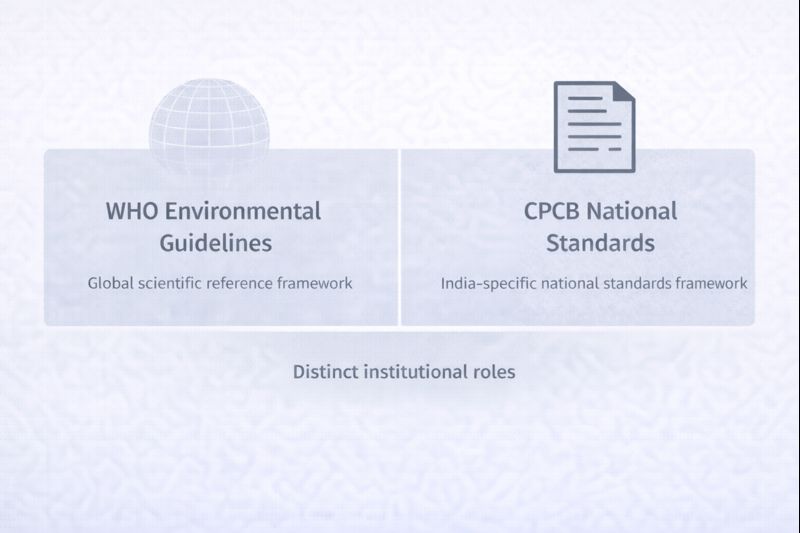
• CPCB NAAQS – National regulatory standards used for air pollution monitoring and reporting in India.
• WHO AQG – Global scientific guideline values derived from international health research.
• These frameworks serve different institutional roles, so their numerical values should not be interpreted as direct rankings of environmental quality.
Comparison of CPCB NAAQS Standards and WHO Air Quality Guidelines
The conceptual differences between the two frameworks can be summarized as follows:
| Framework | Role | Scope |
|---|---|---|
| CPCB NAAQS | National regulatory standards | India monitoring systems |
| WHO AQG | Global scientific guideline values | International reference |
Why “Stricter” vs “Looser” Comparisons Are Often Misleading
Air pollution standards are sometimes described using simplified terms such as “stricter” or “weaker,” but such comparisons can obscure important contextual factors. Numerical values alone do not capture how standards are defined or applied.
Key factors that shape differences include:
- variation in averaging periods
- monitoring coverage differences across regions
- institutional reporting conventions
- measurement and classification frameworks
- differences in the intended role of standards versus guideline values
As a result, lower or higher numerical values cannot be interpreted in isolation. Standards function within broader institutional systems that determine how air pollution data is recorded and presented.
How Standards Appear in AQI Reporting and Public Communication
Indian pollution standards are therefore most visible to the public through AQI dashboards and environmental reporting platforms. In India, air quality data recorded by monitoring stations is often converted into AQI categories before being released publicly.
This reporting process applies standardized averaging periods and pollutant categories, which are shaped by CPCB institutional reference frameworks. In parallel, international reporting sources may cite WHO guideline values to provide comparative context.
Because different frameworks may be referenced in different reporting contexts, air pollution numbers may appear inconsistent across platforms even when they originate from similar monitoring measurements. These differences reflect the use of different interpretive frameworks rather than contradictions in the underlying data.
Understanding the institutional role of standards helps interpret air pollution figures
as reporting outputs shaped by measurement and averaging conventions, rather than as absolute indicators of environmental quality.

Key Takeaways for Readers
- CPCB standards function as institutional reference frameworks that structure how air pollution data is monitored, aggregated, and reported in India.
- WHO guideline values provide global scientific reference points based on international evidence review and are advisory rather than legally enforceable.
- Differences between CPCB and WHO values reflect institutional design, averaging conventions, and reporting objectives, rather than simple rankings of “better” or “worse.”
- Air pollution figures reported through dashboards and AQI systems are shaped by the measurement and reporting conventions associated with each framework.
References
- Central Pollution Control Board (CPCB). National Ambient Air Quality Standards (NAAQS).
Official reference standards for ambient air pollution monitoring in India.
https://cpcb.nic.in/national-ambient-air-quality-standards/ - Ministry of Environment, Forest and Climate Change (MoEFCC).
Institutional oversight and environmental policy framework for pollution regulation in India.
https://moef.gov.in/ - World Health Organization (WHO). WHO Global Air Quality Guidelines (2021).
Scientific reference values for ambient air pollutants based on international assessments.
https://www.who.int/publications/i/item/9789240034228
Author Bio
Soumen Chakraborty is the founder of GreenGlobe25, an independent educational platform focused on air pollution systems and air quality research in India. His work centers on explaining pollution-related concepts, standards, and institutional frameworks using publicly available data and authoritative sources.
Content published on GreenGlobe25 is written as neutral, research-based educational explainers. It draws on materials from organizations such as the Central Pollution Control Board (CPCB), the World Health Organization (WHO), and other institutional bodies, and follows a documented fact-checking and source-attribution process. The material is descriptive in nature and does not provide professional, medical, or policy advice.
Educational Context Note: This article explains institutional and scientific frameworks for pollution measurement and reporting. It does not provide personal health, safety, or compliance advice.

- Health Effects of Air Pollution: Short-Term and Long-Term Impacts - March 24, 2026
- What AQI Numbers Mean in India (AQI Chart + Health Effects Guide) - March 22, 2026
- Emission Inventory in India: How Pollution Sources Are Measured (Complete Guide) - March 21, 2026