

What Is the National Clean Air Programme (NCAP)? (Quick Answer)
The National Clean Air Programme (NCAP) is India’s national policy framework launched in 2019 to reduce particulate matter (PM2.5 and PM10) levels in major cities. It focuses on monitoring air quality, setting reduction targets, and coordinating action across government agencies.
Introduction
The National Clean Air Programme (NCAP) is India’s national policy framework for addressing urban air pollution through coordinated monitoring, planning, and institutional cooperation. Launched by the Ministry of Environment, Forest and Climate Change in 2019, the programme aims to reduce particulate matter concentrations in selected Indian cities while strengthening air quality monitoring and data systems.
By outlining goals, monitoring systems, and observed patterns, the article aims to help readers understand NCAP as a policy mechanism within India’s broader air quality governance framework. The emphasis remains on explanation, context, and interpretation of publicly available information, without assuming certainty or uniform outcomes.
In India, many cities covered under NCAP continue to experience pollution levels above national standards, making the programme central to long-term air quality management.
For a broader understanding, see what is air pollution in India.
Key Points of NCAP
- Launched in 2019 to address urban air pollution
- Covers 100+ non-attainment cities
- Focuses on PM2.5 and PM10 reduction
- Uses monitoring data to track progress
- Targets up to 40% reduction by 2026
Background and Purpose of the National Clean Air Programme
What the National Clean Air Programme Is?
The National Clean Air Programme (NCAP) is a national framework introduced by the Government of India to address persistent urban air pollution through coordinated planning rather than isolated measures. Announced in 2019, the programme focuses on improving ambient air quality by strengthening monitoring systems, setting medium-term reduction targets, and aligning efforts across multiple levels of government. It is structured as a planning and coordination mechanism, not a regulatory law with penalties.
NCAP operates alongside existing environmental regulations, providing a common reference point for cities to assess pollution sources and track trends over time. It focuses on using data to assess pollution trends and coordinate actions across different levels of government.
Why Air Quality Became a National Policy Priority
Urban air quality emerged as a national concern due to sustained observations of high particulate matter concentrations across many Indian cities. Publicly available monitoring data from national agencies indicated that several cities consistently exceeded national ambient air quality standards for PM₂.₅ and PM₁₀. These indicators are used because they are widely monitored and internationally comparable, not because they capture every dimension of air pollution exposure.
From a policy perspective, the issue was framed around air quality governance framework, urban sustainability, and regulatory capacity. NCAP reflects an administrative response to long-term trends rather than a reaction to short-term pollution events.
Scope and Cities Covered
NCAP initially covered over 100 “non-attainment cities,” a term used for urban areas that did not meet national air quality standards over a defined assessment period. City selection was based on historical monitoring data, not population size or economic importance. This approach placed emphasis on measurable air quality performance rather than perception or visibility.
Timeline of the National Clean Air Programme
| Year | Development |
|---|---|
| 2019 | NCAP launched |
| 2019–2020 | 100+ cities identified |
| 2022 | 40% reduction target added |
| Ongoing | Monitoring expansion |
The development of the National Clean Air Programme has occurred through several stages since its launch.
Stated Goals, Targets, and Design of NCAP
Official Objectives and Reduction Targets
NCAP set a national target to reduce average concentrations of PM₂.₅ and PM₁₀ by a specified percentage compared to baseline levels, within a defined time frame. These targets were framed as indicative goals intended to guide planning and evaluation. Official documents note that outcomes depend on multiple variables, including meteorology, emission sources, and local implementation capacity.
Importantly, the targets are expressed at an aggregate level. They do not guarantee uniform improvement across all participating cities, nor do they function as legally binding commitments for individual urban areas.
Institutional Structure and Coordination
Overall policy direction is provided by the Ministry of Environment, Forest and Climate Change, while technical oversight and data management are supported by the Central Pollution Control Board. State Pollution Control Boards and urban local bodies are responsible for city-level planning and execution.
This multi-tiered structure reflects the shared nature of air quality governance in India. NCAP’s role is to align these institutions around common metrics and reporting formats rather than replace existing authorities.
Funding, Planning, and Implementation Framework
Participating cities are required to prepare City Action Plans (CAPs) outlining pollution sources, proposed interventions, and monitoring approaches. Central financial assistance is provided to support monitoring infrastructure and planning activities, while states and cities contribute additional resources. Variation in administrative capacity means that implementation depth differs significantly between locations.
Monitoring, Measurement, and Data Systems Under NCAP
How Air Quality Is Measured
NCAP relies on India’s existing air quality monitoring infrastructure, including manual stations under the National Air Quality Monitoring Programme and automated Continuous Ambient Air Quality Monitoring Stations, which are operated by central and state agencies and reported through the Central Pollution Control Board (CPCB). These systems track pollutants such as PM₂.₅, PM₁₀, nitrogen dioxide, and sulfur dioxide at fixed locations.
Among these, fine particulate matter (PM2.5) is a key indicator of health-related air pollution and is explained in detail in PM2.5 explained in India.
These monitoring systems form the primary evidence base used by policymakers to evaluate whether particulate matter concentrations are increasing, stabilising, or declining over multi-year periods.
To understand how air quality data is reported publicly, see AQI explained in India.
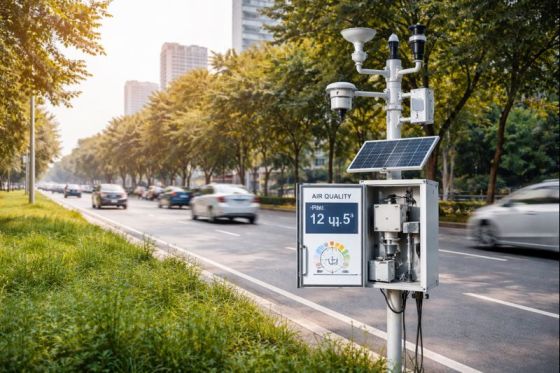
Data from these stations are used to calculate annual and seasonal averages, which form the basis for trend analysis. Monitoring density varies by city, influencing how representative the data may be of overall urban conditions.
Indicators Used to Assess Progress
Particulate matter concentrations are the primary indicators for NCAP evaluation, consistent with CPCB monitoring protocols and international air quality assessment practices. Progress is generally assessed by comparing multi-year averages rather than single-year values, reducing the influence of short-term fluctuations.
This method supports broad trend assessment but does not capture localized variations within cities. As a result, reported improvement at the city level may coexist with persistent hotspots.
Data Gaps and Interpretation Challenges
Differences in baseline years, changes in monitoring locations, and expansion of monitoring networks can complicate direct comparisons over time. In some cities, improved monitoring coverage has led to higher reported pollution levels, reflecting better measurement rather than deterioration. NCAP documentation acknowledges these limitations and treats results as indicative rather than definitive.

Reported changes discussed below are drawn from official monitoring summaries and should not be interpreted as causal attribution to NCAP interventions alone.
Observed Outcomes, City Examples, and Mixed Results
Aggregate Trends Observed Since Implementation
National summaries published in official progress reports indicate that some cities have recorded declines in average particulate matter concentrations over multi-year periods, while others show limited or inconsistent change. These patterns are presented as observations rather than causal outcomes attributable solely to NCAP.
These aggregate trends are reported as observations over time and are not presented as definitive evidence of programme-level causation.
Weather variability, economic activity, and external events can influence annual averages, which is why trends are interpreted cautiously in official assessments.
City-Level Examples (Illustrative, Not Comparative)
Cities with denser monitoring networks, such as large metropolitan regions, tend to show more detailed trend data. In contrast, smaller cities often rely on fewer stations, making trend interpretation more sensitive to local conditions. NCAP treats these examples as illustrative cases rather than performance rankings.
Example: Variation Across Cities
For example, cities with more extensive monitoring networks—such as large metropolitan regions—often show clearer long-term trends in particulate matter levels because data is collected from multiple locations.
In contrast, cities with fewer monitoring stations may show more variable or less consistent trends, as limited data points can be influenced by local conditions.
For instance, in Delhi, continuous monitoring across multiple stations provides detailed information on seasonal pollution patterns, including winter spikes in PM2.5 levels. This allows trends to be interpreted more clearly compared to cities with sparse monitoring coverage.
This illustrates how differences in monitoring infrastructure can influence how NCAP progress is assessed across cities.
Why Results Vary Across Locations
Variation arises from differences in emission profiles, geography, climate, and administrative capacity. Industrial structure, transport patterns, and construction activity all affect pollution levels differently across cities. NCAP documentation emphasizes correlation and contextual interpretation, avoiding single-factor explanations.
Such variation reflects differences in administrative capacity, monitoring density, and local context rather than uniform policy outcomes across all cities.
What Do NCAP Results Mean?
NCAP results are reported as trends rather than direct outcomes of policy actions. Some cities show improvements in particulate matter levels, while others show limited or inconsistent change.
This variation means:
- Air pollution trends depend on multiple factors, not just policy
- Improvements may reflect weather, economic activity, or monitoring changes
- NCAP helps track patterns rather than guarantee outcomes
Interpretation, Limitations, and Policy Context
How Policymakers Interpret NCAP Outcomes
NCAP progress reports are used to review planning assumptions and identify areas where monitoring or coordination can be improved. Adjustments to timelines and targets over time reflect learning rather than failure, acknowledging the complexity of air quality management.
Structural Constraints and Long-Term Nature
Air quality improvement is widely described in policy literature as a cumulative process. NCAP frames progress in terms of sustained monitoring and institutional strengthening rather than short-term outcomes.
NCAP Within India’s Broader Environmental Policy Landscape
NCAP operates alongside other national and urban governance programmes that influence air quality monitoring, emissions reporting, and environmental planning. Its primary function is to provide a common analytical and reporting framework, positioning air quality as a measurable component of long-term environmental governance rather than a standalone issue.
These adjacent policy areas are referenced only to situate NCAP institutionally and are not examined here as solutions or interventions.
Why the National Clean Air Programme Matters
The National Clean Air Programme is significant because it provides India with a coordinated framework for understanding and managing urban over long time periods. By expanding monitoring networks and encouraging city-level planning, the programme improves the availability of comparable air quality data across regions.
Although air pollution outcomes depend on many factors—including weather patterns, emission sources, and economic activity—NCAP helps policymakers and researchers identify long-term trends in particulate matter concentrations. This data-driven approach allows cities to better understand pollution sources and develop more informed strategies for improving urban air quality.
For health implications, see health effects of air pollution in India.
Conclusion
The National Clean Air Programme is India’s primary national framework for monitoring and addressing urban air pollution through coordinated planning, expanded data systems, and city-level implementation. It brings together monitoring networks, city action plans, and national reporting under a shared structure, helping create a more consistent approach to understanding air quality across regions.
Rather than acting as a single solution, NCAP functions as a coordination and measurement system. It supports long-term assessment of pollution trends while recognising that outcomes depend on multiple factors such as weather conditions, emission sources, and local implementation capacity.
Across cities, results may vary due to differences in monitoring coverage, administrative capacity, and environmental conditions. For this reason, NCAP findings are interpreted as trends over time rather than direct outcomes of specific interventions.
In practical terms, NCAP helps India track long-term air pollution trends and improve how air quality data is collected and compared across cities. While results vary depending on local conditions, the programme provides a structured way to understand how air quality is changing over time.
Frequently Asked Questions
What is the National Clean Air Programme (NCAP)?
The National Clean Air Programme is a Government of India initiative launched in 2019 to improve urban air quality by reducing particulate matter concentrations in selected cities while strengthening monitoring and planning systems.
How many cities are included in NCAP?
The programme initially identified more than 100 “non-attainment cities,” defined as cities that consistently exceeded national ambient air quality standards over a defined monitoring period.
Which pollutants does NCAP focus on?
NCAP primarily focuses on particulate matter pollutants, especially PM₂.₅ and PM₁₀, because these pollutants are widely monitored and are strongly associated with urban air pollution exposure.
Does NCAP guarantee pollution reduction?
NCAP sets indicative reduction targets, but outcomes vary across cities because pollution levels are influenced by multiple environmental and economic factors.
References
- Ministry of Environment, Forest and Climate Change (MoEFCC), Government of India. (2019). National Clean Air Programme (NCAP).
- Central Pollution Control Board (CPCB), Government of India. National Air Quality Monitoring Programme (NAMP): Guidelines and Methodology.
- Central Pollution Control Board (CPCB), Government of India. (n.d.). Continuous Ambient Air Quality Monitoring Stations (CAAQMS): Technical Documentation.
- Central Pollution Control Board (CPCB), Government of India. National Air Quality Index (AQI): Technical Framework.
- NITI Aayog, Government of India. (n.d.). Reports and publications related to air quality governance and urban environmental management.
- World Health Organization (WHO). (2021). WHO Global Air Quality Guidelines. Geneva: WHO.

His work focuses specifically on India’s CPCB monitoring systems and real-world pollution exposure. He simplifies complex air quality science for Indian households and policy understanding.