

NCAP stands for National Clean Air Programme, a Government of India initiative launched in 2019 to improve urban air quality and strengthen pollution monitoring systems across Indian cities.
Introduction
The National Clean Air Programme (NCAP) is India’s national framework for monitoring and reducing urban air pollution. Launched in 2019, the programme focuses mainly on PM2.5 and PM10 pollution in cities that regularly exceed national air quality standards.
Instead of functioning as a single pollution-control law, NCAP supports sustained air quality management through monitoring systems, pollution data collection, and city-level action plans. It also helps authorities track pollution trends across different regions of India.
This article explains how NCAP works, why non-attainment cities were identified, and how air quality monitoring systems are used to track pollution trends across Indian cities.
What You Will Learn in This Article
This article explains:
- what NCAP means,
- why non-attainment cities were identified,
- how PM2.5 and PM10 pollution are monitored,
- how air quality monitoring stations work,
- and why pollution levels vary across Indian cities.
Key Points of NCAP
- NCAP was launched in 2019 to address urban air pollution in India.
- The programme mainly tracks PM2.5 and PM10 pollution.
- It covers more than 100 non-attainment cities.
- NCAP uses monitoring data to study pollution changes over multiple years.
- Cities prepare City Action Plans (CAPs) under the programme.
- Monitoring systems such as CAAQMS help track pollution levels across cities.
The sections below explain how NCAP uses air quality monitoring stations and pollution data to assess urban air quality across Indian cities.
Background and Purpose of the National Clean Air Programme
What Is the National Clean Air Programme?
The National Clean Air Programme (NCAP) was launched in 2019 to help Indian cities better monitor and manage urban air pollution over multiple years.
The programme mainly focuses on PM2.5 and PM10 particulate pollution in cities where air quality levels regularly exceed national standards.
NCAP does not work as a single pollution-control law. Instead, it acts as a national system for:
- monitoring pollution trends,
- improving air quality data collection,
- expanding monitoring infrastructure,
- and supporting city-level pollution planning.
The programme also helps government agencies monitor and report air quality data more consistently across India.
Why Air Quality Became a National Policy Priority
Air pollution became a major concern because many Indian cities continued to record PM2.5 and PM10 levels above national air quality standards over several years.
Monitoring data from the Central Pollution Control Board (CPCB) showed that pollution was affecting both large metropolitan areas and smaller urban regions. Traffic emissions, industrial activity, construction dust, and seasonal weather conditions all contributed to rising particulate pollution levels.
As air quality monitoring expanded across India, the government introduced NCAP to help cities track pollution trends more consistently and prepare sustained air quality action plans.
What Is a Non-Attainment City?
A non-attainment city is a city where pollution levels remain above India’s National Ambient Air Quality Standards (NAAQS) over multiple years of monitoring.
These cities are identified using air quality data collected from monitoring stations. The classification is based on measured pollution levels rather than population size or economic importance.
Under NCAP, non-attainment cities receive additional attention for pollution monitoring, reporting, and city-level planning.
Timeline of the National Clean Air Programme
| Year | Development |
|---|---|
| 2019 | NCAP launched by the Government of India |
| 2019–2020 | Non-attainment cities identified using monitoring data |
| 2022 | Pollution reduction target expanded to up to 40% by 2026 |
| Ongoing | Expansion of monitoring stations and city-level reporting systems |
Stated Goals and Targets of NCAP
The main goal of the National Clean Air Programme (NCAP) is to reduce particulate air pollution in Indian cities, especially PM2.5 and PM10.
The programme introduced pollution reduction targets based on multi-year monitoring data collected from participating cities. In 2022, NCAP expanded its target to support up to a 40% reduction in particulate pollution levels by 2026 compared to earlier baseline years.
Instead of using a single nationwide solution, NCAP allows cities to prepare City Action Plans (CAPs) based on local pollution sources and monitoring data. These plans may include:
- pollution monitoring expansion,
- traffic and road dust management,
- industrial emission control,
- and construction dust reduction measures.
NCAP mainly uses monitoring data to compare PM2.5 and PM10 levels across participating cities over multiple years.
Monitoring, Measurement, and Data Systems Under NCAP
How Air Quality Is Measured Under NCAP
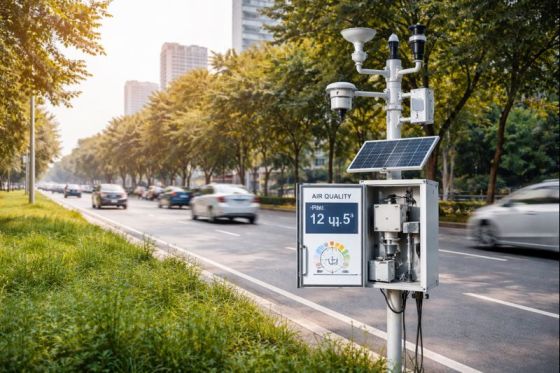
NCAP uses air quality monitoring stations to measure pollutants such as PM2.5, PM10, nitrogen dioxide (NO₂), and sulfur dioxide (SO₂).
Most pollution data comes from:
- National Air Quality Monitoring Programme (NAMP) stations,
- and Continuous Ambient Air Quality Monitoring Stations (CAAQMS).
These monitoring systems are operated by agencies such as the Central Pollution Control Board (CPCB) and State Pollution Control Boards (SPCBs).
Among all pollutants, PM2.5 is one of the most important indicators because fine particles can remain suspended in the air for long periods and are strongly associated with urban air pollution exposure.
To understand how air quality data is reported publicly, see AQI explained in India.
Manual vs Continuous Air Quality Monitoring
| Monitoring Type | How It Works | Example |
|---|---|---|
| Manual Monitoring | Pollution samples are collected periodically and analysed later | NAMP stations |
| Continuous Monitoring | Pollution levels are measured in real time using automated systems | CAAQMS stations |
Continuous monitoring systems are important because they provide faster and more detailed pollution data across cities.
Indicators Used to Assess Progress
NCAP mainly uses PM2.5 and PM10 data to assess air pollution levels across cities over time.
Instead of focusing on short-term daily changes, pollution levels are usually compared over multiple years. This helps authorities identify whether particulate pollution levels are improving, remaining stable, or continuing to exceed national air quality standards.
Monitoring data also helps compare pollution patterns between different cities and identify areas with consistently high pollution levels.
Data Gaps and Interpretation Challenges
Air quality data can vary across cities because monitoring coverage, weather conditions, and pollution sources are different in each region.
Cities with more monitoring stations usually provide more detailed pollution data than cities with limited monitoring coverage.
In some cases, pollution levels may appear higher after monitoring networks expand because more areas are being measured.

Observed Outcomes, City Examples, and Mixed Results
Aggregate Trends Observed Since Implementation
Official monitoring reports show that some NCAP cities have recorded declines in PM2.5 and PM10 levels over multiple years, while other cities continue to experience high pollution levels or inconsistent improvement.
Pollution trends may vary due to factors such as traffic emissions, industrial activity, weather conditions, and differences in monitoring coverage.
City-Level Examples
Large metropolitan cities usually have more monitoring stations, which helps produce more detailed air quality data.
Cities with fewer monitoring stations may show less consistent pollution trends because fewer locations are being measured across the city.
For example, large cities such as Delhi usually show more detailed seasonal PM2.5 patterns because they have denser monitoring networks than many smaller cities.
What Do NCAP Results Mean?
NCAP results help authorities study air pollution patterns and compare PM2.5 and PM10 levels across cities over time.
Some cities have shown improvement in particulate pollution levels, while others continue to experience high pollution levels or inconsistent trends. These differences are influenced by factors such as traffic emissions, industrial activity, weather conditions, and monitoring coverage.
The results also show why air quality monitoring systems are important for understanding how pollution levels change across different regions of India.
Understanding NCAP Results
How Policymakers Interpret NCAP Outcomes
NCAP monitoring data is used to review pollution trends, identify areas with persistent air quality problems, and improve city-level planning.
The programme also helps authorities expand monitoring systems and compare pollution data across different cities more consistently.
Why Air Pollution Improvement Takes Time
Air pollution levels are influenced by many factors, including traffic emissions, industrial activity, construction dust, weather conditions, and seasonal changes.
Because of this, pollution improvement usually happens gradually over multiple years rather than through short-term changes alone.
NCAP Within India’s Air Quality System
NCAP works alongside India’s air quality monitoring systems, pollution standards, and city-level environmental planning programmes.
Together, these systems help authorities compare pollution data, expand monitoring coverage, and improve urban air quality management.
Why the National Clean Air Programme Matters
NCAP is important because it helps India monitor and compare urban air pollution levels across different cities using standardized air quality data.
The programme helps cities expand monitoring systems, improve pollution reporting, and prepare air quality management plans based on local pollution conditions.
By strengthening air quality monitoring systems, NCAP also helps researchers and policymakers better understand how PM2.5 and PM10 pollution levels change over time.
For health implications, see health effects of air pollution in India.
Conclusion
The National Clean Air Programme (NCAP) helps India monitor urban air pollution through air quality monitoring stations, pollution data systems, and city-level action plans.
The programme plays an important role in tracking PM2.5 and PM10 levels across different cities and improving how air quality data is collected and compared over time.
As monitoring networks continue to expand, NCAP also helps improve understanding of how air pollution levels vary across different regions of India.
Frequently Asked Questions
What is the National Clean Air Programme (NCAP)?
NCAP is a Government of India programme launched in 2019 to monitor and reduce urban air pollution, especially PM2.5 and PM10 pollution in non-attainment cities.
How many cities are included in NCAP?
NCAP initially identified more than 100 non-attainment cities where pollution levels regularly exceeded national air quality standards.
What is a non-attainment city?
A non-attainment city is a city where air pollution levels remain above India’s National Ambient Air Quality Standards (NAAQS) over multiple years of monitoring.
Which pollutants does NCAP focus on?
NCAP mainly focuses on particulate pollutants such as PM2.5 and PM10 because these pollutants are widely monitored across Indian cities.
How does NCAP measure air pollution?
NCAP uses monitoring systems such as NAMP stations and Continuous Ambient Air Quality Monitoring Stations (CAAQMS) to track pollution levels across cities.
Does NCAP guarantee pollution reduction?
NCAP sets pollution reduction targets, but results may vary across cities because pollution levels are influenced by traffic emissions, industries, weather conditions, and monitoring coverage.
References
- Ministry of Environment, Forest and Climate Change (MoEFCC), Government of India. (2019). National Clean Air Programme (NCAP).
- Central Pollution Control Board (CPCB), Government of India. National Air Quality Monitoring Programme (NAMP): Guidelines and Methodology.
- Central Pollution Control Board (CPCB), Government of India. (n.d.). Continuous Ambient Air Quality Monitoring Stations (CAAQMS): Technical Documentation.
- Central Pollution Control Board (CPCB), Government of India. National Air Quality Index (AQI): Technical Framework.
- NITI Aayog, Government of India. (n.d.). Reports and publications related to air quality governance and urban environmental management.
- World Health Organization (WHO). (2021). WHO Global Air Quality Guidelines. Geneva: WHO.