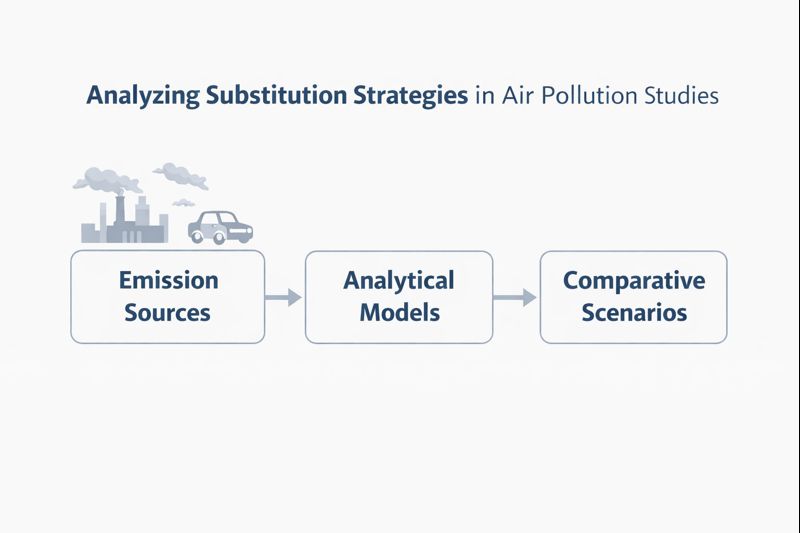
Conceptual framework illustrating substitution strategies examined in air pollution research

Substitution Strategies Examined in Air Pollution Research

This educational explainer reviews how substitution strategies are examined in air pollution research, focusing on analytical frameworks rather than implementation guidance.

Introduction

Substitution is a concept frequently examined in air pollution research to understand how changes in energy sources, technologies, materials, or processes may influence emission patterns. Rather than prescribing actions, environmental studies use substitution as an analytical lens to compare emission outcomes across different scenarios. This approach helps researchers assess how air pollutant levels might vary under alternative system configurations while accounting for economic, technological, and infrastructural constraints.

In the context of air pollution, substitution research is commonly applied in emissions modeling, life-cycle assessment, and policy evaluation studies. Researchers may compare energy systems, industrial processes, or transportation technologies to examine differences in pollutant intensity, distribution, and temporal trends. These analyses are typically conducted using hypothetical or scenario-based frameworks, allowing findings to be interpreted as indicative rather than predictive.

For a broader conceptual classification of atmospheric contaminants discussed in environmental studies, see types of air pollution.

This educational explainer examines how substitution strategies are studied within air pollution research literature. It focuses on the conceptual foundations, methodological approaches, and interpretive limits associated with substitution analysis. The purpose is to clarify how researchers structure and evaluate substitution scenarios, not to recommend specific technologies or behaviors. By outlining how substitution is examined in academic and institutional research, the article supports a clearer understanding of air pollution assessment methods for students, educators, and general readers.
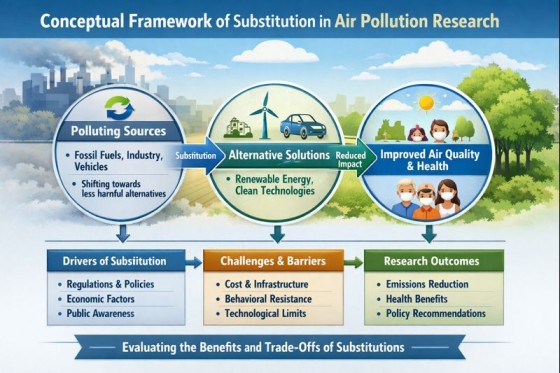
Conceptual framework illustrating air pollution substitution research methods
Substitution as a comparative research framework in air pollution studies

Scope and Methodological Context
This article synthesizes concepts commonly discussed in peer-reviewed air pollution research, including emissions modeling, scenario analysis, and life-cycle assessment. The discussion does not present new empirical findings but draws on secondary literature to explain how substitution is conceptualized and analyzed across studies. Interpretations are descriptive and illustrative, reflecting prevailing academic approaches rather than policy prescriptions.

Understanding Substitution in Air Pollution Research

What “Substitution” Means in Environmental Research

In air pollution research, substitution refers to the analytical comparison of alternative systems, inputs, or processes to evaluate differences in emission characteristics. Rather than implying replacement in practice, the term is used to frame hypothetical scenarios that help researchers understand how pollutant levels might change under different conditions. Substitution is therefore a methodological construct, not an operational directive.

Environmental studies commonly distinguish substitution from mitigation or intervention. While mitigation focuses on reducing emissions within an existing system, substitution analysis compares one system configuration against another. This distinction allows researchers to examine structural differences in emission intensity, pollutant composition, and spatial distribution without prescribing real-world adoption.

Why Researchers Study Substitution in Air Pollution

Substitution is studied because air pollution arises from interconnected systems such as energy production, transport, manufacturing, and household fuel use. Evaluating emissions solely at the point of release often provides an incomplete picture. Substitution analysis enables researchers to explore how broader system changes may influence overall pollution profiles.

In academic literature, substitution is frequently used in scenario modeling, comparative assessments, and policy impact studies. Researchers may examine how emissions differ when energy inputs, technologies, or materials vary, while holding other factors constant. This approach supports a more comprehensive understanding of emission drivers and system-level interactions.

Distinction Between Research Analysis and Real-World Action

It is important to distinguish between analytical substitution and practical decision-making. Research studies typically frame substitution as a theoretical comparison, often using assumptions and boundary conditions that simplify complex realities. Findings are therefore context-dependent and not intended as universal solutions.

Educational explanations of substitution emphasize this research-distance perspective. By maintaining neutral language and avoiding directive phrasing, such explainers clarify how substitution functions as a tool for understanding air pollution dynamics rather than as guidance for individual or institutional action.

Typologies of Substitution in Air Pollution Literature
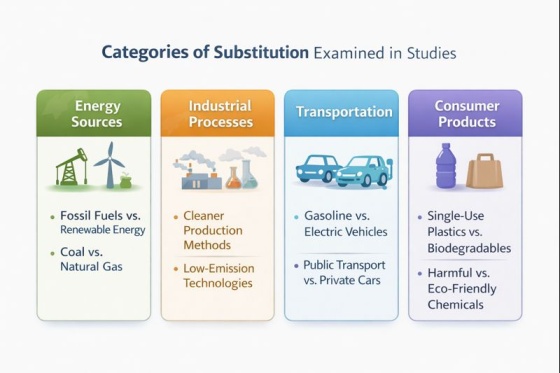
Diagram illustrating energy, technology, and material substitution in air pollution research
Major substitution categories examined in academic air pollution literature

Energy Source Substitution

Energy-related substitution is a prominent area in air pollution research. Studies often compare emissions associated with different energy sources to examine variations in pollutant output. These comparisons may consider electricity generation, industrial energy use, or household energy consumption, depending on the research scope.

Researchers typically analyze emission intensity per unit of energy produced, rather than absolute emissions alone. This allows comparisons across systems of differing scale. Such studies may be global in scope or focused on specific national contexts, with findings interpreted within clearly defined boundaries.

Technology and Process Substitution

Technology substitution studies examine how alternative processes or equipment influence emission profiles. In industrial research, this may involve comparing production methods with differing combustion characteristics or material flows. In transportation studies, substitution analysis may compare propulsion technologies or vehicle categories to assess differences in pollutant composition.

These analyses frequently rely on life-cycle assessment frameworks, which account for emissions across production, operation, and disposal phases. By using standardized assessment methods, researchers aim to improve comparability across studies while acknowledging uncertainty in underlying data.

Material and Input Substitution

Material substitution research explores how changes in raw materials or inputs affect emissions generated during manufacturing or construction. Studies may assess differences in particulate matter formation, gaseous emissions, or secondary pollutant formation associated with alternative materials.

Such analyses often highlight trade-offs rather than definitive outcomes. Researchers note that emission reductions in one stage may coincide with increases elsewhere in the system. As a result, material substitution studies emphasize system-wide evaluation rather than isolated comparisons.

How Substitution Effects Are Measured and Compared

Emissions Indicators Used in Substitution Studies
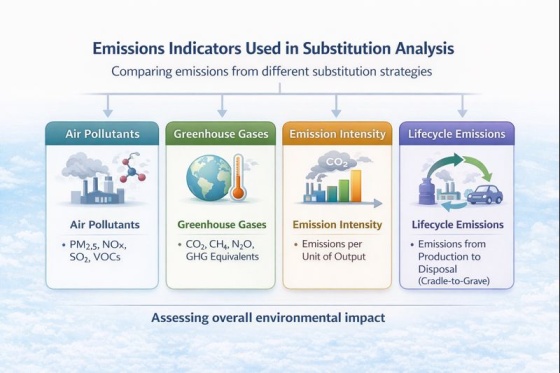
Chart showing common air pollution indicators used in substitution studies
Indicators commonly used to compare emissions across substitution scenarios

Air pollution substitution research relies on specific indicators to compare emission outcomes. Commonly examined pollutants include particulate matter, nitrogen oxides, sulfur dioxide, and selected greenhouse gases used as proxies for broader emission patterns. Studies may report emissions per unit of output, per capita, or per geographic area.

Indicator selection depends on study objectives and data availability. Researchers typically avoid single-metric conclusions, instead presenting multiple indicators to capture different dimensions of air pollution.

Modeling and Scenario-Based Analysis
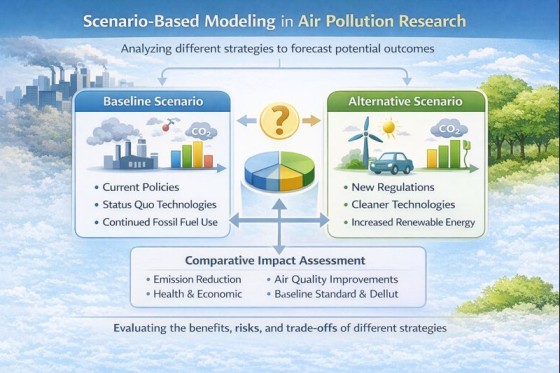
Illustration of baseline and alternative scenarios in air pollution modeling
Scenario-based comparison used in substitution research

Many substitution studies employ modeling techniques to simulate alternative scenarios. These models compare baseline conditions with hypothetical configurations to estimate relative emission differences. Integrated assessment models and sector-specific simulation tools are commonly used for this purpose.

Results from such models are interpreted as indicative trends rather than precise forecasts. Variability in assumptions, input data, and system boundaries can lead to differing outcomes across studies, reinforcing the importance of cautious interpretation.

Data Sources and Monitoring Constraints
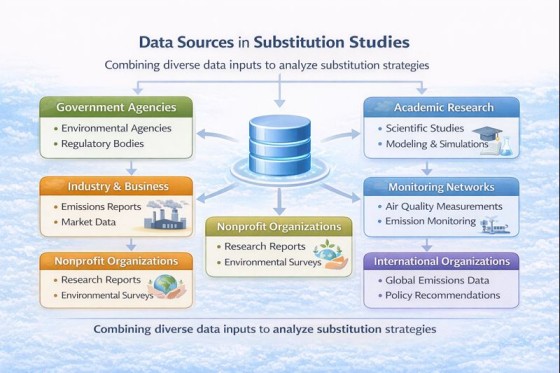
Diagram of national inventories and international databases used in air pollution research
Typical data sources informing substitution analysis

Substitution analysis often draws on national emission inventories, international databases, and peer-reviewed datasets. While air quality monitoring provides observed data, substitution studies frequently extend beyond observed conditions by incorporating modeled estimates.

Researchers explicitly document data limitations and uncertainties. Educational discussions of substitution therefore emphasize transparency in methods and acknowledge gaps in monitoring coverage, particularly in regions with limited long-term datasets.

Interpretation Limits and Research Uncertainty

Why Substitution Outcomes Are Context-Dependent

Substitution outcomes vary widely depending on geographic, economic, and infrastructural contexts. Factors such as energy mix, urban density, regulatory frameworks, and technological maturity influence emission patterns. As a result, findings from one context may not translate directly to another.

This discussion is descriptive rather than normative, aiming to explain how substitution is analyzed in air pollution research without endorsing specific technologies, policies, or implementation choices.

Temporal factors also affect interpretation. Short-term analyses may differ significantly from long-term assessments, particularly when system transitions are gradual. Researchers therefore frame conclusions within specific temporal and spatial scopes.

Some substitution assessments also acknowledge cross-media interactions, which are conceptually examined in classifications such as types of water pollution.
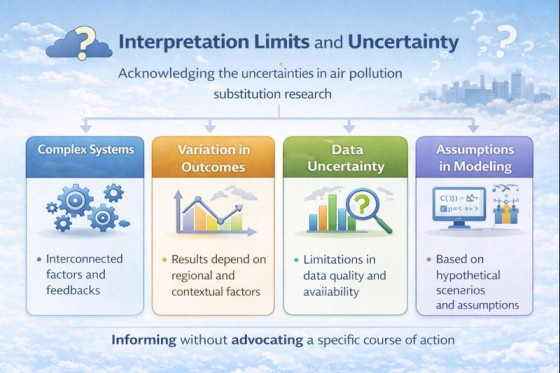
Diagram showing uncertainty and context dependence in substitution outcomes
Why substitution results vary across contexts

Avoiding Overgeneralization in Educational Content

Academic literature consistently cautions against overgeneralizing substitution findings. Educational explainers reflect this caution by presenting substitution as a comparative research approach rather than a definitive pathway.

By highlighting uncertainty, methodological assumptions, and context specificity, purely educational content supports informed interpretation without implying certainty or recommendation. This approach aligns with institutional research standards and reinforces the explanatory purpose of substitution analysis.

CONCLUSION

Substitution is examined in air pollution research as an analytical method for comparing emission patterns across alternative systems, technologies, or inputs. Rather than offering prescriptive guidance, substitution studies use hypothetical and scenario-based frameworks to explore how pollutant levels may vary under different structural conditions. This approach allows researchers to move beyond point-source analysis and consider broader system interactions that influence air quality.

The discussion in this explainer has shown that substitution research is applied across multiple domains, including energy systems, industrial processes, transportation technologies, and material inputs. Each category relies on specific indicators, modeling techniques, and data sources, with findings interpreted within clearly defined spatial and temporal boundaries. Differences in assumptions, data availability, and contextual factors contribute to variation across studies.

By emphasizing methodological foundations and interpretive limits, this article has framed substitution as a research tool rather than a solution framework. Understanding how substitution is studied helps readers interpret environmental assessments more accurately and recognize the uncertainty inherent in comparative pollution analysis. Such an educational perspective supports informed learning and critical evaluation of air pollution research without extending into advice or recommendations.

References

About the Author

This article is part of GreenGlobe25’s educational explainer series, which presents neutral, research-based explanations of environmental systems using publicly available institutional and academic sources.

Last update on January 2026.

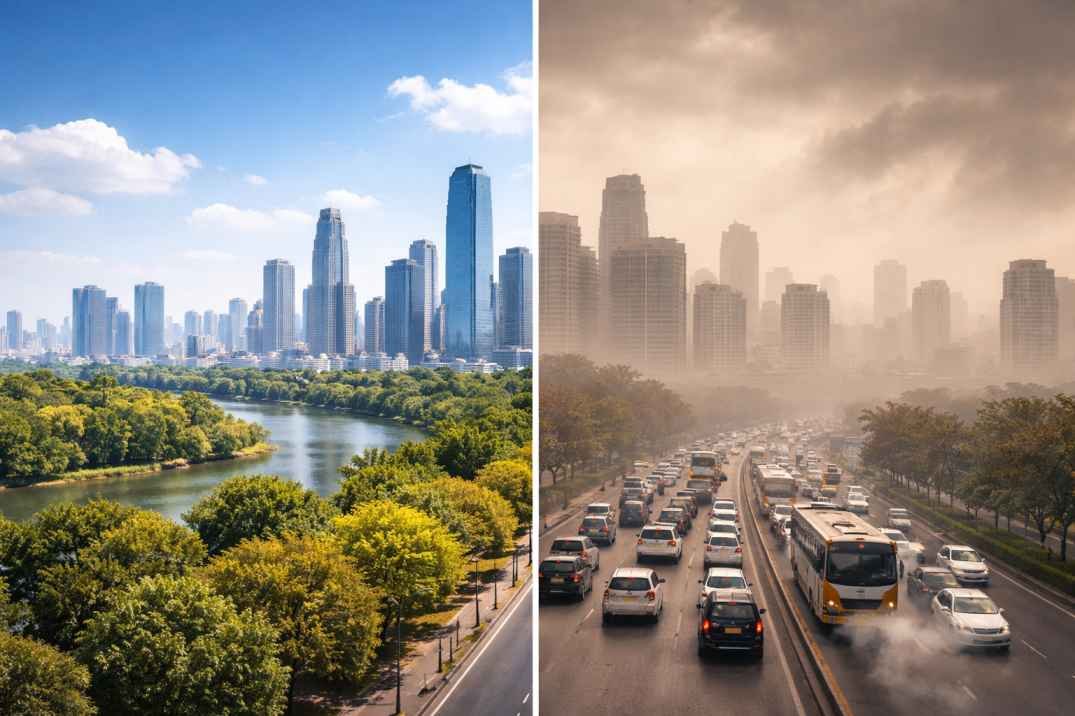
Clean and smog-covered city skyline comparison illustrating visible air pollution in India

What Is Air Pollution? Meaning, Causes, Types & India Context

Introduction

Air pollution happens when harmful particles or gases mix with the air we breathe. These substances can come from vehicles, factories, burning fuels, construction dust, and natural sources such as wildfires or dust storms. When their concentration becomes high enough, air quality deteriorates and can affect health, visibility, and the environment.

In India, air pollution is commonly discussed through measurements such as PM2.5 levels and the Air Quality Index (AQI). Cities such as Delhi, Mumbai, and Kolkata face both seasonal and year-round air quality challenges.

Understanding what air pollution means is the first step before exploring its causes, health effects, and monitoring systems.

What Is Air Pollution? (Simple Definition)

Air pollution refers to the presence of unwanted or harmful substances in the air at levels that can affect living beings, infrastructure, or the natural environment.

The air around us naturally contains nitrogen, oxygen, and small amounts of other gases. Problems begin when additional substances—such as smoke, fine dust particles, chemical fumes, or exhaust gases—enter the atmosphere in large quantities. When these pollutants accumulate beyond normal levels, air quality declines.

For example:

  • Vehicle exhaust releases nitrogen dioxide and fine particles.
  • Construction activities release dust into the air.
  • Burning coal or biomass releases smoke and chemical gases.
  • Industrial emissions add various pollutants depending on the process.

Air pollution is therefore not just “dirty air.” It is measurable, monitored, and classified using scientific methods.

What Causes Air Pollution in India?

Air pollution in India results from a combination of urban growth, energy use, transportation patterns, and seasonal factors.

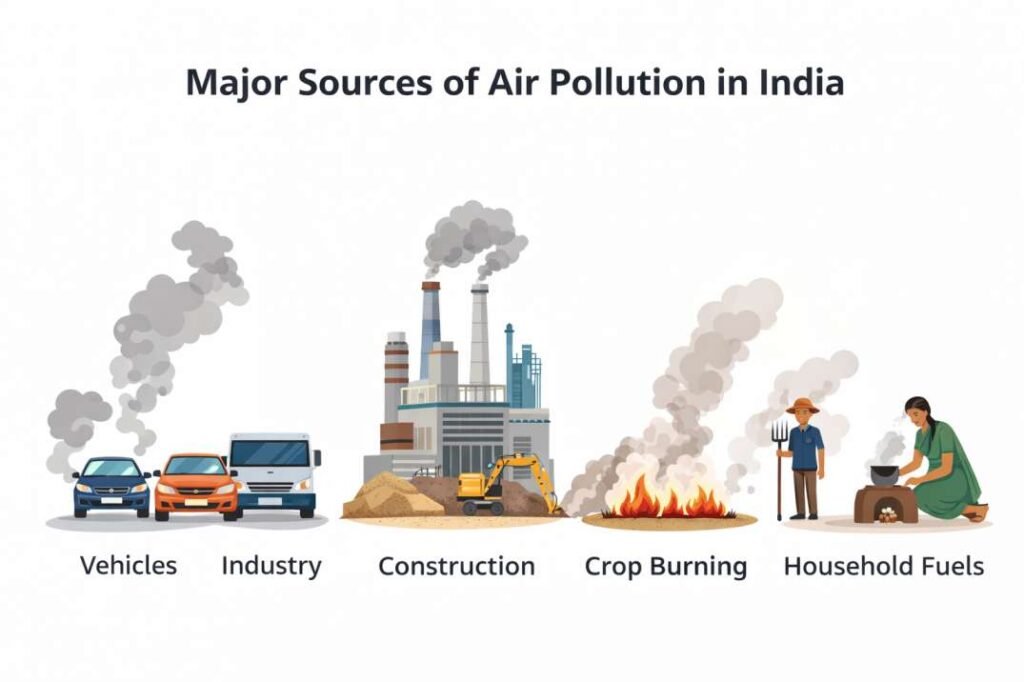
Major contributors include:

Illustration showing major sources of air pollution in India including vehicles, industry, construction dust and crop burning
Major contributors to air pollution in India include transport emissions, industrial activity, construction dust, crop residue burning, and household fuels.

1. Vehicular Emissions

Cars, buses, trucks, and two-wheelers emit nitrogen oxides, carbon monoxide, and fine particulate matter. In large cities with heavy traffic congestion, transport is a major pollution source.

2. Industrial Activities

Thermal power plants, manufacturing units, brick kilns, and refineries release gases and particulate matter into the atmosphere.

3. Construction and Road Dust

Rapid urban development generates large amounts of dust. Unpaved roads and debris can significantly increase PM10 levels.

4. Crop Residue Burning

In parts of northern India, agricultural burning during certain seasons contributes to regional pollution episodes.

5. Household Fuels

In some areas, the use of solid fuels such as wood or coal for cooking contributes to indoor and local outdoor pollution.

These sources vary by region and season. For example, coastal cities may experience different pollution patterns compared to northern inland cities during winter.

A detailed breakdown of the major sources of air pollution in India explains how each source affects urban and rural air quality.

Types of Air Pollution

Air pollution can be understood in different ways depending on where it occurs and how pollutants behave in the atmosphere.

Outdoor (Ambient) Air Pollution

Outdoor air pollution refers to contamination of the air in open environments such as cities, highways, industrial areas, and rural regions.

This is the type most commonly reported in news updates and government dashboards. In India, outdoor air pollution levels are tracked by monitoring stations operated under national systems and reported using the Air Quality Index (AQI).

During winter months, several Indian cities regularly record particulate matter levels above national air quality standards, particularly in densely populated urban areas.

Indoor Air Pollution

Indoor air pollution occurs inside homes, offices, schools, and other enclosed spaces.

It can result from:

  • Cooking with solid fuels
  • Tobacco smoke
  • Poor ventilation
  • Chemical products and cleaning agents
  • Outdoor pollutants entering buildings

Indoor exposure can be especially significant because people spend a large portion of their time indoors.

Indoor exposure can differ significantly from outdoor pollution patterns. Learn more about indoor air pollution in Indian homes and how it develops in enclosed environments.

Primary and Secondary Pollutants

Pollutants are also classified based on how they enter the atmosphere.

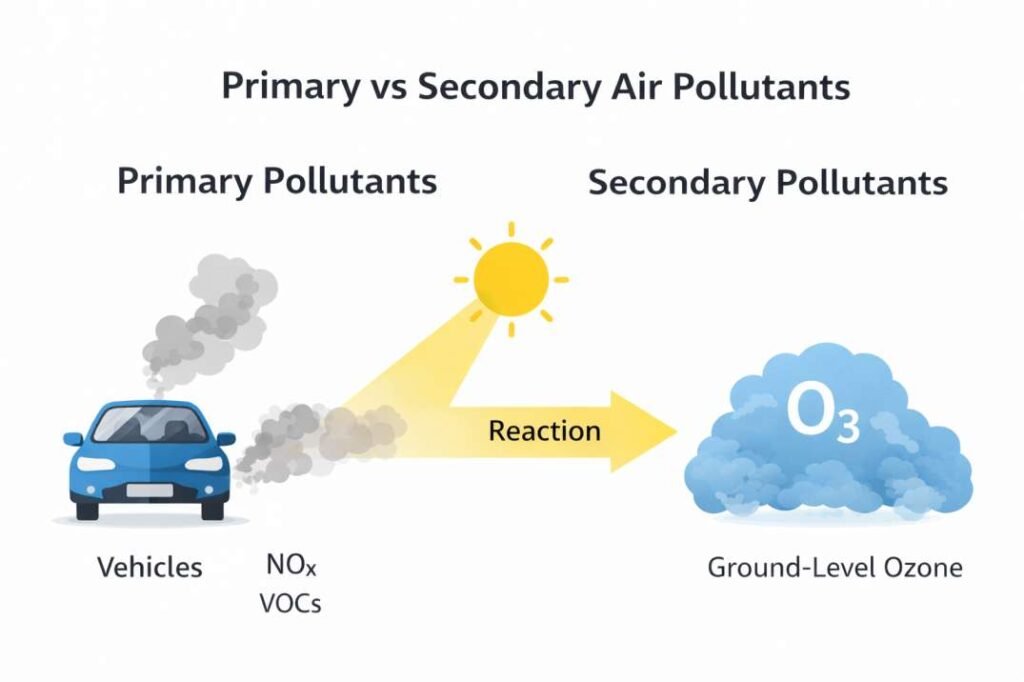
Diagram explaining formation of secondary air pollutants from primary emissions under sunlight
Primary pollutants are emitted directly from sources, while secondary pollutants form through chemical reactions in the atmosphere.

Primary Pollutants

These are released directly from a source.

Examples:

  • Vehicle exhaust gases
  • Smoke from burning fuels
  • Dust from construction sites

Secondary Pollutants

These form in the atmosphere when primary pollutants react with sunlight or other atmospheric components.

For example, ground-level ozone forms when nitrogen oxides react with volatile organic compounds in the presence of sunlight.

This distinction explains why pollution can worsen even when direct emissions appear stable.

A more detailed explanation of pollutant classification is available in our guide on air pollutant categories.

Major Air Pollutants Measured in India

Air pollution is monitored through specific measurable pollutants. In India, national reporting systems track several key indicators.

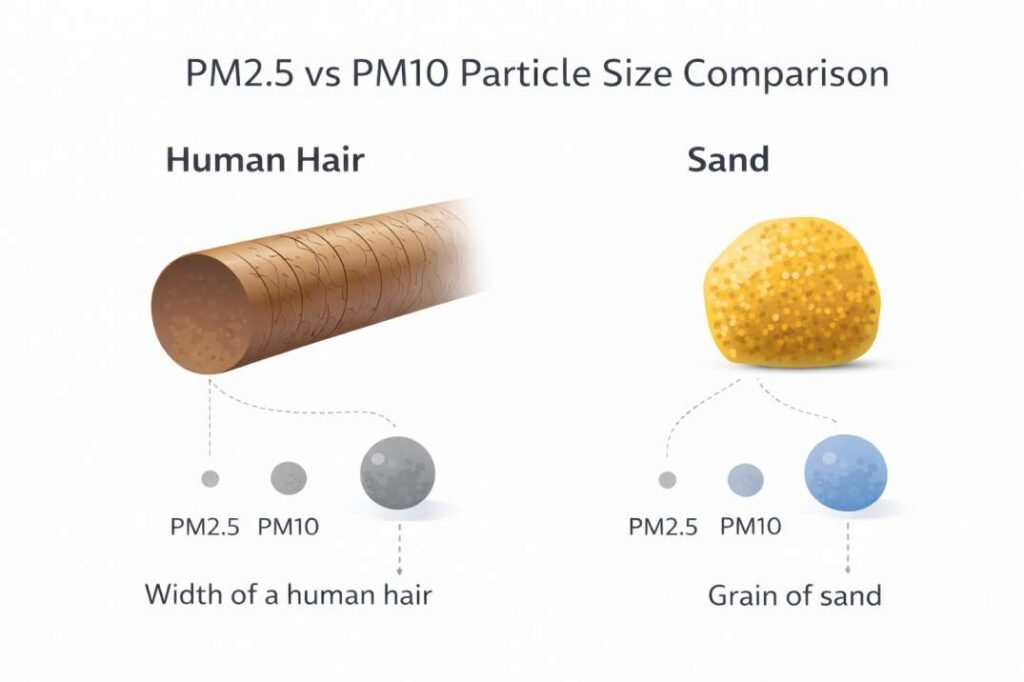
Size comparison of PM2.5 and PM10 particles relative to a human hair
PM2.5 particles are much smaller than PM10 and can penetrate deeper into the respiratory system.

Particulate Matter (PM2.5 and PM10)

Particulate matter consists of tiny solid or liquid particles suspended in air.

  • PM10 includes larger particles such as dust.
  • PM2.5 refers to much finer particles that can penetrate deep into the lungs. Because of their small size, these particles can remain suspended in the air for extended periods.

PM2.5 is often considered more harmful because of its small size and ability to enter the bloodstream.

Nitrogen Dioxide (NO₂)

Produced mainly from vehicle engines and industrial processes, nitrogen dioxide contributes to urban smog and respiratory irritation.

Sulphur Dioxide (SO₂)

Commonly linked to coal-based power generation and industrial combustion.

Ozone (O₃)

Ground-level ozone is not emitted directly. It forms when pollutants react under sunlight.

Carbon Monoxide (CO)

An invisible gas produced from incomplete combustion of fuels.

These pollutants form the basis of India’s national air quality reporting framework.

Why Air Pollution Is a Serious Issue in India

Air pollution affects more than the environment. It also influences public health, productivity, and daily life.

When pollutant levels rise, especially fine particles like PM2.5, they can enter the respiratory system through normal breathing. Short-term exposure may cause symptoms such as coughing, throat irritation, breathing discomfort, or eye irritation. Sensitive individuals may feel these effects more quickly.

Long-term exposure over months or years is associated with increased risk of respiratory and cardiovascular problems. While health outcomes depend on multiple factors, sustained exposure to polluted air is widely recognised as a public health concern.

Children and Vulnerable Groups

Children are often more vulnerable to air pollution because:

  • Their lungs are still developing
  • They breathe more rapidly than adults
  • They spend time outdoors in schools and playgrounds

Older adults and people with pre-existing respiratory conditions may also experience stronger effects during high pollution periods.

For a deeper discussion, see our detailed guide on the health effects of air pollution.

Seasonal Pollution Episodes in India

In northern India, especially across the Indo-Gangetic Plain—a region that includes parts of Punjab, Haryana, Uttar Pradesh, Bihar, and Delhi—winter months often bring visible smog episodes.

For example, Delhi frequently experiences elevated particulate matter levels during late autumn and winter. Weather conditions such as lower wind speed and temperature inversion can trap pollutants close to the ground, allowing concentrations to rise.

Seasonal episodes show that weather conditions can significantly influence pollution levels.

How Air Pollution Is Measured in India

Air pollution is quantified using standardized monitoring systems rather than subjective perception.

India monitors ambient air quality through a national network coordinated by the Central Pollution Control Board (CPCB). Monitoring stations across cities measure pollutant concentrations such as PM2.5, PM10, nitrogen dioxide, sulphur dioxide, ozone, and carbon monoxide.

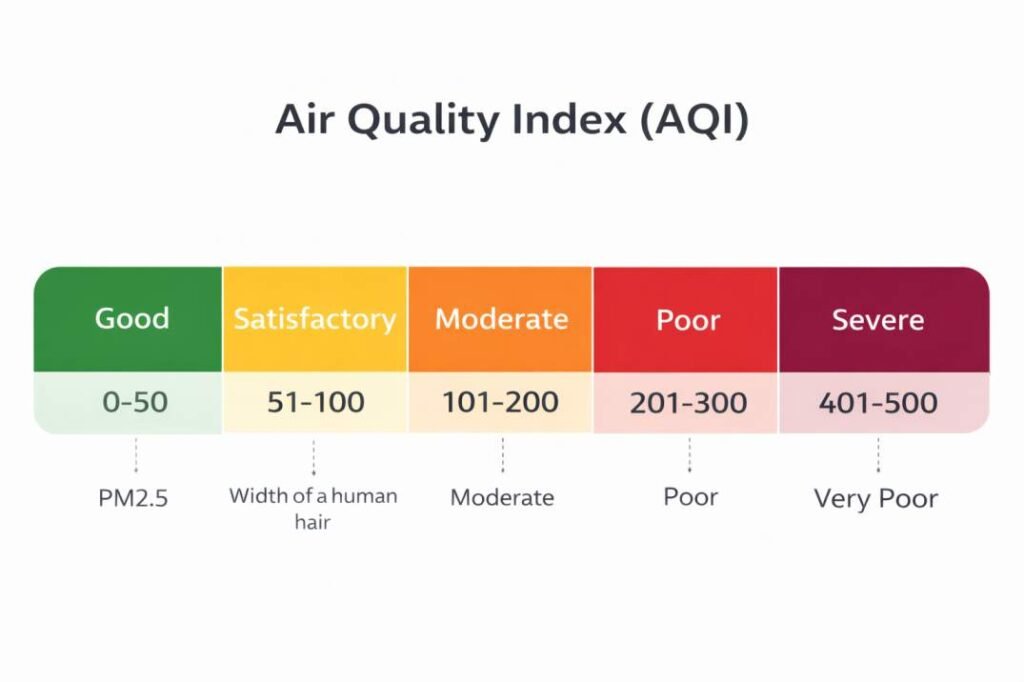
These measured values are then converted into a simplified reporting format called the Air Quality Index (AQI).

What Is AQI?

Air Quality Index scale from Good to Severe used for reporting air pollution levels in India
India’s Air Quality Index translates pollutant concentrations into public categories ranging from Good to Severe.

The Air Quality Index is a scale that translates pollutant concentrations into categories such as:

  • Good
  • Satisfactory
  • Moderate
  • Poor
  • Very Poor
  • Severe

Instead of showing multiple pollutant numbers separately, AQI provides a single index value based on the pollutant with the highest impact at that time.

This makes it easier for the public to understand overall air quality conditions without interpreting raw concentration data.

To understand how pollutant concentrations are converted into public categories, see how India’s Air Quality Index (AQI) framework is structured and calculated.

Frequently Asked Questions

Is air pollution only a problem in big cities?

No. While large cities often receive more attention, smaller towns and rural areas can also experience pollution from industry, transport, burning practices, and household fuel use.

Is air pollution visible?

Not always. Smog or haze can be visible, but many harmful pollutants are invisible and can only be detected through monitoring instruments.

What is the difference between AQI and pollution levels?

Pollution levels refer to measured concentrations of specific pollutants. AQI is an index that converts those measurements into an easier-to-understand category.

Is indoor air pollution different from outdoor pollution?

Yes. Indoor pollution occurs inside buildings and may result from cooking fuels, tobacco smoke, or poor ventilation. Outdoor pollution refers to air contamination in open environments.

Conclusion

Air pollution is a measurable environmental condition shaped by emission sources, atmospheric processes, and human activity. In India, it is systematically monitored and publicly reported through structured frameworks such as the Air Quality Index.

A clear understanding of its causes, pollutant types, and measurement systems helps readers interpret air quality information accurately and explore deeper topics within this air pollution knowledge hub.

Last update: February 2026

References & Further Reading

Official Indian Sources

Central Pollution Control Board (CPCB)
Official authority responsible for air quality monitoring and regulation in India.
https://cpcb.nic.in/
National Air Quality Index (NAQI) – CPCB
Explains how India’s Air Quality Index is structured and calculated.
https://cpcb.nic.in/National-Air-Quality-Index/
National Ambient Air Quality Standards (NAAQS) – CPCB Notification
Official pollutant limits prescribed under Indian environmental law.
https://cpcb.nic.in/uploads/National_Ambient_Air_Quality_Standards.pdf
National Clean Air Programme (NCAP) – Ministry of Environment, Forest and Climate Change
India’s national framework for reducing particulate pollution in non-attainment cities.
https://moef.gov.in/en/division/air-pollution/national-clean-air-programme/
Real-Time Air Quality Data Portal – Government of India
Public dashboard for city-level AQI data.
https://app.cpcbccr.com/AQI_India/

International & Scientific References

World Health Organization (WHO) – Air Pollution Overview
Global health perspective on air pollution and exposure risks.
https://www.who.int/health-topics/air-pollution
WHO Global Air Quality Guidelines
Updated scientific recommendations on pollutant exposure levels.
https://www.who.int/publications/i/item/9789240034228
United States Environmental Protection Agency (EPA) – Air Quality Basics
Clear explanation of pollutants and AQI structure.
https://www.epa.gov/air-quality-management-process
AirNow – Air Quality Index Basics
Public-friendly explanation of AQI categories and interpretation.
https://www.airnow.gov/aqi/aqi-basics/