
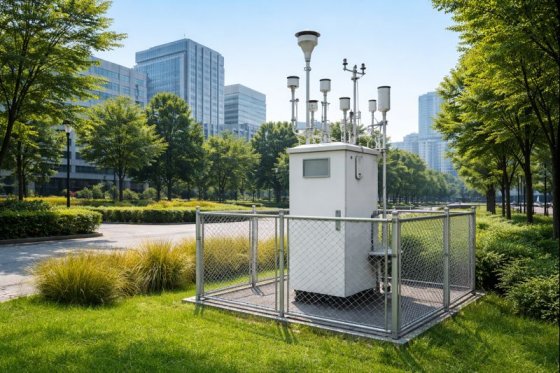
What Are Criteria Pollutants?
Criteria pollutants are common air pollutants used to measure and compare outdoor air quality. To understand where these pollutants originate, see our guide on Sources of Air Pollution.
The most widely monitored criteria pollutants are:
- PM₂.₅
- PM₁₀
- Nitrogen dioxide (NO₂)
- Sulfur dioxide (SO₂)
- Ground-level ozone (O₃)
These pollutants are commonly used in Air Quality Index (AQI) systems because they can be measured reliably using established monitoring methods. To understand how these pollutants are converted into AQI values, read our detailed guide on how AQI is calculated in India.
In India, the Central Pollution Control Board (CPCB) monitors these pollutants through national air-quality monitoring networks.
This article explains:
- what these pollutants are
- how particulate and gaseous pollutants are classified
- how air-quality monitoring systems measure them
- why they are important in AQI reporting and pollution monitoring
Why Are These Pollutants Monitored?
Criteria pollutants are monitored because they provide a practical and reliable way to study outdoor air quality.
These pollutants help scientists and environmental agencies:
- track pollution levels over time
- compare air quality between cities
- calculate Air Quality Index (AQI) values
- study long-term pollution trends
Particulate pollutants such as PM₂.₅ and PM₁₀ are classified mainly by particle size, while gaseous pollutants such as NO₂, SO₂, and O₃ are identified by their chemical properties.
Many other pollutants also exist in the atmosphere, including volatile organic compounds (VOCs) and air toxics. However, criteria pollutants are widely used in routine monitoring because reliable measurement systems and long-term monitoring data are available for these pollutants.
Although monitoring systems may differ slightly between countries, the basic goal remains the same: to measure air pollution using pollutants that can be tracked using similar monitoring methods across different cities and regions.
Criteria pollutants are not grouped because they are chemically similar. Instead, they are treated as standard reference pollutants that help scientists and environmental agencies track air pollution levels across different locations and time periods.
How Criteria Pollutants Relate to India’s Air Quality Standards
| Pollutant | Included in India’s NAAQS | Used in India’s AQI |
|---|---|---|
| PM₂.₅ | ✓ | ✓ |
| PM₁₀ | ✓ | ✓ |
| NO₂ | ✓ | ✓ |
| SO₂ | ✓ | ✓ |
| O₃ | ✓ | ✓ |
India’s National Ambient Air Quality Standards (NAAQS) specify concentration limits for these pollutants, while the Air Quality Index (AQI) uses measured pollutant concentrations to communicate current air quality in a simple format. Because the same pollutants are monitored continuously, they serve as the foundation of India’s routine air-quality assessment.
Editorial Note: India’s AQI uses pollutant measurements from CPCB-approved monitoring networks. The specific pollutants used in AQI reporting and the applicable concentration breakpoints are defined in the CPCB National AQI Technical Framework.
The Five Major Criteria Pollutants Used in Air Quality Monitoring
The table below shows the most commonly monitored criteria pollutants and their typical pollution sources.
| Pollutant | Type | Common Sources | Primary or Secondary |
|---|---|---|---|
| PM2.5 | Particle | Smoke | Primary |
| PM10 | Particle | Dust | Primary |
| NO2 | Gas | Traffic | Primary |
| SO2 | Gas | Industry | Primary |
| O3 | Gas | Atmospheric reactions | Secondary |
Common Misconception
Misconception: Criteria pollutants are the only pollutants present in the atmosphere.
Reality: They are the pollutants most commonly monitored for routine air-quality assessment. Other pollutants, such as volatile organic compounds (VOCs) and toxic metals, may also affect air quality but are not always included in routine AQI reporting.
Particulate Matter (PM₂.₅ and PM₁₀)
Particulate matter refers to tiny solid particles and liquid droplets suspended in the air. These particles may include dust, smoke, soot, ash, and other microscopic materials.
Because airborne particles vary greatly in composition, shape, and origin, air-quality systems classify particulate matter mainly by particle size. This allows monitoring systems to measure and compare particles using similar measurement standards.
PM₂.₅ vs PM₁₀
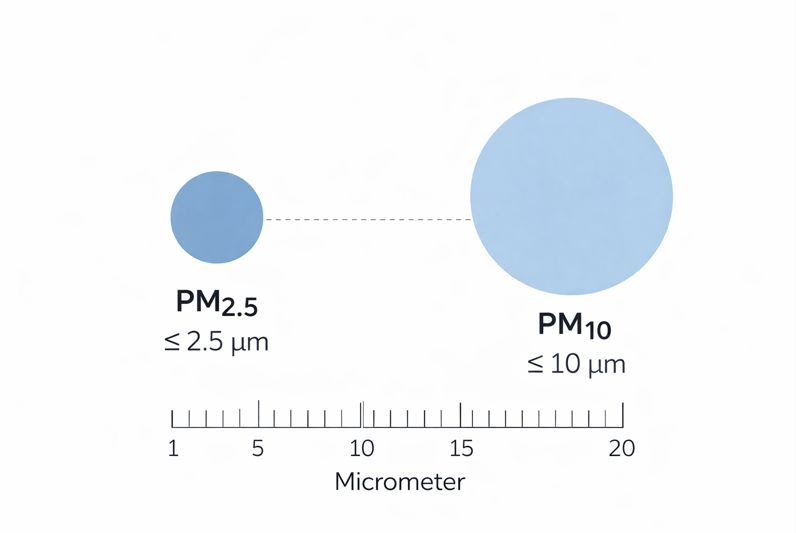
PM₂.₅ consists of airborne particles with a diameter of 2.5 micrometers (µm) or smaller. Because these particles are extremely small, they can remain suspended in the air for long periods and are often invisible to the naked eye. For comparison, a human hair is much wider than a PM₂.₅ particle.
PM₁₀ includes particles with diameters of 10 micrometers (µm) or smaller. This category contains both fine particles and larger coarse particles, such as road dust, construction dust, and windblown soil.
Although both PM₂.₅ and PM₁₀ are particulate pollutants, they are classified separately because particle size influences how long particles remain suspended in the air, how they are transported by wind, and how monitoring instruments measure their concentrations.
The illustration below compares the particle-size thresholds used to distinguish PM₂.₅ from PM₁₀ in routine air-quality monitoring.
Classroom Observation
Imagine a room where someone shakes a dusty rug. The larger dust particles settle quickly onto surfaces, while much smaller particles remain suspended in the air for longer. This simple observation helps explain why PM₂.₅ and PM₁₀ are measured separately in air-quality monitoring systems.
Think About It: If two cities have the same amount of visible dust, could one still have much higher PM₂.₅ levels? Why?
Why Particle Size Matters
Particle size affects how particles move through the atmosphere and how they are measured by monitoring systems.
Particle size is one of the most important physical characteristics used in air-quality monitoring because it influences both pollutant behavior and measurement methods.
Smaller particles usually remain suspended in the air longer, while larger particles settle more quickly. For this reason, particle size is one of the main classification methods used in modern air-quality monitoring systems and AQI frameworks worldwide.
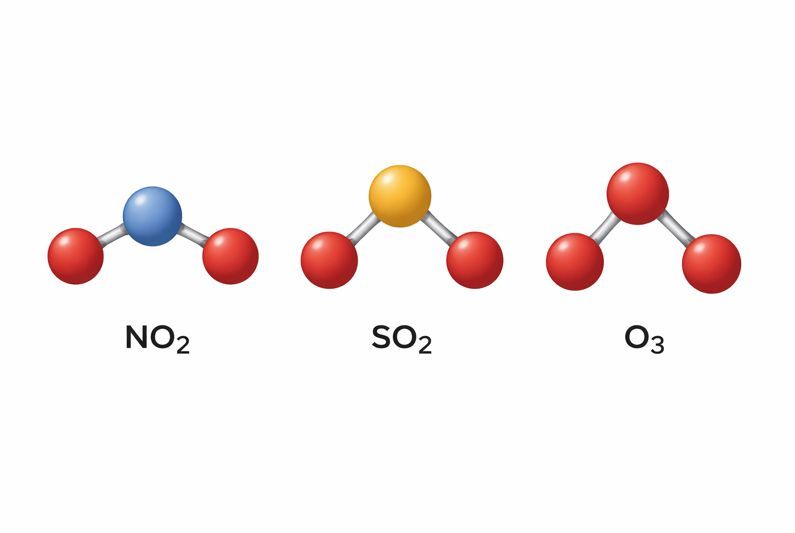
Gaseous Criteria Pollutants (NO₂, SO₂, and O₃)
Besides particulate matter, air-quality systems also monitor several important gaseous pollutants.
The most commonly monitored gaseous criteria pollutants are:
- Nitrogen dioxide (NO₂)
- Sulfur dioxide (SO₂)
- Ground-level ozone (O₃)
These gases are monitored because they are commonly found in polluted urban air and can be tracked using established air-quality monitoring systems.
Nitrogen Dioxide (NO₂)
NO₂ is mainly associated with vehicle emissions, fuel combustion, and urban traffic pollution. It is commonly found in cities with heavy traffic and is widely used as an indicator of urban air pollution.
Because NO₂ can be measured continuously using air-quality monitoring instruments, it is included in AQI reporting systems in many countries, including India.
Sulfur Dioxide (SO₂)
SO₂ is mainly linked to industrial activities and the burning of sulfur-containing fuels such as coal and oil.
Air-quality monitoring systems track SO₂ because it is commonly associated with industrial emissions and thermal power generation in many regions.
Ground-Level Ozone (O₃)
Ground-level ozone is a gaseous pollutant found in the lower atmosphere. Unlike pollutants that are released directly into the air, ozone forms through chemical reactions involving other pollutants in sunlight.
Ground-level ozone is considered a secondary pollutant because it forms through atmospheric chemical reactions rather than being released directly from a source. This makes ozone different from pollutants that are emitted directly into the air from vehicles or industrial activities.
High ground-level ozone concentrations are often associated with urban smog conditions during hot and sunny weather.
Because ozone levels can vary depending on weather conditions and sunlight intensity, monitoring systems track ozone as an important component of air-quality assessment.
Why These Gases Are Important
NO₂, SO₂, and O₃ help scientists and environmental agencies study changes in urban air pollution over time.
These pollutants are also used in AQI calculations and long-term air-quality monitoring programs.
From Pollutants to AQI: How Monitoring Data Becomes Public Information
Emission Sources
↓
Criteria Pollutants
↓
Air Monitoring Station
↓
Continuous Measurement
↓
Pollutant Concentration
↓
AQI Calculation
↓
AQI Category
↓
Public AQI Report
Monitoring stations continuously measure pollutant concentrations. These measurements are processed using India’s AQI calculation framework, allowing the public to understand current air-quality conditions through a single AQI value rather than individual pollutant measurements.
How Air-Quality Monitoring Systems Measure These Pollutants
Air-quality monitoring systems use specialized instruments to measure pollutant concentrations in the atmosphere.
Particulate matter such as PM₂.₅ and PM₁₀ is measured using instruments that separate airborne particles by size before calculating particle concentration.
Gaseous pollutants such as NO₂, SO₂, and O₃ are measured using gas analyzers designed to detect specific pollutants in ambient air.
Pollutant concentrations are usually reported using standard units such as:
- micrograms per cubic meter (µg/m³)
- parts per billion (ppb)
Using common measurement units allows pollution data to be compared across locations and time periods.
Different monitoring instruments are used for particulate matter and gaseous pollutants because these pollutants behave differently in the atmosphere and require different measurement methods.
In India, organizations such as the Central Pollution Control Board (CPCB) use national air-quality monitoring stations to track these pollutants and support AQI reporting systems.
During winter in many Indian cities, including Delhi, AQI values may increase because cooler weather and weaker air movement can trap pollutants closer to the ground for longer periods.
Real Example
Delhi
↓
Winter Season
↓
Lower Wind Speed
+
Temperature Inversion
↓
PM₂.₅ Accumulates Near the Ground
↓
AQI Reaches “Severe”
Learn how air-quality monitoring stations measure pollutants such as PM₂.₅, ozone, and nitrogen dioxide using specialized monitoring instruments.

Limitations of Criteria Pollutant Classification
Criteria pollutants are important reference pollutants in air-quality monitoring systems, but they do not represent every pollutant present in the atmosphere.
Many other pollutants, including volatile organic compounds (VOCs), toxic metals, and region-specific industrial pollutants, may also affect air quality.
Particulate matter categories such as PM₂.₅ and PM₁₀ are based mainly on particle size rather than exact chemical composition. As a result, particles within the same size category may still differ in origin and chemical properties.
In addition, monitoring systems and pollutant lists may vary slightly between countries depending on monitoring infrastructure, environmental conditions, and national air-quality frameworks.
Despite these limitations, criteria pollutants remain widely used because they provide a practical way to measure and compare outdoor air quality across different locations and time periods.
Student Learning Summary
After reading this article you should now understand:
✔ What criteria pollutants are
✔ Why PM₂.₅ and PM₁₀ are classified by size
✔ Why ozone is a secondary pollutant
✔ How monitoring stations measure pollutants
✔ How AQI uses these pollutant measurements
Teacher Activity
Classroom Activity
Ask students to classify the following as either a particulate pollutant or a gaseous pollutant.
| Pollutant | Student Answer |
|---|---|
| PM₂.₅ | ____ |
| PM₁₀ | ____ |
| NO₂ | ____ |
| SO₂ | ____ |
| O₃ | ____ |
Frequently Asked Questions
What are the main criteria pollutants?
The most commonly monitored criteria pollutants are PM₂.₅, PM₁₀, nitrogen dioxide (NO₂), sulfur dioxide (SO₂), and ground-level ozone (O₃).
Are criteria pollutants used in the Air Quality Index (AQI)?
Yes. AQI systems use measured concentrations of these pollutants to calculate air-quality levels. For example, AQI values may rise sharply during heavy traffic, industrial activity, wildfire smoke events, or winter smog conditions.
What unit is used to measure PM₂.₅ and PM₁₀?
Particulate matter is usually measured in micrograms per cubic meter of air (µg/m³).
Why is PM₂.₅ considered more concerning than larger dust particles?
PM₂.₅ particles are extremely small, remain suspended in the air for long periods, and are therefore closely monitored in AQI systems.
How is AQI calculated?
AQI is calculated by converting pollutant concentrations into standardized index values based on national air-quality guidelines.
Why can AQI change quickly?
AQI can change because pollutant concentrations vary throughout the day due to traffic, weather conditions, industrial activity, and changes in wind patterns.
Why isn’t carbon dioxide (CO₂) considered a criteria pollutant?
CO₂ is an important greenhouse gas, but India’s AQI and routine air-quality monitoring focus on pollutants that directly affect day-to-day ambient air quality. Therefore, CO₂ is not included as a criteria pollutant in India’s AQI framework.
Are criteria pollutants the same in every country?
Many countries monitor PM₂.₅, PM₁₀, NO₂, SO₂, and ozone, but the exact list, standards, and AQI calculation methods may differ depending on national environmental regulations.
Do all criteria pollutants come directly from pollution sources?
No. Some pollutants, such as ground-level ozone, are secondary pollutants that form through chemical reactions in the atmosphere rather than being emitted directly.
Which criteria pollutant usually determines India’s AQI?
India’s AQI is determined by the pollutant with the highest sub-index rather than an average of all pollutants. Depending on local conditions, PM₂.₅, PM₁₀, ozone, nitrogen dioxide, sulfur dioxide, carbon monoxide, or ammonia may become the dominant pollutant.
Why are PM₂.₅ and PM₁₀ measured separately?
PM₂.₅ and PM₁₀ are measured separately because particle size affects how particles behave in the atmosphere and how monitoring instruments classify them. Smaller particles usually remain suspended longer than larger particles, so air-quality monitoring systems report them as separate pollutant categories.
Conclusion
Criteria pollutants such as PM₂.₅, PM₁₀, NO₂, SO₂, and O₃ are important components of modern air-quality monitoring systems.
In India, organizations such as the CPCB use these pollutants to track air-quality conditions across cities and regions.
Understanding these pollutants helps explain how AQI systems and air-quality monitoring networks interpret pollution conditions in different environments.
Understanding criteria pollutants provides the scientific foundation for learning how AQI is calculated, how monitoring stations collect data, and why pollution levels vary across cities and seasons. These concepts form the basis of modern air-quality monitoring in India.
Related Learning
Continue exploring:
→ Primary vs Secondary Pollutants
→ Air Pollution Monitoring Stations
→ Health Effects of Air Pollution
References
- World Health Organization (WHO). (2021). WHO Global Air Quality Guidelines: Particulate Matter (PM₂.₅ and PM₁₀), Ozone, Nitrogen Dioxide, Sulfur Dioxide and Carbon Monoxide. Geneva: WHO.
- Ministry of Environment, Forest and Climate Change (MoEFCC), Government of India. (2009). National Ambient Air Quality Standards (NAAQS).
- Central Pollution Control Board (CPCB), Government of India. National Air Quality Monitoring Programme (NAMP): Guidelines and Methodology.
- Central Pollution Control Board (CPCB), Government of India. National Air Quality Index (AQI): Technical Framework.
- Seinfeld, J. H., & Pandis, S. N. (2016). Atmospheric Chemistry and Physics: From Air Pollution to Climate Change (3rd ed.). Wiley.
Last Update: June 2026