
Introduction
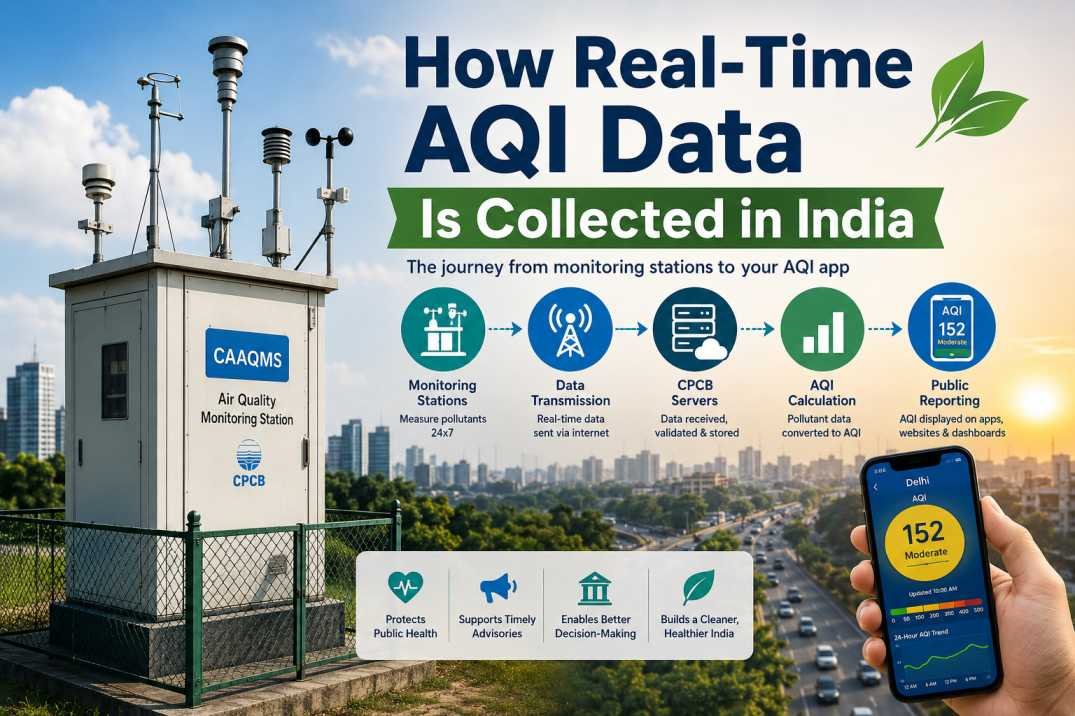
Real-time Air Quality Index (AQI) reporting in India depends on continuous monitoring systems that measure air pollutants throughout the day.
These systems collect pollution data from monitoring stations installed across cities, industrial regions, and urban environments. The collected measurements are processed, validated, and converted into AQI values used in public air quality reporting.
In India, most real-time AQI monitoring is coordinated through the Central Pollution Control Board (CPCB) and state pollution control agencies using Continuous Ambient Air Quality Monitoring Stations (CAAQMS).
This guide explains how real-time AQI data is collected, how monitoring stations transmit pollution measurements, and how AQI values are updated on public reporting platforms.
What Is Real-Time AQI Data?
Real-time AQI data refers to continuously updated air pollution measurements collected from automated monitoring stations.
Unlike manual air monitoring systems that rely on periodic sampling, real-time systems measure pollutant concentrations continuously and transmit data automatically to central databases.
This allows environmental agencies to monitor changing pollution levels throughout the day.
Real-time AQI reporting is especially important in large cities where pollution levels can change rapidly because of:
- traffic emissions
- industrial activity
- weather conditions
- seasonal pollution
- construction dust
How Monitoring Stations Collect Pollution Data
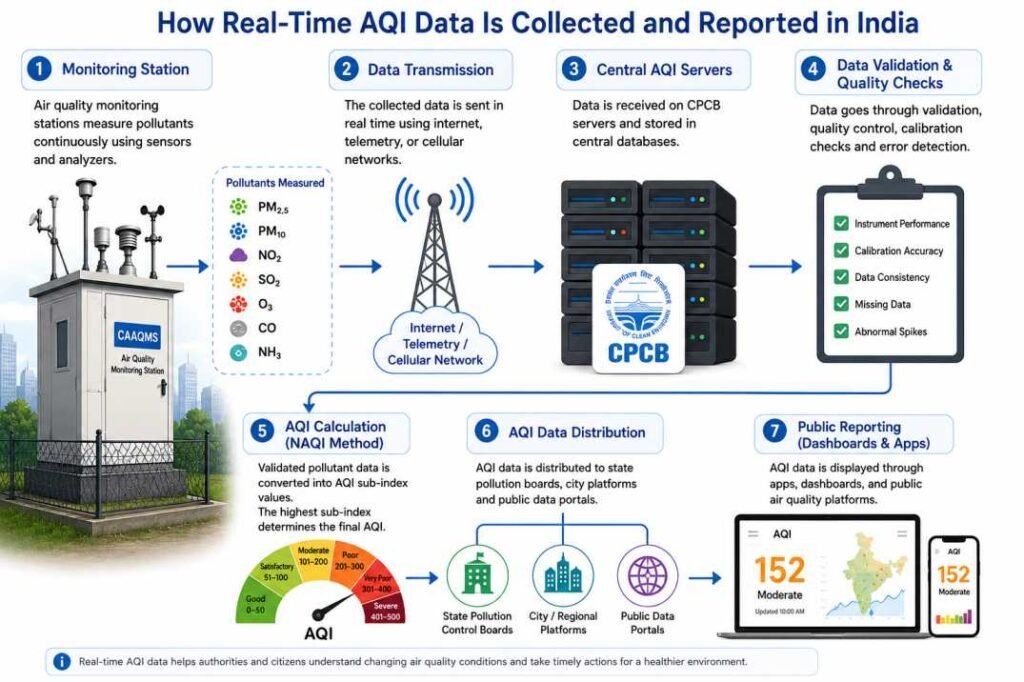
Real-time AQI data is collected using air quality monitoring stations equipped with pollutant analyzers and atmospheric sensors.
These stations continuously measure pollutants present in ambient air and record pollutant concentrations at regular intervals.
Most Indian cities use:
- Continuous Ambient Air Quality Monitoring Stations (CAAQMS)
- automated sensor-based monitoring systems
- manual monitoring stations in some regions
Most large Indian cities use Continuous Ambient Air Quality Monitoring Stations (CAAQMS) and automated monitoring networks for real-time pollution measurement.
Pollutants Measured in Real-Time AQI Systems
Monitoring stations commonly measure pollutants used in India’s AQI framework.
These include:
- PM₂.₅
- PM₁₀
- NO₂
- SO₂
- O₃
- CO
- NH₃
These pollutants are commonly known as criteria pollutants because they are widely used to assess air quality and pollution-related health risks.
For detailed pollutant explanations, see:
Criteria Pollutants Explained: PM₂.₅, PM₁₀, NO₂, SO₂, and O₃
How Stations Measure What They Report
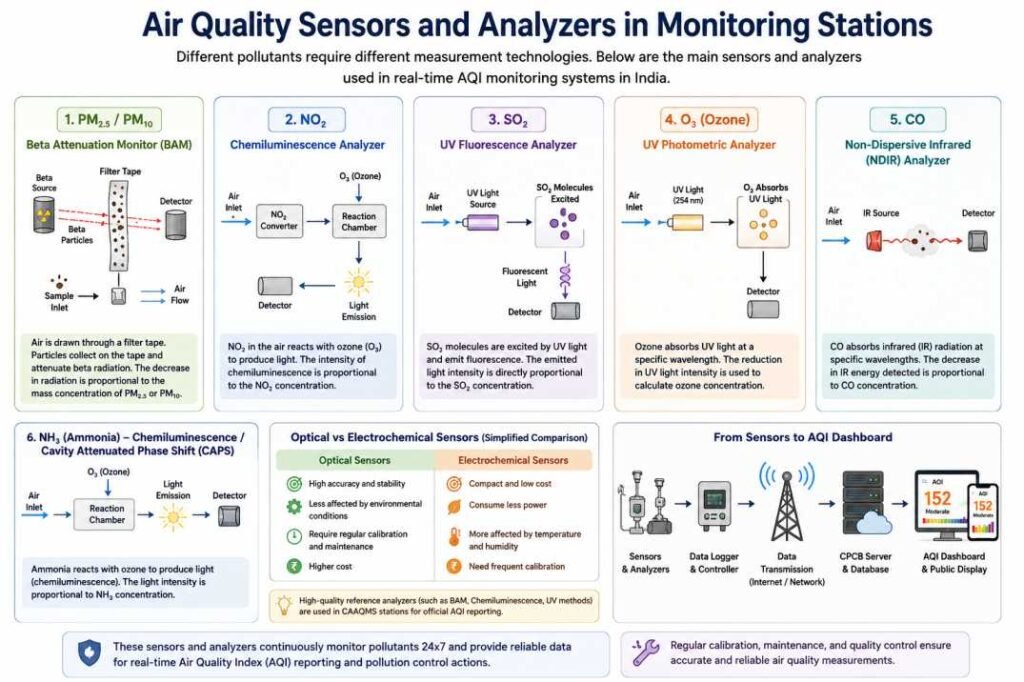
Each pollutant is measured using a different instrument — from light-scattering sensors for particulate matter to chemical analyzers for gases like NO2 and SO2.
See exactly which instrument measures which pollutant in our CAAQMS guide: Read the full sensor breakdown →
How Monitoring Data Is Transmitted
After pollutant measurements are collected, monitoring stations transmit the data to central reporting systems using automated communication networks.
Most real-time monitoring systems use:
- internet-based data transmission
- telemetry systems
- remote data acquisition systems
The transmitted data is sent to:
- CPCB central servers
- state pollution control boards
- regional environmental monitoring platforms
This allows AQI values to be updated regularly across public reporting dashboards.
Data Validation and Quality Checks
Before public reporting, monitoring data undergoes validation and quality control checks.
Environmental agencies verify:
- instrument performance
- calibration accuracy
- abnormal pollutant spikes
- missing measurements
- sensor stability
This process helps improve the reliability of real-time AQI reporting.
Monitoring stations also require regular maintenance and calibration to ensure accurate measurements.
How AQI Values Are Updated
After pollutant concentrations are validated, AQI values are calculated using pollutant-specific breakpoint tables and sub-index formulas — the pollutant with the highest sub-index determines the final AQI value reported for a location.
For the complete calculation method, see: How AQI Is Calculated in India →
Why Real-Time AQI Changes Throughout the Day
AQI values can change rapidly because pollution levels vary continuously.
Common reasons include:
- morning and evening traffic peaks
- industrial emissions
- weather changes
- wind speed variation
- temperature inversions
- construction activity
For example, Delhi’s AQI can rise sharply during winter mornings when low wind speed and temperature inversions trap pollutants close to the ground.
For related reading, see: Why Air Pollution Is Worse in Winter in India
Quick Explanation
Real-time AQI values can rise or fall within hours because pollution levels are strongly affected by traffic activity, weather conditions, industrial emissions, and atmospheric stability.
Limitations of Real-Time AQI Data
Although real-time AQI systems provide valuable information, they also have limitations.
Monitoring Coverage Is Uneven
Some cities and rural regions have fewer monitoring stations, which can reduce spatial coverage.
Short-Term Fluctuations Can Occur
Pollution levels may change rapidly within short time periods because of local emissions and weather conditions.
Instrument Maintenance Is Important
Real-time systems require regular calibration, maintenance, and quality checks to maintain reliable measurements.
Why Real-Time AQI Monitoring Is Important
Real-time AQI monitoring helps governments, researchers, and the public understand changing air pollution conditions.
It supports:
- public health advisories
- pollution control planning
- environmental research
- AQI forecasting
- emergency pollution response
Continuous monitoring also helps scientists identify pollution trends and evaluate the effectiveness of pollution control measures.
Quick Takeaway: Real-time AQI monitoring helps authorities detect pollution spikes quickly and provide faster public air quality updates.
Conclusion
Real-time AQI data in India is collected using continuous air quality monitoring systems that measure pollutant concentrations throughout the day.
These monitoring stations transmit pollution data to CPCB and environmental reporting platforms, where pollutant measurements are validated and converted into AQI values.
Understanding how real-time AQI data is collected helps explain why AQI values change continuously and how air pollution information is generated for public reporting.
Frequently Asked Questions
What is real-time AQI data?
Real-time AQI data refers to continuously updated pollution measurements collected from automated air quality monitoring stations.
Which pollutants are measured in real-time AQI systems?
Real-time AQI systems commonly measure PM₂.₅, PM₁₀, NO₂, SO₂, O₃, CO, and NH₃.
What is CAAQMS?
CAAQMS stands for Continuous Ambient Air Quality Monitoring System. These systems continuously measure air pollutants and transmit data automatically for AQI reporting.
Why does AQI change throughout the day?
AQI changes because pollution levels vary due to traffic emissions, weather conditions, industrial activity, and atmospheric changes.
Who manages AQI reporting in India?
AQI reporting in India is coordinated mainly through the Central Pollution Control Board (CPCB) and associated environmental monitoring agencies.
Why do AQI apps sometimes show different values?
AQI values may differ slightly between apps because reporting platforms can use different monitoring stations, update intervals, or data validation methods.
References
- CPCB — National Air Quality Index (NAQI)
- CPCB — Air Quality Management
- CPCB — National Air Monitoring Programme (NAMP)
- WHO — Air Quality Guidelines
- SAFAR India — Air Quality Monitoring Framework