
Introduction
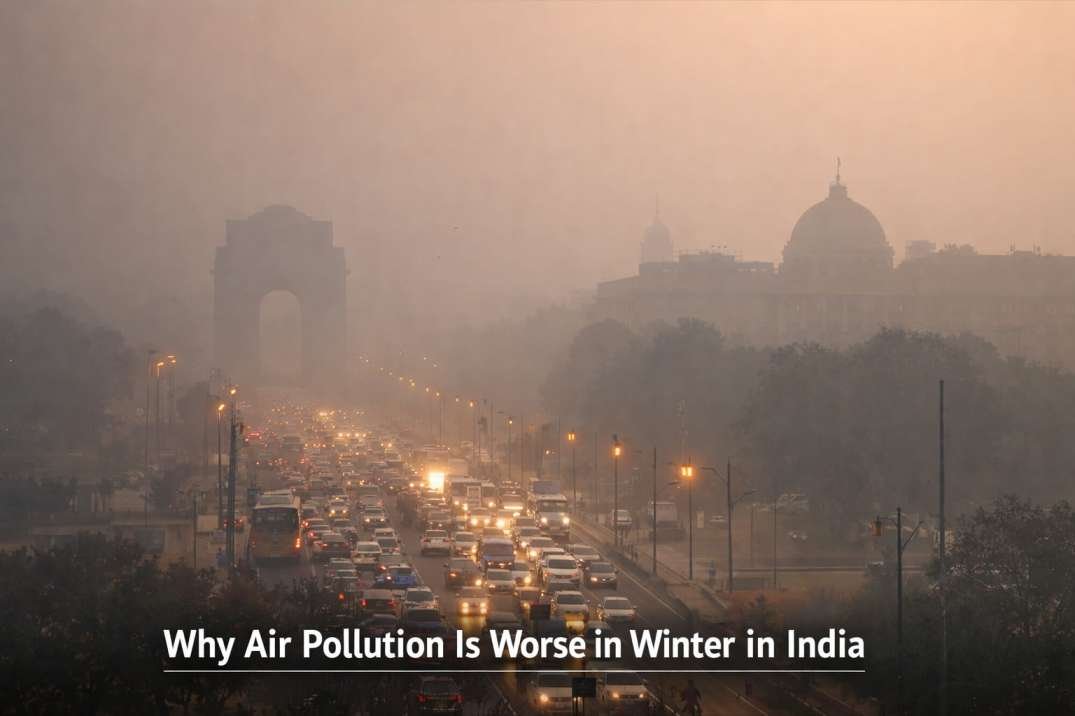
Winter air pollution in India can rise rapidly because pollutants become trapped near the ground under stagnant weather conditions. During severe winter episodes, AQI levels may increase sharply even when traffic and industrial activity appear unchanged.
Temperature inversion, weak winds, lower mixing height, and humidity reduce the atmosphere’s ability to disperse pollutants efficiently. As pollution builds up over multiple days, air quality can quickly shift from moderate to severe conditions in many Indian cities.
Quick Answer: Winter pollution increases because weak winds, temperature inversion, and lower mixing height trap pollutants closer to the ground.
Winter Pollution = Constant Emissions + Zero Dispersion.
Winter pollution becomes especially dangerous when pollutants remain trapped for several consecutive days. Even if emissions stay similar, reduced atmospheric movement allows PM2.5 and other pollutants to accumulate more quickly near breathing level.
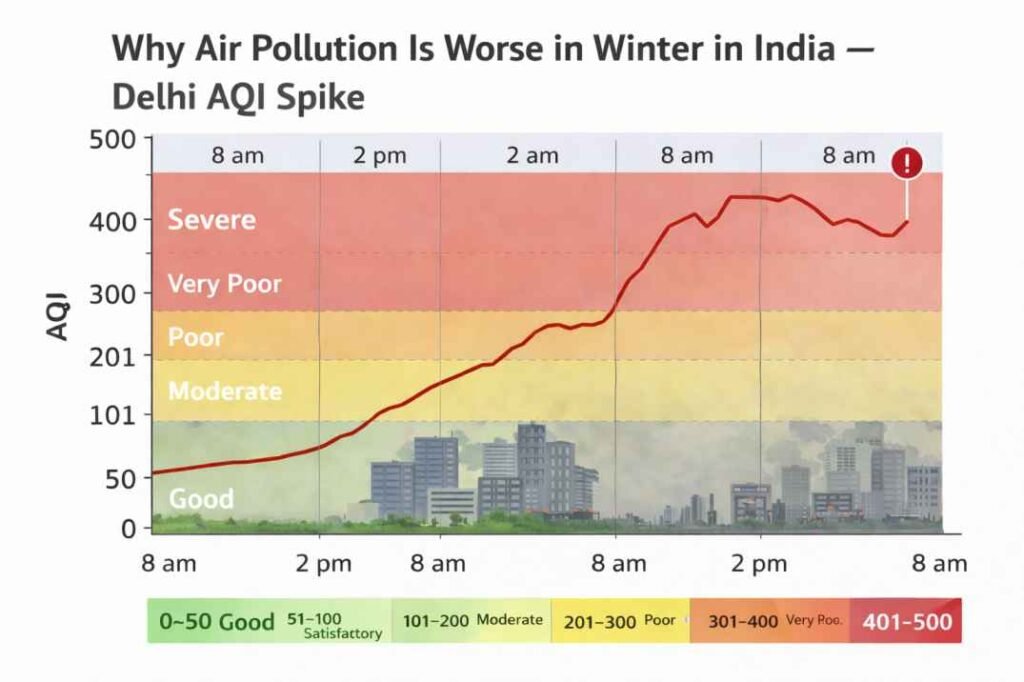
The Atmospheric Trap: Why the Air Stops Moving
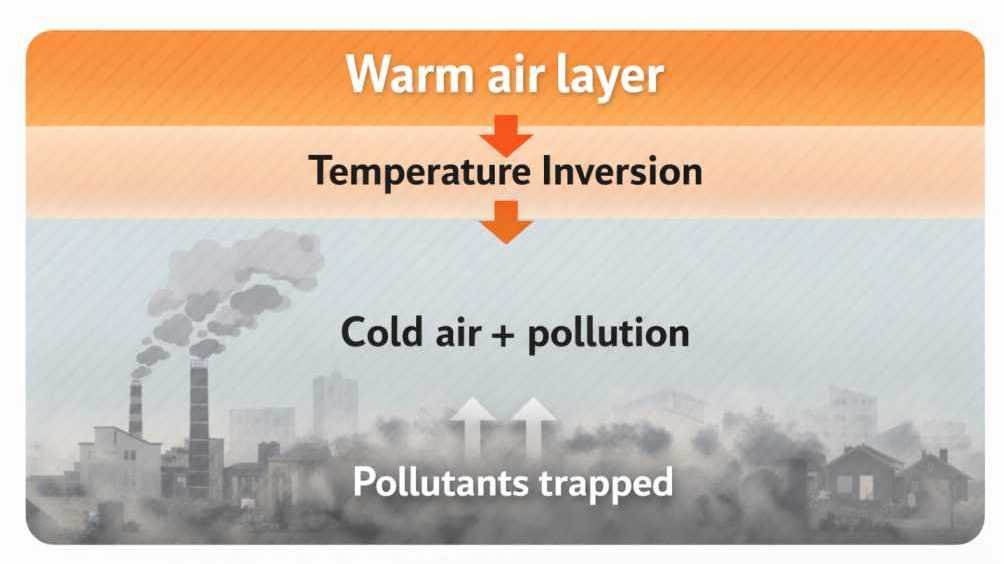
During winter nights, the ground cools quickly while warmer air remains above it. This creates a layer that traps pollutants near the surface instead of allowing them to rise and disperse.
Temperature Inversion: The “Lid” Effect
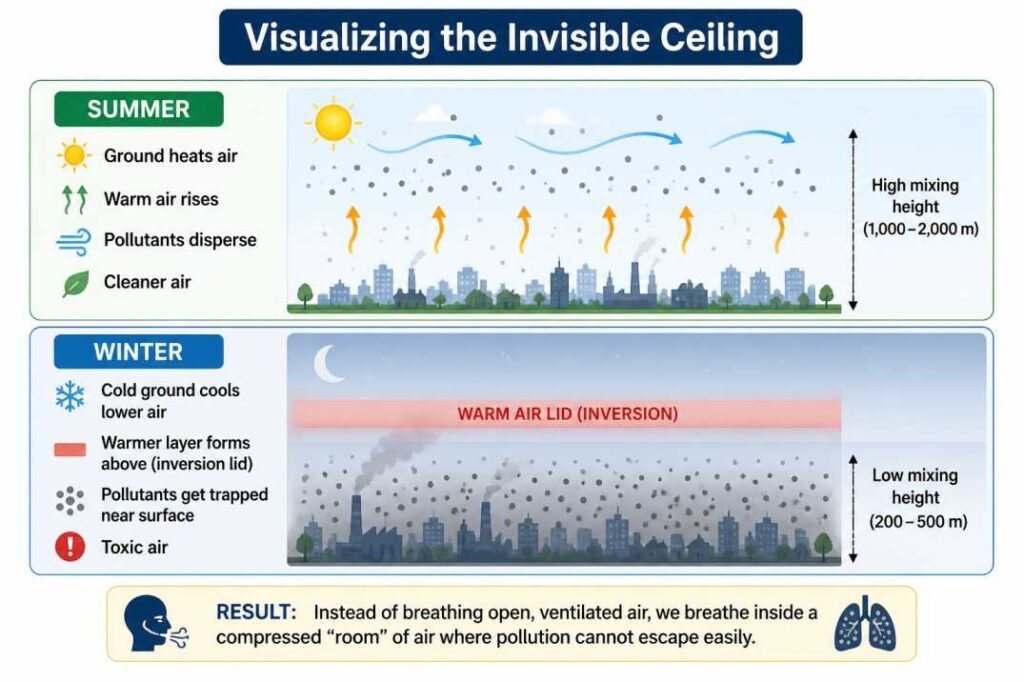
Normally, warm air near the ground rises and helps carry pollutants upward. During winter nights, however, the ground cools quickly while warmer air remains above it. This creates a layer that traps smoke, dust, and exhaust closer to the surface instead of allowing them to disperse.
The Shrinking Mixing Layer
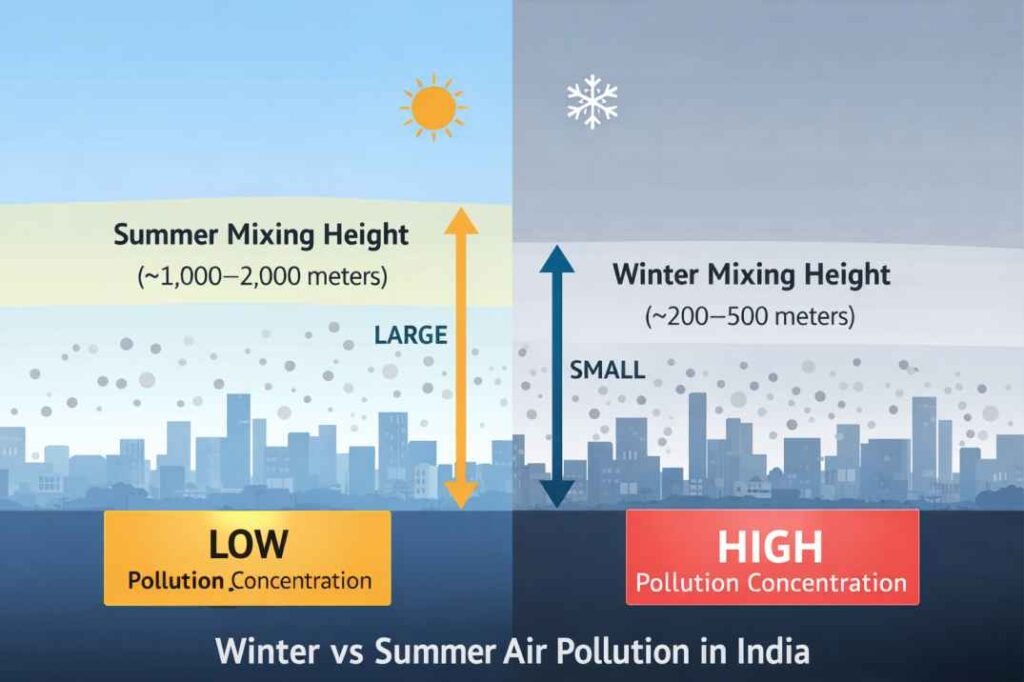
The atmosphere can be imagined as a room with a ceiling.
- In summer, the “ceiling” is higher, giving pollution more space to spread out.
- In winter, the mixing layer becomes much lower, so the same amount of pollution becomes more concentrated near breathing level.
Geography: Why North India Faces More Severe Winter Pollution
North India often experiences stronger winter pollution because the Indo-Gangetic Plain frequently has weak winds, stagnant air, and poor atmospheric ventilation during colder months.
Pollutants from traffic, industry, dust, and seasonal burning can remain trapped across large areas instead of dispersing quickly. This allows pollution from multiple nearby regions to combine into one broader pollution episode.
Some coastal cities experience better air movement due to sea breezes, which can help disperse pollutants more efficiently.
Major Sources of Winter Pollution
Winter weather mainly traps pollution that is already being produced through daily human activities. Common contributors include traffic emissions, road dust, industrial activity, construction work, biomass burning, and seasonal crop-residue burning.
During stagnant winter conditions, these pollutants remain closer to the surface for longer periods instead of dispersing quickly, causing AQI levels to rise more rapidly.
Why Winter Pollution Spikes Become Worse
Winter pollution episodes in North India can intensify further during crop-residue burning periods, festival emissions, humid weather conditions, and stagnant air.
High humidity and low wind speeds may also increase fine-particle formation in the atmosphere, allowing pollution to remain trapped near the surface for longer periods.
In many Indian cities, winter pollution often worsens during early morning and late evening hours when colder temperatures and weaker air circulation reduce dispersion further.
How Authorities Respond During Severe Winter Pollution
During severe winter pollution episodes in Delhi-NCR, authorities may temporarily introduce emergency measures such as construction restrictions, traffic controls, school advisories, and dust-control actions to reduce exposure and limit additional emissions.
These actions are usually implemented when AQI reaches very poor or severe levels for extended periods.
Note: Winter pollution is often dangerous before it is visible. In late October 2025, several IGP cities hit “Very Poor” AQI while the sun was still shining brightly.
Decision Rule: Winter pollution is not always visible. Even on clear-looking days, AQI levels may still remain unhealthy.
How Winter Air Pollution Affects Health
Winter pollution can irritate the eyes, throat, and lungs, especially during prolonged exposure to fine particles such as PM2.5. High AQI levels may also reduce exercise tolerance and worsen breathing discomfort during outdoor activity.
Children, elderly individuals, and people with asthma, heart disease, or other respiratory conditions are usually more sensitive to these effects during severe winter pollution episodes.
How to Protect Yourself During Winter Pollution
Reducing overall exposure is one of the most effective ways to lower winter pollution risk.
- Avoid prolonged outdoor exercise during severe AQI conditions, especially in the early morning when pollutants are often trapped closer to the surface.
- Use a well-fitted N95 or FFP2 mask during high pollution episodes.
- During severe AQI periods, indoor air may also become polluted, so using a HEPA air purifier can help improve indoor air quality.
- Check local AQI regularly before outdoor travel, exercise, or long commutes.
Frequently Asked Questions
Why is winter air usually worse in the morning?
Winter pollution is usually worse during early morning hours because colder temperatures and stagnant air trap pollutants closer to the ground. Conditions may improve slightly later in the afternoon as the atmosphere becomes more active.
Can I use a cloth mask during severe AQI conditions?
Cloth masks do not filter PM2.5 particles effectively. During severe pollution episodes, a well-fitted N95 or FFP2 mask provides better protection.
Does an air purifier help during winter pollution?
Yes. During severe AQI conditions, indoor air can also become polluted over time. A HEPA air purifier can help reduce indoor PM2.5 exposure.
Why is winter pollution often worse in North India?
North India frequently experiences weak winds, stagnant weather, and poor atmospheric ventilation during winter. These conditions allow pollutants to remain trapped near the surface for longer periods.
Conclusion
Winter air pollution in India becomes worse because weather conditions trap pollutants closer to the ground and reduce atmospheric dispersion. Weak winds, temperature inversion, and stagnant air can quickly increase AQI levels during colder months.
Understanding how winter weather affects pollution can help people reduce exposure and make safer outdoor decisions during severe AQI periods.
References & Data Sources
- CPCB (Central Pollution Control Board): National Air Quality Index Framework
https://cpcb.nic.in/national-air-quality-index/ - SAFAR-India: Air Quality and Stubble Burning Analysis Reports
https://safar.tropmet.res.in/ - IIT Kanpur: Source Apportionment Study for Delhi (Urban Smog Analysis)
https://cpcb.nic.in/source-apportionment-studies/ - WHO: Global Air Quality Guidelines (2021 Update)
https://www.who.int/publications/i/item/9789240034228 - CAQM (Commission for Air Quality Management): GRAP Orders & Notifications
https://caqm.nic.in/