
Prepared by the GreenGlobe25 editorial research team.
Introduction
Air pollution is examined in environmental research as a system-level phenomenon shaped by multiple interacting sources and processes. A broader explanation of how air pollution is defined and measured is discussed in our guide to What Is Air Pollution. Rather than being attributed to a single origin, observed air quality conditions reflect the combined influence of emissions from human activities and natural processes, modified by atmospheric transport and transformation. For this reason, research literature places emphasis on clearly defining sources before examining measurement, impacts, or policy interpretation, which are addressed in later analytical stages.
Within this analytical context, the identification and classification of air pollution sources serves as a foundational step. Sources are used as conceptual reference points to describe where pollutants originate, how they enter the atmosphere, and how different origins are distinguished in scientific assessment. These definitions are not intended to represent real-world complexity in full detail, but to provide a structured vocabulary that supports comparison across studies, regions, and time periods.
This section introduces the core terminology and classification logic used in air pollution studies. It clarifies how sources are distinguished from ambient pollutant presence, how human-related and natural contributors are defined, and how sector-based groupings are employed as analytical tools. Establishing these conceptual boundaries is necessary for understanding subsequent discussions of specific source categories without extending into measurement methods or impact interpretation.
Key Takeaways
- Air pollution sources refer to activities or processes that release pollutants into the atmosphere.
- Sources are broadly classified into anthropogenic (human-related) and natural contributors.
- Major anthropogenic sectors include energy production, transportation, industrial processes, and residential fuel use.
- Natural contributors include wind-blown dust, vegetation emissions, and episodic events such as wildfires.
- Emissions inventories organize these sources into standardized categories for scientific analysis and policy reporting.
Framing Air Pollution Sources Within Environmental Systems
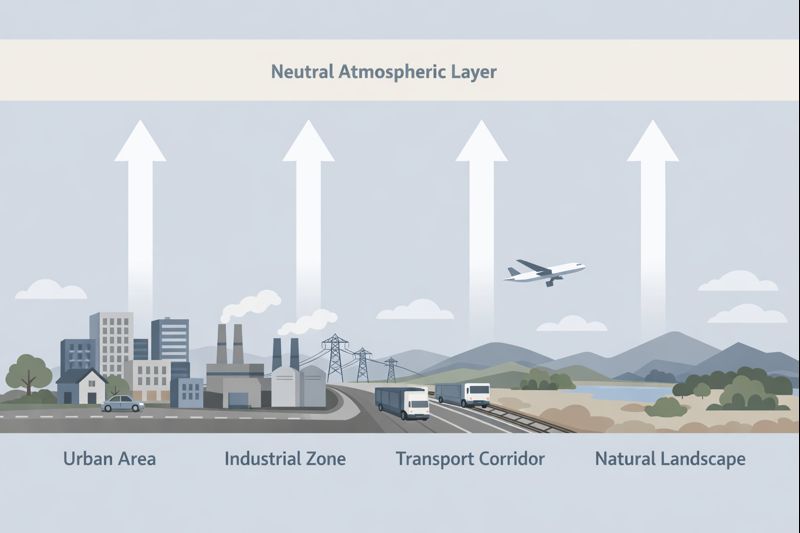
In air pollution research, sources are broadly grouped into anthropogenic and natural categories to distinguish human-related emission activities from background environmental processes.
What Is Meant by “Sources” in Air Pollution Studies
In air pollution research, the term source is used to denote the origin of pollutant emissions rather than the presence of pollutants in the atmosphere. An emission source refers to an activity, process, or phenomenon that releases substances into the air, whereas ambient pollutant presence describes the concentration of those substances measured at a given location and time. This distinction is foundational, as observed air quality levels reflect not only emissions but also atmospheric transport, chemical transformation, and removal processes.
Sources are commonly described as primary or secondary in conceptual terms. This distinction is closely related to the classification of pollutants themselves, which is explained in more detail in our guide to Primary and Secondary Air Pollutants. Primary sources directly emit pollutants into the atmosphere, such as particulate matter or gaseous compounds released during combustion or mechanical processes. Secondary sources refer to pollutants that are not emitted directly but are formed in the atmosphere through chemical reactions involving precursor substances. This classification is used to clarify origin pathways rather than to indicate magnitude or impact.
Anthropogenic and Natural Source Classifications
Air pollution sources are broadly grouped into anthropogenic (human-related) and natural categories. Anthropogenic sources include emissions associated with energy use, industrial activity, transportation, and other human systems. Natural sources encompass emissions arising from environmental processes such as wind-driven dust, vegetation-related emissions, or episodic events like wildfires.
This high-level categorization is widely applied in atmospheric science to organize diverse emission origins into analytically manageable groups. Source classification supports research comparability, enables systematic reporting, and provides a shared framework for interpreting air quality observations across regions and time periods.
Major anthropogenic source sectors include:
- Energy production and power generation
- Transportation and mobile sources
- Industrial processes
- Residential and commercial fuel use
Sectoral Attribution as an Analytical Construct
Within anthropogenic categories, emissions are often attributed to sectors, such as transport, industry, or residential activity. These sectors are defined for accounting and analysis purposes, grouping activities with similar functional characteristics. Sectoral attribution is an analytical construct rather than a direct representation of real-world separation. Many activities span multiple sectors, and emissions may arise from mixed or informal practices. As a result, strict sectoral boundaries are recognized as simplified representations used to support consistent analysis rather than definitive classifications of emission origins.
Major Anthropogenic (Human-Related) Source Categories
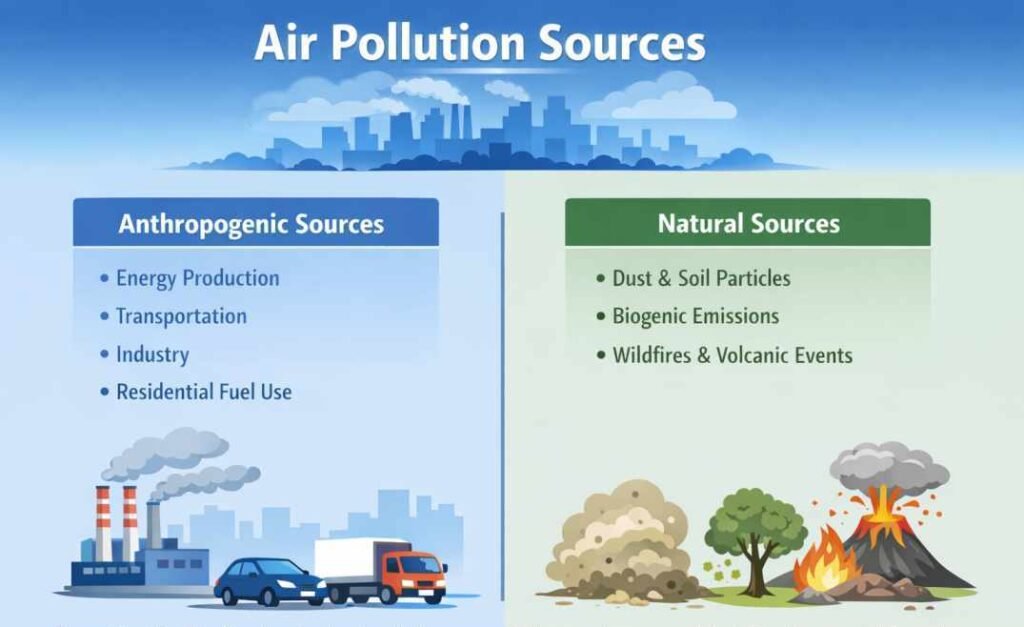
Anthropogenic sources of air pollution are defined in the literature as emissions arising from human activities that introduce substances into the atmosphere. For analytical clarity, these activities are grouped into broad source categories that reflect shared functional characteristics rather than individual behaviors. The categories described below are commonly used in emissions inventories and atmospheric research as definitional constructs, forming the basis for subsequent measurement and comparative analysis.
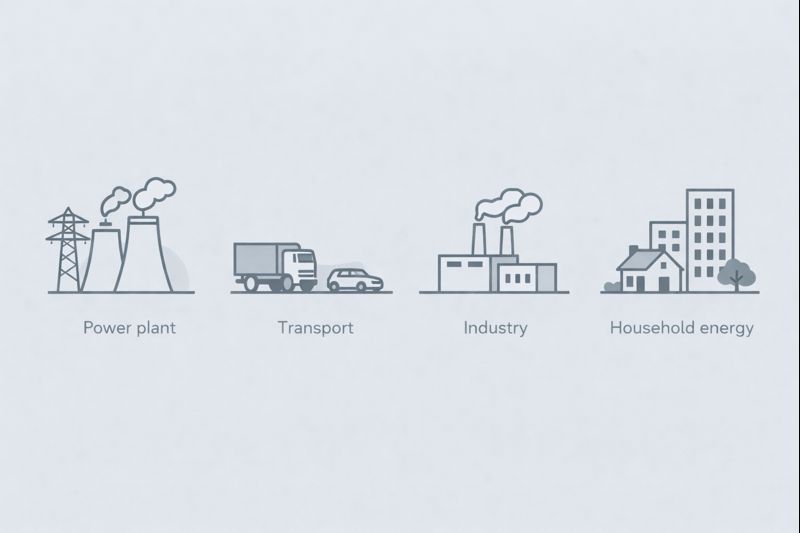
Energy Production and Combustion-Based Power Generation
Energy production is widely identified as a core anthropogenic source category due to its reliance on large-scale combustion processes. National emissions inventories and air-quality assessments consistently classify power generation as a major emission sector (Central Pollution Control Board; WHO Air Quality Guidelines). In this context, fossil fuel combustion is treated as a distinct emissions category encompassing the burning of coal, oil, natural gas, and related fuels for electricity and heat generation. These processes are characterized by continuous or semi-continuous operation and centralized infrastructure, such as thermal power plants.
Large-scale energy systems are associated with a defined set of pollutant types documented across studies. These typically include particulate matter of varying size fractions, sulfur dioxide, nitrogen oxides, and trace quantities of other combustion by-products. The categorization of energy production as a source does not imply uniform emission profiles, as fuel type, combustion technology, and operating conditions vary. Instead, the category serves to group emissions that originate from power generation activities within a shared analytical framework.
Transportation and Mobile Emission Sources
Transportation is classified as a major anthropogenic source through the category of mobile emission sources. This category includes on-road transport, such as cars, buses, and trucks, as well as non-road transport, including railways, aviation, shipping, and off-road machinery. The on-road versus non-road distinction is used to reflect differences in vehicle design, fuel use, and operational patterns.
Within transportation studies, a conceptual distinction is also made between exhaust and non-exhaust emissions. Exhaust emissions refer to pollutants released through fuel combustion in engines, while non-exhaust emissions include particles generated through mechanical processes such as brake wear, tire wear, and road surface interaction. This distinction is definitional and is used to clarify emission pathways rather than to assess relative importance. Together, these classifications allow transportation-related emissions to be systematically described within air pollution research.
Industrial Processes and Manufacturing Activities
Industrial sources are defined as emissions arising from manufacturing, processing, and extractive activities. In this category, research literature distinguishes between process-related and fuel-related emissions. Process-related emissions originate from chemical or physical transformations inherent to industrial production, such as material heating, chemical reactions, or material handling. Fuel-related emissions, by contrast, result from the combustion of fuels used to power industrial equipment or generate heat.
Emissions inventories often subdivide industrial activity into classes based on production type, such as metal processing, cement and construction materials, chemical manufacturing, and textiles. These classes are used to standardize reporting and facilitate cross-sector comparison. The industrial category encompasses a wide range of emission characteristics, reflecting variability in technology, scale, and raw materials, while remaining a unified analytical grouping.
Residential, Commercial, and Informal Combustion Sources
Residential and commercial combustion sources are defined through energy use at the household and small-enterprise level. Household fuel use is treated as a distinct source category in air pollution studies, encompassing fuels used for cooking, heating, and lighting. These sources are characterized by dispersed emission points and variable fuel types, which are documented descriptively in research.
Informal and small-scale combustion activities are also included within this category. These may involve unregistered enterprises, open burning associated with livelihoods, or localized fuel use not captured by formal sector classifications. In emissions classification systems, such activities are grouped to acknowledge their presence without assuming uniformity. Together, residential, commercial, and informal combustion sources form a defined anthropogenic category used to describe emissions arising from decentralized human energy use systems.
Natural and Semi-Natural Contributors to Air Pollution
Natural and semi-natural contributors to air pollution refer to airborne substances originating from environmental processes rather than direct human activity. In atmospheric science, these contributors are examined to distinguish background conditions from human-associated emissions and to clarify how naturally occurring materials interact with the atmosphere. Their inclusion in air pollution research reflects the need to describe the full range of inputs influencing ambient air composition, without implying manageability or intervention.
Geological and Crustal Sources
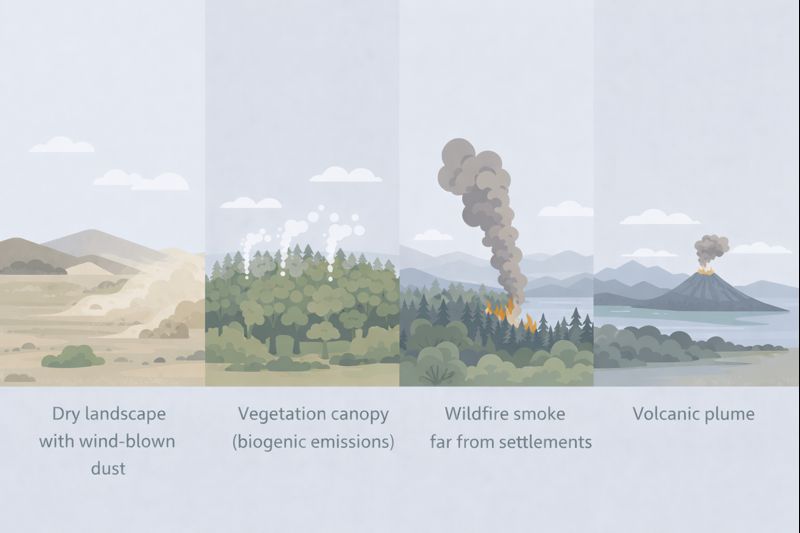
Geological and crustal sources primarily involve particulate matter generated from the Earth’s surface. Wind-driven erosion of soil, resuspension of dust from arid and semi-arid regions, and the mechanical breakdown of rocks contribute mineral particles to the atmosphere. These materials are commonly described as crustal aerosols and are composed of elements such as silicon, aluminum, calcium, and iron.
The presence of crustal particulates is observed to vary significantly by geography and season. Regions characterized by dry climates, sparse vegetation cover, or exposed soils tend to exhibit higher background levels of mineral dust. Seasonal patterns are also documented, with increased dust mobilization during dry or windy periods. In research contexts, these variations are treated as part of natural atmospheric dynamics rather than as anomalies, and they are often distinguished from anthropogenic particulates based on chemical composition and particle characteristics.
Biogenic Emissions
Biogenic emissions refer to gases released by living organisms, particularly vegetation. Among these, naturally occurring volatile organic compounds (VOCs) emitted by plants are frequently examined in atmospheric studies. These compounds are produced as part of normal biological processes, including plant growth and metabolic activity.
In descriptive atmospheric chemistry, biogenic VOCs are noted for their role in chemical reactions occurring in the air. Under certain conditions, they participate in processes that contribute to the formation of secondary pollutants, such as ozone or secondary organic aerosols. The emphasis in Phase 1 discussion remains on defining their origin and general behavior, rather than on quantifying impacts or drawing causal conclusions.
Episodic Natural Events
Some natural contributors to air pollution occur as episodic events rather than continuous background processes. Wildfires, volcanic eruptions, and large-scale dust storms are examples of such events. These phenomena can introduce substantial amounts of gases and particulates into the atmosphere over relatively short periods.
In analytical frameworks, a distinction is commonly made between baseline background concentrations and event-driven contributions. Episodic events are characterized by their temporal intensity and spatial reach, which may differ markedly from typical conditions. Their inclusion in air pollution studies serves to contextualize short-term deviations in observed air quality and to differentiate persistent background sources from irregular natural occurrences.
How Sectoral and Natural Sources Are Conceptually Integrated in Research
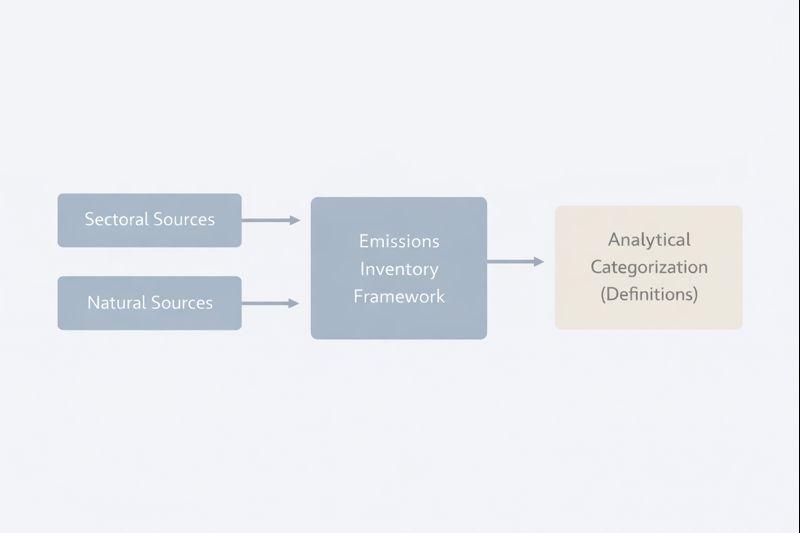
In air pollution research, sectoral and natural sources are not treated as isolated categories but are integrated within conceptual frameworks that allow researchers to describe the origins of pollutants in a structured and comparable manner. At the definition stage, this integration is primarily classificatory rather than quantitative, serving to organize diverse emission-generating activities and processes into analytically useful groupings.
Emissions Inventories as Conceptual Aggregations
Emissions inventories are widely used as organizing frameworks that aggregate information about pollutant sources according to predefined categories. At a conceptual level, inventories function as taxonomies: they specify what types of activities or processes are considered sources and how those sources are grouped. These groupings commonly distinguish between anthropogenic sectors (such as energy production or transport) and natural contributors (such as wind-blown dust or biogenic emissions), without yet addressing how much each contributes.
National emissions inventories are typically structured to reflect country-specific economic activities, regulatory classifications, and data availability. In India, these classifications are closely connected to national air-quality monitoring frameworks described in our guide to Air Pollution Monitoring in India. In India, for example, sector definitions used by Central Pollution Control Board align with national reporting and administrative categories. By contrast, global inventories developed under international frameworks, such as those referenced by the Intergovernmental Panel on Climate Change, apply standardized sector definitions to enable cross-country comparison. At this stage, differences between national and global inventories are conceptual rather than methodological, reflecting varying purposes rather than measurement techniques.
Such sectoral classification frameworks are reflected in institutional documentation published by national and international assessment bodies.
Regional Context and Source Dominance
Conceptual integration of sources also accounts for regional context. The relevance of particular source categories is understood to vary with geography, land use, and settlement patterns. Urban areas are commonly associated with dense transportation networks, commercial energy use, and industrial activity, whereas peri-urban regions may reflect mixed characteristics, including small-scale industry and residential fuel use. Rural contexts are more often associated, in definitional terms, with agricultural activities, biomass combustion, and natural dust sources.
These contrasts are used descriptively in research to contextualize source categories, not to assign relative importance or dominance. The emphasis remains on recognizing that the same conceptual source category can have different contextual meanings across regions.
In India, national emissions inventories compiled by the Central Pollution Control Board (CPCB) classify these sources into sectors such as power generation, transport, industrial activity, and residential fuel use. These sectoral categories are used in national air-quality assessments and policy frameworks to organize emissions data and support comparative analysis across regions.
Limits of Source Attribution at the Definition Stage
At the definition stage, source attribution is understood to have inherent limits. Many pollutants originate from overlapping activities or result from interactions between anthropogenic and natural processes. These combined influences are reflected in ambient measurements such as the Air Quality Index (AQI), which summarizes overall air-quality conditions. For example, particulate matter may include components derived from combustion, soil dust, and atmospheric chemical reactions, making single-source classification conceptually simplified.
For this reason, definitions are established prior to quantification in research workflows. Conceptual clarity allows researchers to specify categories consistently before engaging in measurement, modelling, or attribution analysis, which are addressed in later analytical phases and documented in institutional air quality assessment frameworks and national reporting documentation.
Conclusion
Within air pollution research, sectoral and natural sources are integrated at the conceptual level through definitional frameworks that organize diverse emission-generating activities into coherent categories. These frameworks are designed to clarify what is considered a source rather than to determine the magnitude of contributions. By distinguishing between anthropogenic sectors and natural contributors, research literature establishes a shared vocabulary that supports consistent description across studies.
Emissions inventories function as central organizing tools in this process, aggregating source categories according to nationally or internationally defined classifications. Differences between national and global inventories reflect variation in reporting objectives, administrative structures, and analytical scope, while maintaining broadly comparable conceptual foundations. Regional context further shapes how source categories are interpreted, as urban, peri-urban, and rural settings are associated with different dominant activities and environmental processes.
At the definition stage, limitations of source attribution are explicitly recognized. Many pollutants originate from overlapping or interacting sources, and simplified classifications are used to manage this complexity at an early analytical stage. As a result, conceptual definitions precede quantification in research workflows, providing a structured basis for subsequent measurement, modelling, and interpretation addressed in later phases of air pollution analysis.
Frequently Asked Questions (FAQ)
What are the main sources of air pollution?
Air pollution originates from both anthropogenic and natural sources. Major human-related sources include energy production, transportation, industrial activities, and residential fuel combustion. Natural contributors include wind-blown dust, biogenic emissions from vegetation, and episodic events such as wildfires or volcanic eruptions.
What is the difference between anthropogenic and natural sources?
Anthropogenic sources refer to emissions generated by human activities, such as vehicle use or industrial production. Natural sources originate from environmental processes, including soil dust, plant emissions, and natural fires.
Why are air pollution sources grouped into sectors?
Sectoral grouping is used in emissions inventories to organize complex emission activities into standardized categories. This allows researchers and policymakers to compare emissions across regions and time periods.
Are natural sources considered air pollution?
Natural emissions are not necessarily pollution in a regulatory sense. However, they contribute substances to the atmosphere that influence measured air quality and atmospheric chemistry.
References
- Central Pollution Control Board (CPCB). (n.d.). National Air Quality Index (AQI): Technical Framework of Air Quality Index. Government of India.
- Central Pollution Control Board (CPCB). (n.d.). National Air Quality Monitoring Programme (NAMP): Guidelines and Methodology. Government of India.
- Ministry of Environment, Forest and Climate Change (MoEFCC). (2009). National Ambient Air Quality Standards (NAAQS). Government of India.
- World Health Organization (WHO). (2021). WHO Global Air Quality Guidelines: Particulate Matter (PM2.5 and PM10), Ozone, Nitrogen Dioxide, Sulfur Dioxide and Carbon Monoxide. Geneva: WHO.
- World Health Organization (WHO). (2006). Air Quality Guidelines: Global Update 2005. Copenhagen: WHO Regional Office for Europe.
(Optional, include only if used) - World Health Organization (WHO). (n.d.). Air Quality Monitoring: A Practical Guide. World Health Organization.
- Seinfeld, J. H., & Pandis, S. N. (2016). Atmospheric Chemistry and Physics: From Air Pollution to Climate Change (3rd ed.). Wiley.
(Your version says Academic Press, but the standard publisher is Wiley.)
GreenGlobe25 Editorial Research Team
The GreenGlobe25 Editorial Research Team produces independent educational research content focused exclusively on air pollution in India. Content is developed using publicly available government datasets, institutional reports, and peer-reviewed scientific literature.
The team does not conduct primary data collection or experimental research. All material is written for general educational understanding and follows a documented editorial process emphasizing source verification, conceptual clarity, and neutral interpretation.
GreenGlobe25 content is informational in nature and does not provide medical, legal, regulatory, or policy advice. The platform maintains a non-commercial, non-advocacy approach to air pollution research communication.
Health Disclaimer
This content is provided for general educational and informational purposes only and does not offer medical, health, exposure, or risk-reduction guidance.

- Health Effects of Air Pollution: Short-Term and Long-Term Impacts - March 24, 2026
- What AQI Numbers Mean in India (AQI Chart + Health Effects Guide) - March 22, 2026
- Emission Inventory in India: How Pollution Sources Are Measured (Complete Guide) - March 21, 2026