
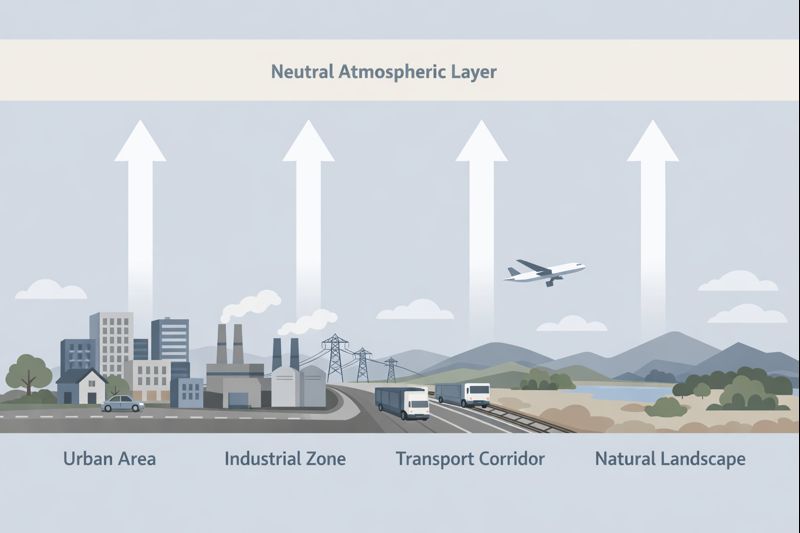
Quick Answer: Air pollution sources are the activities and natural processes that release pollutants into the atmosphere.
They are broadly classified into human (anthropogenic) and natural sources.
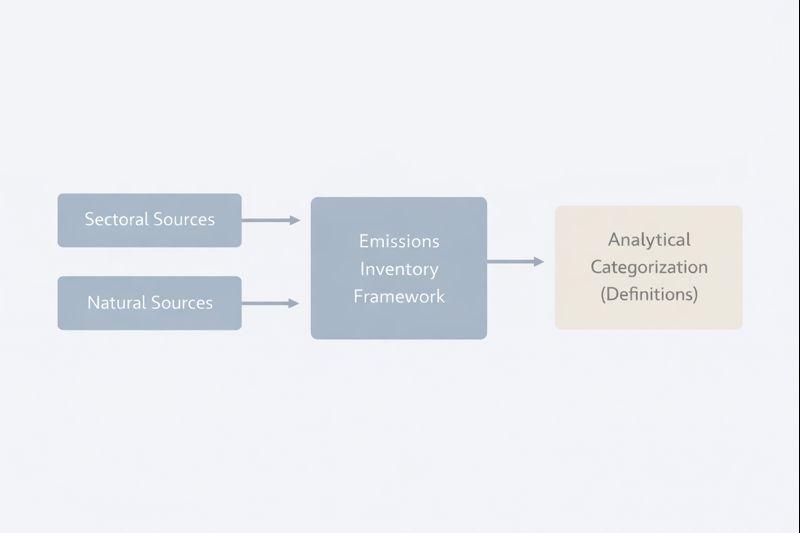
Scientists group these sources into sectors to study emissions, monitor air quality, and develop pollution-control strategies.
Introduction
Air pollution comes from many different human activities and natural environmental processes. These origins are known as sources of air pollution.
Understanding pollution sources helps explain where pollutants come from, how they enter the atmosphere, and why air quality differs between cities, regions, and seasons.
In environmental science, air pollution sources are broadly grouped into two categories:
- anthropogenic (human-related) sources
- natural sources
Human-related sources include transportation, industries, power generation, construction activity, and residential fuel combustion. Natural contributors include dust storms, vegetation emissions, wildfires, and volcanic activity.
This guide explains the major sectoral and natural contributors to air pollution and how these source categories are used in air pollution research and environmental monitoring.
After reading this guide, you will be able to:
- Explain what air pollution sources are.
- Distinguish natural and anthropogenic sources.
- Identify the major emission sectors in India.
- Understand why pollution sources are grouped in emission inventories.
What Are Sources of Air Pollution?
In air pollution studies, a source refers to any activity, process, or natural phenomenon that releases pollutants into the atmosphere. Before exploring different pollution sources, it is helpful to understand what air pollution is and how pollutants enter the atmosphere.
A source does not describe pollution already present in the air. Instead, it explains where pollutants originally come from.
For example:
- vehicle exhaust releases pollutants from transportation systems
- thermal power plants emit pollutants during fuel combustion
- dust storms introduce natural particulate matter into the atmosphere
Air quality at a location is influenced not only by pollution sources but also by weather conditions, atmospheric transport, and chemical reactions occurring in the atmosphere.
In environmental research, pollution sources are broadly grouped into anthropogenic (human-related) and natural categories to distinguish emissions generated by human activities from naturally occurring environmental processes.
Key Takeaways
- Air pollution originates from both human activities and natural environmental processes.
- Major human-related sources include transportation, industries, power generation, and residential fuel combustion.
- Natural contributors include dust storms, vegetation emissions, and wildfires.
- Pollution sources are grouped into sectors to support environmental research and air-quality analysis.
- Different regions experience different dominant pollution sources depending on climate, land use, and human activity.
Human vs Natural Sources of Air Pollution
| Human (Anthropogenic) Sources | Natural Sources |
|---|---|
| Vehicle emissions | Dust storms |
| Thermal power plants | Wildfires |
| Industrial activities | Volcanic activity |
| Construction and road dust | Sea salt aerosols |
| Residential fuel and biomass burning | Biogenic emissions from vegetation |
Key Point: Human sources are produced by human activities, whereas natural sources originate from environmental processes. Both can influence local air quality, but their frequency, intensity, and control measures differ.
Anthropogenic and Natural Pollution Sources
Air pollution sources are broadly divided into two major categories:
Anthropogenic Sources
Anthropogenic sources are caused by human activities. These include emissions from transportation, industries, thermal power plants, construction activities, and residential fuel combustion.
Most urban air pollution is strongly influenced by anthropogenic emissions generated through fuel combustion, industrial production, and energy use.
Natural Sources
Natural sources originate from environmental processes rather than direct human activity. Common examples include dust storms, wildfires, volcanic activity, sea salt particles, and gases released by vegetation.
Natural contributors can affect air quality significantly under certain seasonal and weather conditions.
This classification helps researchers organize pollution sources into simplified categories for environmental monitoring and air-quality analysis.
| Source Sector | Major Pollutants |
|---|---|
| Transport | PM₂.₅, NO₂, CO, VOCs |
| Thermal Power | PM, SO₂, NOₓ |
| Industry | PM, SO₂, Heavy Metals |
| Construction | PM₁₀, PM₂.₅ |
| Biomass Burning | PM₂.₅, CO, VOCs |
Different pollution sources emit different mixtures of pollutants, which is why scientists classify emission sectors separately when assessing air quality and designing pollution-control strategies.
Why Pollution Sources Are Grouped into Sectors
In air pollution research, human-related emission sources are often grouped into sectors such as transportation, industry, power generation, and residential fuel use.
These sector categories help researchers organize complex emission activities into simplified groups for environmental monitoring, emissions inventories, and policy analysis. These standardized sector classifications are also used when preparing national and regional emission inventories.
For example, vehicle exhaust emissions are grouped under the transportation sector, while emissions from thermal power plants are grouped under energy production.
Although real-world pollution sources often overlap, sector-based classification helps create a standardized system for comparing pollution patterns across cities, regions, and time periods.
Major Anthropogenic (Human-Related) Source Categories
Anthropogenic air pollution sources are emissions generated through human activities. In environmental research, these sources are grouped into major sectors based on the type of activity producing the emissions.
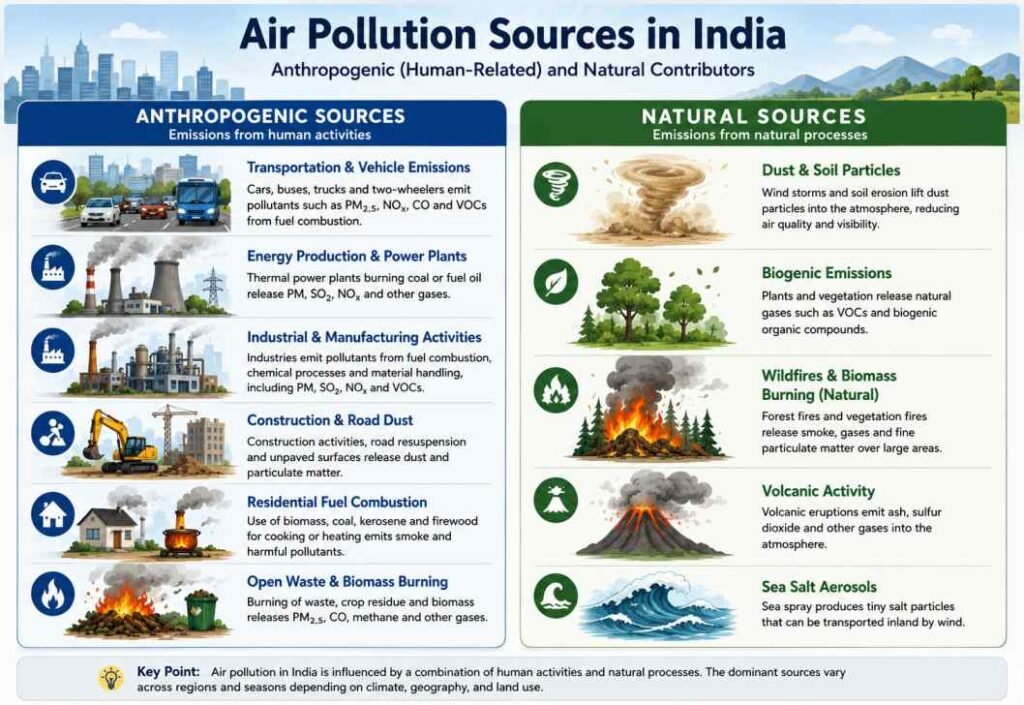
Common anthropogenic source categories include:
- energy production and thermal power generation
- transportation and vehicle emissions
- industrial and manufacturing activities
- construction and road dust
- residential fuel combustion
- open waste and biomass burning
These categories commonly appear in emissions inventories, environmental monitoring programs, and air-quality policy frameworks.
Different sectors release different combinations of pollutants depending on fuel type, technology, operating conditions, and emission controls.
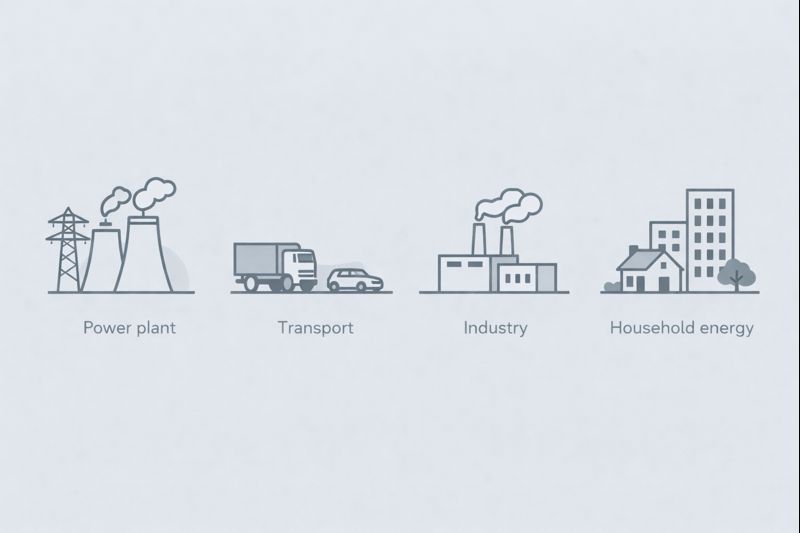
Energy Production and Power Generation
Energy production is one of the major anthropogenic sources of air pollution. Large thermal power plants and industrial combustion systems release pollutants during the burning of fossil fuels such as coal, oil, and natural gas.
Common pollutants associated with power generation include:
Many of these pollutants are classified as criteria pollutants because they are routinely monitored to assess ambient air quality.
- particulate matter (PM₂.₅ and PM₁₀)
- sulfur dioxide (SO₂)
- nitrogen oxides (NOₓ)
- carbon monoxide (CO)
In India, coal-based thermal power plants are important contributors to industrial air emissions in several urban and industrial regions.
Emission levels vary depending on fuel type, combustion technology, plant efficiency, and pollution-control systems installed at the facility.
Transportation and Vehicle Emissions
Transportation is one of the most important urban sources of air pollution. Emissions are generated from cars, buses, trucks, two-wheelers, railways, shipping, and other mobile sources.
Vehicle-related air pollution mainly comes from:
- fuel combustion in engines
- diesel exhaust emissions
- brake and tire wear
- road dust resuspension
Common pollutants associated with transportation include:
- PM₂.₅
- PM₁₀
- nitrogen dioxide (NO₂)
- carbon monoxide (CO)
- volatile organic compounds (VOCs)
In large Indian cities such as Delhi, Mumbai, and Bengaluru, traffic congestion and high vehicle density can significantly increase urban pollution levels, especially during peak traffic hours.
Emission intensity varies depending on vehicle type, fuel quality, traffic conditions, and emission-control technologies.
Example from Indian Cities
In cities such as Delhi and Bengaluru, traffic congestion during peak commuting hours can significantly increase roadside concentrations of PM₂.₅ and nitrogen dioxide (NO₂).
Industrial and Manufacturing Activities
Industrial activities are major contributors to air pollution in many urban and industrial regions. Emissions are generated during manufacturing processes, material handling, fuel combustion, and chemical operations.
Common industrial sources include:
- cement production
- metal processing
- chemical manufacturing
- brick kilns
- refineries
- textile and construction-material industries
Industrial emissions may contain:
- particulate matter (PM)
- sulfur dioxide (SO₂)
- nitrogen oxides (NOₓ)
- volatile organic compounds (VOCs)
- heavy metals and trace pollutants
Pollution levels vary depending on industrial technology, fuel use, production scale, and emission-control systems.
In India, industrial clusters located near urban areas can significantly influence regional air quality, especially where multiple industries operate within a concentrated area.
Construction Activity and Road Dust
Construction activity is an important source of particulate pollution in many growing urban areas. Dust is generated during excavation, demolition, material transport, concrete mixing, and road construction.
Road dust also contributes to air pollution when vehicle movement resuspends loose dust particles into the atmosphere.
Common pollutants associated with construction and road dust include:
- PM₂.₅
- PM₁₀
- mineral dust particles
Construction-related pollution is often more noticeable in densely populated cities with rapid urban expansion and heavy traffic movement.
In India, construction dust and road dust resuspension are frequently identified as important contributors to urban particulate pollution, especially during dry weather conditions.
Residential Fuel Combustion and Biomass Burning
Residential fuel use is an important source of air pollution in many regions. Emissions are produced during cooking, heating, lighting, and small-scale combustion activities.
Common fuels include:
- firewood
- coal
- kerosene
- agricultural residue
- charcoal
- biomass fuels
Biomass burning and household fuel combustion release pollutants such as:
- PM₂.₅
- carbon monoxide (CO)
- nitrogen oxides (NOₓ)
- volatile organic compounds (VOCs)
Open burning of waste and crop residue can also increase particulate pollution and smoke concentrations in surrounding areas.
In several parts of India, biomass combustion and seasonal crop-residue burning are associated with increased air pollution during dry and winter periods.
Seasonal Pollution in North India
During winter, crop-residue burning and stagnant atmospheric conditions can contribute to elevated particulate pollution across parts of northern India.
Natural and Semi-Natural Contributors to Air Pollution
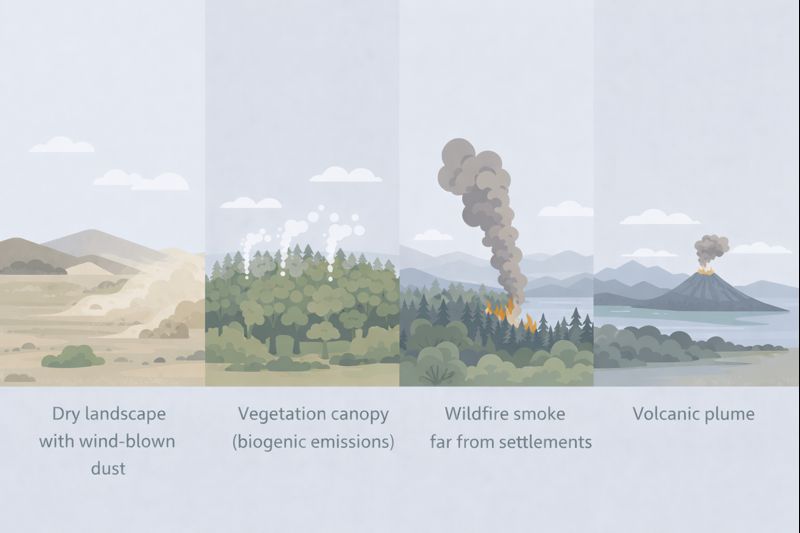
Not all air pollution originates from human activities. Some pollutants enter the atmosphere through natural environmental processes.
Natural and semi-natural contributors commonly include:
- dust storms
- wildfires
- volcanic activity
- sea salt particles
- gases released by vegetation
These natural processes can affect air quality temporarily or seasonally depending on weather conditions, geography, and atmospheric movement.
For example, dry regions may experience higher dust concentrations during windy periods, while wildfire smoke can increase particulate pollution across large areas.
In India, seasonal dust transport and dry-weather conditions can contribute to elevated particulate matter levels in several northern and western regions.
Dust and Geological Sources
Dust and soil particles are important natural contributors to airborne particulate matter. These particles are generated through wind-driven erosion, dry soil movement, and the breakdown of rocks and surface materials.
Common natural dust sources include:
- desert dust
- dry soil erosion
- exposed land surfaces
- wind-blown mineral particles
Dust concentrations often increase during dry seasons, strong winds, and low-moisture conditions.
In India, northern and western regions can experience increased particulate pollution during dry summer periods because of dust transport and exposed soil conditions.
These natural dust particles are commonly classified as crustal aerosols in atmospheric science because they originate from the Earth’s surface.
Biogenic Emissions from Vegetation
Some gases released naturally by plants and vegetation can also influence air quality. These emissions are known as biogenic emissions.
Plants release naturally occurring volatile organic compounds (VOCs) during biological and chemical processes.
Under certain atmospheric conditions, these gases can participate in chemical reactions that contribute to the formation of:
- ground-level ozone (O₃)
- secondary organic aerosols
- photochemical smog
Ground-level ozone is a secondary pollutant because it forms through chemical reactions in the atmosphere rather than being emitted directly.
Biogenic emissions are part of normal environmental processes and are commonly studied in atmospheric chemistry and air-pollution research.
The impact of these emissions varies depending on vegetation type, temperature, sunlight, and atmospheric conditions.
Episodic Natural Events
Some natural pollution sources occur as short-term environmental events rather than continuous background processes.
Examples include:
- wildfires
- volcanic eruptions
- large dust storms
- forest-fire smoke transport
These events can release large amounts of gases and particulate matter into the atmosphere over short periods.
Wildfire smoke, for example, can increase PM₂.₅ concentrations across large regions, while dust storms may significantly reduce air quality and visibility.
The intensity and duration of these pollution events vary depending on weather conditions, wind patterns, and geographic location.
In air-pollution research, episodic natural events are studied separately from regular background pollution because they can temporarily change regional air-quality conditions very rapidly.
How Pollution Sources Are Used in Research and Monitoring
Air pollution sources are grouped into categories to help researchers, environmental agencies, and policymakers study pollution patterns more systematically.
These source categories are commonly used in:
- emissions inventories
- air-quality monitoring programs
- pollution-control planning
- environmental impact assessments
- AQI and atmospheric research
Air-quality monitoring stations measure pollutant concentrations in the atmosphere, helping researchers compare measured pollution with estimated emission sources.
For example, emissions data may be grouped into sectors such as transportation, industry, power generation, and residential fuel use to understand how different activities influence air quality.
In India, organizations such as the Central Pollution Control Board (CPCB) use sector-based classifications in national air-quality assessments and environmental reporting frameworks.
Many of these measurements are collected through Continuous Ambient Air Quality Monitoring Systems (CAAQMS), which provide real-time pollution data.
Grouping pollution sources into standardized categories also helps researchers compare pollution trends across cities, regions, and time periods more consistently.
Researchers first identify pollution sources.
↓
They estimate emissions.
↓
They monitor pollutants.
↓
AQI summarizes the measured pollution.
↓
Governments use the results to plan pollution control.
Why Pollution Sources Differ Between Regions
Air pollution sources vary significantly between cities and regions depending on climate, geography, population density, industrial activity, and energy use.
For example:
- large metropolitan cities often experience higher transportation and industrial emissions
- industrial regions may show increased pollution from manufacturing and power generation
- rural areas may experience more biomass burning and agricultural emissions
- dry regions may have higher dust concentrations during summer periods
Seasonal weather conditions also influence which pollution sources become more important at different times of the year.
In India, winter pollution in northern cities is often associated with traffic emissions, biomass burning, industrial activity, and stagnant atmospheric conditions that trap pollutants near the ground.
Example: Winter Pollution in North India
During winter months, several North Indian cities experience increased particulate pollution because lower temperatures, weak winds, biomass burning, and stagnant atmospheric conditions reduce pollutant dispersion.
Quick Takeaway: Different regions experience different pollution sources depending on transportation activity, industrial development, climate conditions, fuel use, and seasonal weather patterns.
Limits of Pollution Source Classification
Although pollution sources are grouped into categories for research and monitoring, real-world air pollution is often more complex.
Many pollutants originate from multiple overlapping activities and environmental processes at the same time.
For example, particulate matter in urban air may contain contributions from:
- vehicle emissions
- industrial activity
- construction dust
- biomass burning
- natural soil particles
Weather conditions, atmospheric transport, and chemical reactions can also change how pollutants behave after entering the atmosphere.
For this reason, pollution-source categories are used as simplified analytical tools rather than exact representations of real-world conditions.
These classifications help researchers organize pollution data more consistently before conducting detailed measurement, modelling, and source-attribution studies.
A pollution source does not directly determine AQI.
Instead, pollution sources release pollutants such as PM₂.₅, PM₁₀, NO₂, SO₂, and VOCs into the atmosphere.
Weather conditions, atmospheric transport, and chemical reactions determine how these pollutants accumulate before they are reflected in the Air Quality Index (AQI).
This is why two cities with similar pollution sources may experience different AQI values on the same day.
Conclusion
Air pollution originates from a wide range of human activities and natural environmental processes. Transportation, industries, power generation, construction activity, residential fuel use, dust emissions, and wildfire smoke all contribute to changing air-quality conditions.
Grouping these sources into categories helps researchers and environmental agencies study pollution patterns more systematically and develop air-quality monitoring and pollution-control strategies.
Understanding where pollutants come from is an important first step before learning how the Air Quality Index (AQI) is calculated and how pollutant concentrations are converted into AQI values.
Which Pollution Sources Dominate Different Parts of India?
Different regions of India experience different dominant pollution sources because of climate, land use, industrial activity, transportation patterns, and seasonal weather.
| Region | Major Pollution Sources |
|---|---|
| Delhi NCR | Traffic emissions, construction dust, crop-residue burning |
| Mumbai Metropolitan Region | Vehicle emissions, industries, port activities |
| Indo-Gangetic Plain | Biomass burning, residential fuel use, dust transport |
| Western India | Desert dust, industrial emissions, road dust |
| Coastal Cities | Traffic emissions, industrial activities, sea salt aerosols |
Educational Note: Air pollution sources are not identical across India. Understanding regional source patterns helps explain why AQI and pollution control strategies differ from one city to another.
Frequently Asked Questions (FAQ)
What are the main sources of air pollution?
Major sources of air pollution include transportation, industries, thermal power plants, construction activity, residential fuel combustion, biomass burning, and natural contributors such as dust storms and wildfires.
What is the difference between anthropogenic and natural pollution sources?
Anthropogenic sources are caused by human activities such as vehicle use and industrial production, while natural sources originate from environmental processes like dust emissions, vegetation gases, and wildfires.
Why are pollution sources grouped into sectors?
Sector-based grouping helps researchers and environmental agencies organize emissions data for air-quality monitoring, emissions inventories, and pollution-control planning.
Can natural events affect air quality?
Yes. Dust storms, wildfires, and volcanic activity can temporarily increase particulate pollution and reduce air quality over large regions.
Why do pollution sources differ between cities?
Pollution sources differ because cities vary in traffic density, industrial activity, fuel use, climate conditions, construction activity, and surrounding geography.
Which pollution sources are common in Indian cities?
Common urban pollution sources in India include vehicle emissions, industrial activity, thermal power plants, construction dust, road dust, and residential fuel combustion.
What are the major human sources of air pollution?
The major human-related sources include transportation, thermal power generation, industrial activities, construction and road dust, residential fuel combustion, and open biomass or waste burning.
What are the main natural sources of air pollution?
Natural sources include dust storms, wildfires, volcanic activity, sea salt aerosols, and gases released by vegetation. Their impact usually varies with weather and seasonal conditions.
Can natural sources cause poor AQI?
Yes. Events such as dust storms and wildfire smoke can temporarily raise particulate matter concentrations and reduce air quality, resulting in poor AQI values even without a major increase in human emissions.
To understand whether these AQI levels are considered healthy or hazardous, see our guide to safe AQI categories in India.
Which pollution source is most important in Indian cities?
There is no single dominant source for every city. Traffic emissions, industrial activities, construction dust, and residential fuel use are among the most common contributors, but their relative importance depends on local geography, economic activity, and season.
Remember These Key Points
- Pollution sources release pollutants, but they are not pollutants themselves.
- Human and natural sources both affect air quality.
- Different sectors release different pollutant mixtures.
- Weather influences how emissions affect AQI.
- Pollution sources vary across different regions of India.
References
- CPCB — National Air Quality Index (AQI) Framework
- CPCB — National Air Monitoring Programme (NAMP)
- Ministry of Environment, Forest and Climate Change (MoEFCC) — National Ambient Air Quality Standards (NAAQS)
- WHO — Global Air Quality Guidelines
- WHO — Air Pollution and Health Resources
- CPCB — Air Quality Management in India
Health Disclaimer
This content is provided for general educational and informational purposes only and does not offer medical, health, exposure, or risk-reduction guidance.