
Introduction
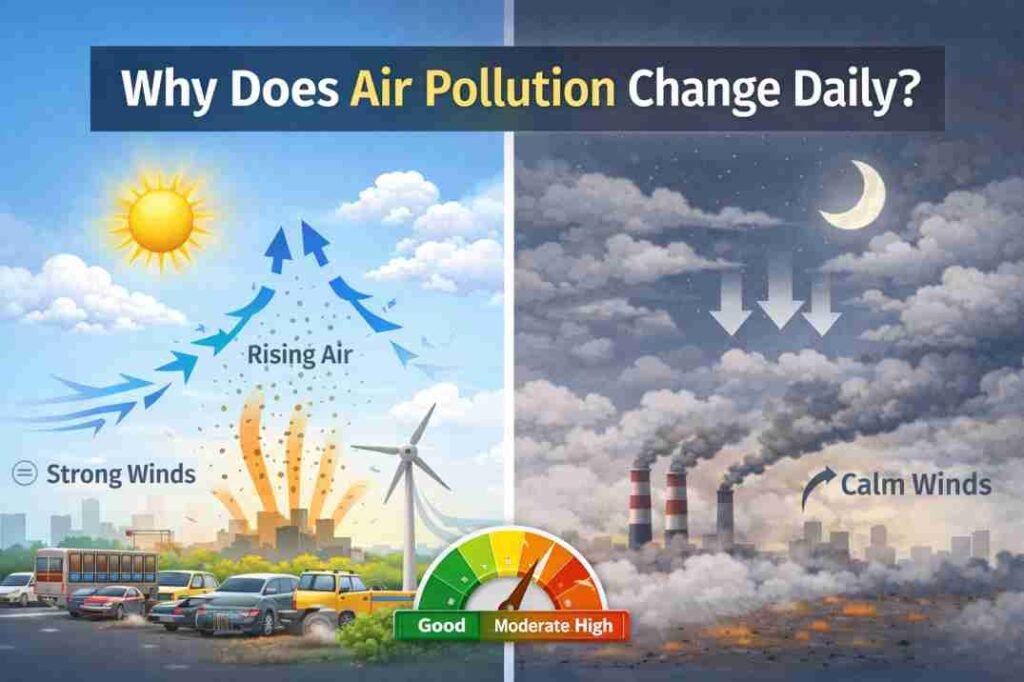
Air pollution changes daily because weather conditions—such as wind, temperature, and atmospheric mixing—control whether pollutants disperse or get trapped near the ground.
Even when emissions from vehicles, industries, and construction remain similar, AQI levels can shift dramatically within hours. This is why air quality in Indian cities can move from “moderate” to “very poor” in a single day.
In simple terms, pollution is always being produced—but whether it builds up or clears depends on how the atmosphere behaves.
You might notice AQI suddenly worsen overnight—even when traffic and daily activity look the same.
This is the core reason why air pollution changes daily, even when emission sources remain similar.
India’s AQI system, defined by the Central Pollution Control Board (CPCB), measures real-time concentrations of pollutants like PM2.5, PM10, NO₂, and ozone to reflect these rapid daily changes.
According to CPCB data, AQI levels in Indian cities can fluctuate significantly within hours depending on meteorological conditions.
Why Air Pollution Changes Daily (Quick Answer)
Air pollution changes daily because atmospheric conditions like wind speed, temperature, humidity, and vertical air mixing determine whether pollutants disperse or build up. Even with similar emissions, poor dispersion conditions can rapidly increase AQI.
Real Example: How AQI Changes Overnight in Delhi
Content:
In cities like Delhi, AQI can change dramatically within a single day—even when pollution sources remain similar.
For example, during winter:
- AQI can rise from around 150 (moderate) in the afternoon
- to 350–400 (very poor to severe) by the next morning
This sharp increase often happens without a major change in traffic or industrial activity.
The reason is not a sudden spike in emissions, but a change in atmospheric conditions:
- Night-time cooling reduces vertical mixing
- Wind speeds drop
- Pollutants get trapped near the ground
According to the Central Pollution Control Board (CPCB), such fluctuations are common during winter pollution episodes in North India, especially in Delhi NCR.
The Key Idea: Pollution Is Not Constant
Air pollution is not fixed—it responds continuously to changing atmospheric conditions.
This is why two days with similar traffic, industrial activity, and fuel use can still have very different AQI levels.
Same Sources, Different Outcomes
Consider a typical city day:
- Vehicles are on the road
- Industries are operating
- Construction activity continues
These sources may remain fairly consistent from one day to the next.
Yet:
- One day feels clear
- Another feels hazy and polluted
This is why pollution can feel unpredictable—even when nothing obvious has changed.
The difference is not always in how much pollution is produced—but in what happens to that pollution after it is released.
If pollutants are quickly dispersed, air quality improves.
If they remain trapped near the ground, pollution builds up.
Air Pollution as a Dynamic System
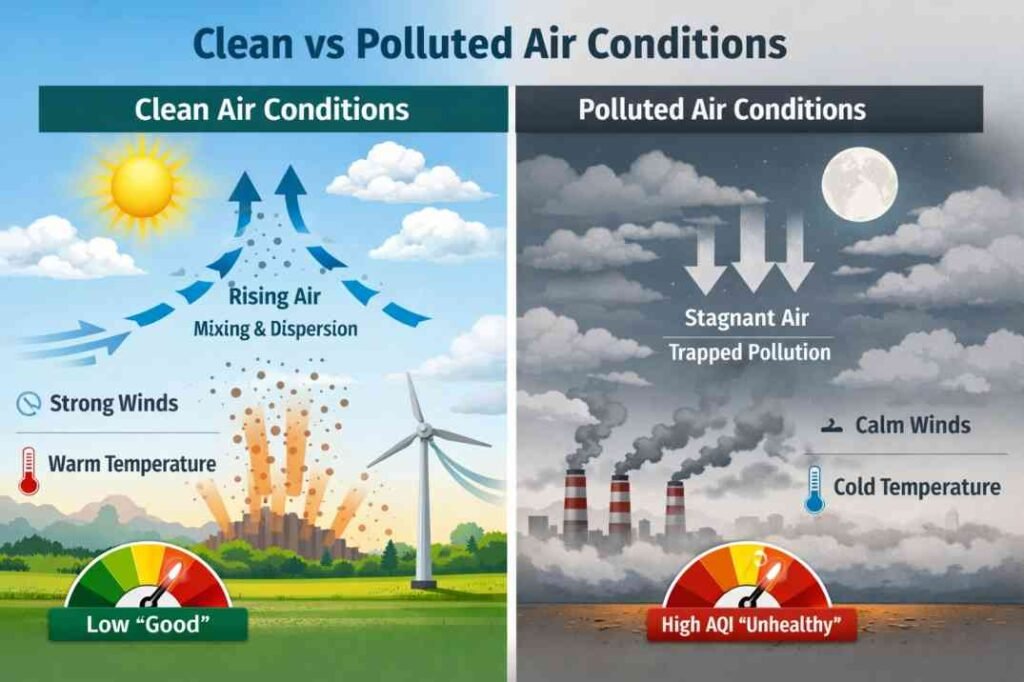
Air pollution is a dynamic system—constantly changing as emissions, weather, and atmospheric conditions interact.
A dynamic system means:
- Conditions are constantly changing
- Multiple factors interact at the same time
- Small changes can lead to very different outcomes
In the case of air pollution, three components are always interacting:
- Emissions (how much pollution is released)
- Weather (wind, temperature, humidity)
- Atmospheric behavior (how pollutants move, mix, or get trapped)
These factors are continuously shifting throughout the day.
Why This Matters for Daily AQI Changes
This explains an important but often overlooked point:
Pollution levels are not controlled by emissions alone.
In the short term, weather and atmospheric conditions often have a stronger influence on how polluted the air becomes.
That is why:
- A windy day can “clean” the air quickly
- A calm, cold day can cause pollution to spike rapidly
One important insight:
Even if pollution sources remain the same, air quality can worsen dramatically simply because the atmosphere stops dispersing pollutants.
This means many severe pollution days are not caused by more emissions—but by the atmosphere failing to clear what is already there.
A Simple Way to Think About It
You can think of air pollution like smoke in a room:
- If windows are open and air is moving → smoke clears quickly
- If the room is closed and still → smoke accumulates
The amount of smoke may be the same, but the outcome is completely different.
Air pollution in cities behaves in a similar way—constantly changing based on how the atmosphere handles it.
Common Misconception: “Pollution increases because emissions increase daily”
This is not always true.
In many cases, emissions remain relatively stable from day to day. What actually changes is how the atmosphere behaves.
- If dispersion is strong → pollution decreases
- If dispersion is weak → pollution accumulates
This is why severe pollution episodes are often caused by trapped pollution, not sudden emission spikes.
Why AQI Changes Daily: Main Factors
Weather Conditions (Most Important Factor)
Weather is the single most important reason why air pollution changes from day to day. Even if emissions remain similar, small changes in weather can significantly alter how pollutants behave in the air.
Wind speed and direction
Wind determines whether pollution stays concentrated or gets dispersed.
- High wind speed: Pollutants are spread out quickly, leading to lower pollution levels
- Low or calm wind: Pollutants accumulate in the same area, increasing AQI
- Wind direction: Can carry pollution from other regions (for example, crop burning smoke traveling into cities)
Temperature
Temperature affects how air moves vertically.
- Warmer surface air: Rises and carries pollutants upward, helping dispersion
- Cooler surface air: Stays near the ground, allowing pollutants to build up
- Sudden temperature changes can quickly shift pollution levels within hours
Humidity
Humidity influences how pollutants behave, especially fine particles (PM2.5).
- High humidity can cause particles to absorb moisture and grow in size
- This makes pollution more persistent and often worsens visibility (haze or smog)
- It can also enhance chemical reactions in the atmosphere
Atmospheric Mixing and Dispersion
Beyond surface weather, how the atmosphere mixes vertically plays a critical role in pollution levels.
Vertical mixing
During the daytime, sunlight heats the ground, causing air to rise. This creates vertical movement that helps dilute pollutants.
- Strong mixing (daytime): Pollution spreads upward → lower concentrations
- Weak mixing (night): Pollution stays near the ground → higher concentrations
Boundary layer (simplified)
The boundary layer is the lowest part of the atmosphere where we live and breathe.
- When the boundary layer is high, pollutants have more space to disperse
- When it is low, pollutants are compressed into a smaller volume of air
Key idea:
A lower boundary layer = more concentrated pollution. This is often measured as “mixing height,” which directly determines how much air volume is available to dilute pollutants.
This is one of the key reasons why pollution spikes during certain times of the day and seasons.
Think of the atmosphere like a vertical space above the city.
When this space is large, pollution spreads out.
When it becomes shallow, the same pollution is compressed—making the air more polluted.
Human Activity Patterns
Daily human behavior creates predictable fluctuations in pollution levels.
Traffic peaks (morning and evening)
- Morning rush hour increases emissions when atmospheric mixing is still weak
- Evening traffic coincides with cooling temperatures, which can trap pollution
Industrial cycles
- Some industries operate on fixed schedules, leading to periodic increases in emissions
- Power plants and small-scale industries may contribute more during peak demand hours
Festivals and episodic spikes
- Firecrackers during festivals like Diwali can cause sudden, sharp increases in pollution
- Local burning (waste, biomass) can create temporary but intense spikes
These short-term events can push AQI into severe categories even if background pollution is moderate.
Seasonal Influences (India Context)
Seasonal patterns strongly influence how pollution behaves across India.
Winter vs summer behavior
- Winter: Low wind speeds, cooler temperatures, and frequent temperature inversions trap pollutants near the ground
- Summer: Stronger sunlight and better air circulation help disperse pollutants, though dust can still increase PM levels
Crop burning impact
- Post-monsoon agricultural burning in states like Punjab and Haryana releases large amounts of smoke
- Winds transport this pollution to northern cities, especially Delhi
Dust storms
- Common in pre-monsoon summer months
- Increase coarse particulate matter (PM10), even if combustion-related pollution is unchanged
This combination of weather, atmospheric behavior, human activity, and seasonal patterns explains why air pollution is constantly changing—even when emission sources appear similar.
Why Pollution Is Worse in Winter (India Example)
Winter is the most polluted season in many Indian cities, especially in North India. Even if pollution sources like vehicles and industries remain active throughout the year, pollution levels rise sharply during winter due to changes in atmospheric conditions.
The key reason is not an increase in emissions alone, but how the atmosphere behaves during colder months.
Temperature Inversion Traps Pollution
Under normal conditions, warm air near the ground rises and carries pollutants upward, allowing them to disperse.
In winter, this pattern often reverses.
A layer of warm air forms above cooler air near the surface—this is called temperature inversion. This layer acts like a lid, trapping pollutants close to the ground.
As a result:
- Pollutants cannot disperse upward
- Pollution accumulates near breathing level
- AQI rises quickly even with normal emissions
This is one of the main reasons cities like Delhi experience severe smog episodes in winter.
Low Wind Speeds Reduce Dispersion
Winter days often have calm or very weak winds.
Without sufficient wind:
- Pollutants stay concentrated in one area
- There is little horizontal movement to clear the air
- Pollution builds up over several days
In contrast, stronger winds in summer help carry pollutants away, improving air quality.
Shallow Mixing Layer Keeps Pollution Near Ground
The mixing layer is the part of the atmosphere where pollutants can spread.
In winter, this layer becomes very shallow.
This means:
- Pollutants are confined to a smaller vertical space
- Concentration increases rapidly
- Even small emissions can lead to high pollution levels
Think of it like smoke trapped in a low ceiling room—it becomes dense very quickly.
Increased Humidity and Fog
Winter often brings higher humidity and foggy conditions.
This affects pollution in two ways:
- Fine particles (PM2.5) absorb moisture and grow in size
- Fog combines with pollutants to form smog, reducing visibility and worsening air quality
This is why winter pollution often appears as thick haze.
Seasonal Sources Add to the Problem
In India, winter pollution is also amplified by seasonal activities:
- Crop residue burning in Punjab and Haryana releases large amounts of smoke
- Increased use of biomass fuels (wood, coal) for heating
- Festival-related emissions (e.g., firecrackers around Diwali)
When these emissions combine with unfavorable weather conditions, pollution levels spike dramatically.
The Key Insight
Winter pollution is not just about more pollution being produced—it is about pollution getting trapped and concentrated.
Even if emissions remain similar, the atmosphere in winter:
- prevents dispersion
- concentrates pollutants
- and prolongs their presence in the air
This is why air quality can deteriorate rapidly and remain poor for extended periods during winter in India.
Why AQI Can Change Within Hours
Air quality is not static throughout the day. Even within a few hours, AQI levels can rise or fall significantly due to changes in sunlight, temperature, and human activity.
In real-world conditions, these changes can be extreme.
In Delhi and other North Indian cities:
- AQI often drops during sunny afternoons due to strong mixing
- But can rise by 100–250+ AQI points overnight when the atmosphere becomes stable
These rapid shifts are regularly observed in CPCB monitoring data, especially during winter months.
Understanding these short-term changes helps explain why pollution may feel worse at certain times of the day, even if overall conditions seem similar.
Morning vs Afternoon Differences
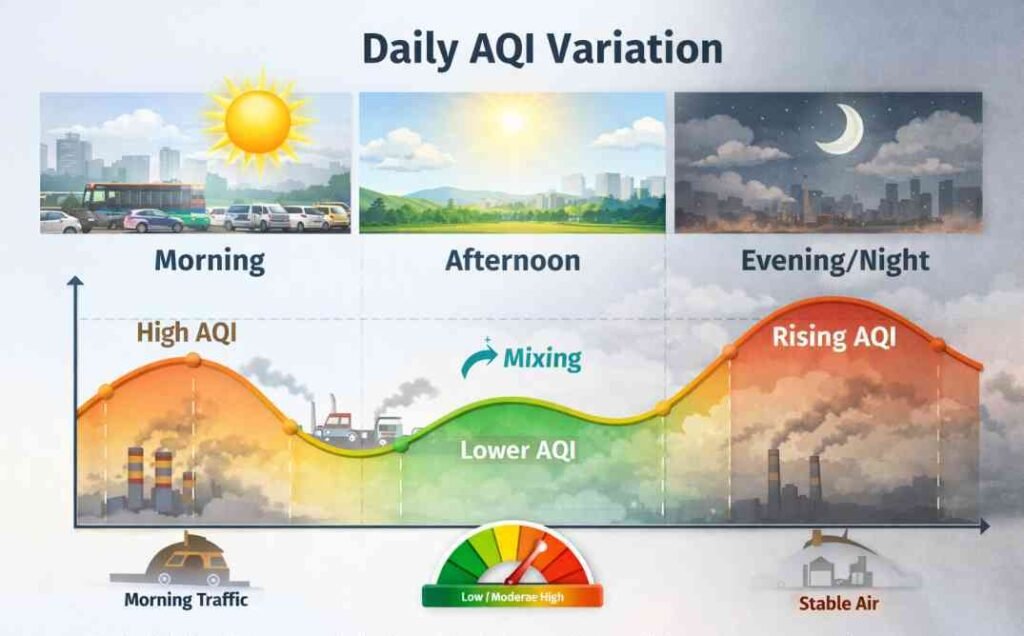
In most Indian cities, AQI tends to follow a daily pattern.
Morning (Higher Pollution Levels)
Early in the day, pollution is often at its peak.
This happens because:
- Low temperatures keep air close to the ground
- Weak sunlight means limited atmospheric mixing
- Morning traffic increases emissions
As a result, pollutants accumulate near the surface, leading to higher AQI levels.
Afternoon (Improved Air Quality)
By afternoon, air quality often improves.
This is mainly due to:
- Stronger sunlight heating the ground
- Rising warm air that lifts pollutants upward
- Better mixing and dispersion of pollutants
Pollution becomes more diluted, so AQI levels drop compared to the morning.
Evening and Night (Pollution Builds Again)
Later in the day, AQI can increase again.
- Sunlight decreases
- The ground cools down
- Air becomes stable with less vertical movement
This allows pollutants to accumulate again, especially when combined with evening traffic.
Role of Sunlight and Heating
Sunlight plays a critical role in controlling how pollution behaves during the day.
When sunlight heats the Earth’s surface:
- the air near the ground warms up
- warm air rises
- pollutants are carried upward and spread out
This process is called atmospheric mixing, and it helps reduce pollution concentration near breathing level.
Without sufficient sunlight—such as during early mornings, evenings, or cloudy winter days—this mixing is weak.
As a result:
- pollutants remain trapped near the ground
- AQI levels stay higher
Key Insight
Daily AQI changes are not only about how much pollution is produced, but also about how effectively the atmosphere can disperse it at different times of the day.
This is why the same city can experience noticeably different air quality within just a few hours.
How to Predict Daily AQI Changes (Simple Guide)
In many Indian cities, this daily pattern repeats regularly. Understanding it helps you plan safer outdoor activities and avoid peak pollution hours.
You can often estimate how air pollution will behave by observing basic weather conditions.
Simple checklist:
• Low wind + cold morning → High pollution likely
• Sunny afternoon → Air quality usually improves
• Calm evening → Pollution builds up again
• Winter + fog → Sustained high pollution
A Simple Way to Understand It
A clear way to understand daily air pollution changes is to think of the atmosphere like a moving container.
Pollution is constantly being added into this container—but whether it builds up or clears out depends on how the container behaves.
The Three-Part Formula
Air pollution at any moment can be understood as:
Air Pollution = Emissions + Weather + Atmospheric Behavior
- Emissions → how much pollution is released (vehicles, industries, dust, burning)
- Weather → how air moves (wind, temperature, humidity)
- Atmospheric behavior → how pollutants spread or get trapped
Two Simple Scenarios
Scenario 1: Pollution Builds Up
- Low wind
- Cooler surface air
- Poor vertical mixing
Pollutants stay near the ground
AQI rises quickly
Scenario 2: Pollution Clears Out
- Strong wind
- Warm surface conditions
- Good mixing of air
Pollutants disperse
AQI improves
The Key Insight
The amount of pollution released may not change much from day to day—but how the air behaves changes constantly.
That’s why:
- A city can have similar traffic levels
- But very different AQI on different days
What This Means for You
Air pollution is not just about sources—it is about conditions.
Understanding this helps you:
- make sense of sudden AQI changes
- choose safer times to go outside based on AQI levels and exposure risk — see health effects of different AQI levels
- avoid assuming pollution is always predictable
In simple terms:
Pollution is always being produced—but whether it stays or clears depends on the atmosphere.
Real-World AQI Pattern (India Example)
Typical winter pattern in North Indian cities:
- Afternoon AQI: 150–250 (Moderate to Poor)
- Late night AQI: 250–350 (Poor to Very Poor)
- Early morning AQI: 300–400+ (Very Poor to Severe)
This pattern is driven more by atmospheric conditions than sudden changes in emissions.
Key Takeaway
Air pollution is not fixed—it changes constantly based on how emissions interact with weather and atmospheric conditions.
Even if the amount of pollution released stays similar, factors like wind, temperature, and air mixing determine whether pollutants disperse or build up.
This is why AQI can improve or worsen quickly, and why understanding daily conditions is just as important as understanding pollution sources.
Conclusion
Air pollution levels change daily because the atmosphere is constantly in motion. Emissions from vehicles, industries, and other sources are only one part of the picture—how those pollutants move, disperse, or get trapped depends largely on weather and atmospheric conditions.
Wind can clear pollution or allow it to accumulate. Temperature changes can either promote mixing or trap pollutants near the ground. Daily human activity adds further variation, while seasonal patterns in India can intensify these effects.
Understanding this dynamic nature of air pollution helps explain why AQI levels fluctuate, sometimes dramatically, even when emission sources remain similar. It also highlights an important insight: improving air quality is not only about reducing emissions, but also about understanding when and why pollution becomes more dangerous.
Frequently Asked Questions (FAQs)
Why does AQI change every day?
AQI changes daily because air pollution depends not only on emissions but also on weather conditions like wind, temperature, and atmospheric mixing. These factors determine whether pollutants disperse or accumulate.
Why is air pollution higher in the morning and night?
In the morning and night, the atmosphere is more stable, which limits the vertical mixing of air. This causes pollutants to stay close to the ground, increasing pollution levels.
Does weather affect air pollution more than sources?
In the short term, yes. Even if emissions remain constant, changes in weather—especially wind and temperature—can significantly increase or decrease pollution levels.
Why is pollution worse in winter in India?
Winter conditions often include low wind speeds and temperature inversion, which trap pollutants near the ground. This leads to higher pollution levels, especially in North Indian cities.
Can AQI change within a few hours?
Yes. AQI can fluctuate throughout the day due to changes in sunlight, temperature, traffic patterns, and atmospheric mixing.
If emissions are constant, why does pollution still vary?
Because pollution levels depend on how pollutants behave in the atmosphere. Even with similar emissions, poor dispersion conditions can cause pollution to build up, while favorable conditions can reduce it quickly.
Does rain reduce air pollution?
Rain can temporarily reduce pollution by washing particles out of the air. However, this effect is usually short-lived and depends on intensity and duration.
Can checking weather help predict AQI?
Yes. Weather factors like wind speed, temperature, and sunlight strongly influence pollution dispersion. Calm, cold conditions usually increase pollution, while windy or sunny conditions help reduce it.
References
National AQI Framework (India – CPCB)
Central Pollution Control Board (CPCB).
National Air Quality Index (AQI) – Framework, pollutants, and calculation method.
🔗 https://cpcb.nic.in/national-air-quality-index/
Delhi Winter Pollution & Meteorology (CEEW)
Council on Energy, Environment and Water (CEEW).
Understanding Delhi’s Air Pollution – Role of meteorology, mixing height, and emissions.
🔗 https://www.ceew.in/publications/understanding-delhi-air-pollution
Diurnal & Seasonal Patterns of Air Pollution (CWE Journal)
Current World Environment Journal.
Diurnal and Seasonal Variation of Air Pollutants
🔗 https://www.cwejournal.org/vol2no2/diurnal-and-seasonal-variation-of-air-pollutants/
Atmospheric Boundary Layer & Air Quality (PMC)
National Center for Biotechnology Information (NCBI).
Atmospheric Boundary Layer and Its Role in Air Pollution
🔗 https://www.ncbi.nlm.nih.gov/pmc/articles/PMC6981967/
Meteorological Factors & AQI Relationship (CWE Journal)
Current World Environment Journal.
Impact of Meteorological Parameters on Air Quality
🔗 https://www.cwejournal.org/vol10no1/impact-of-meteorological-parameters-on-air-quality/
Spatiotemporal AQI Variability (Springer)
SpringerLink.
Spatiotemporal Variation of Air Quality Index
🔗 https://link.springer.com/article/10.1007/s11869-018-0649-2
PM2.5 Daily Variation Study (ScienceDirect)
ScienceDirect (Elsevier).
Diurnal Variation of PM2.5 in Urban Environments
🔗 https://www.sciencedirect.com/science/article/pii/S1352231016305661
Air Pollution & Meteorological Correlation (ScienceDirect)
ScienceDirect (Elsevier).
Relationship Between Air Pollution and Meteorological Factors
🔗 https://www.sciencedirect.com/science/article/pii/S016041201832118X
Atmospheric Stagnation & Pollution Build-up (Nature)
Nature Climate Change / Scientific Reports.
Atmospheric Stagnation Events and Air Pollution
🔗 https://www.nature.com/articles/s41598-018-25683-7
WHO Air Quality Guidelines (GLOBAL AUTHORITY)
World Health Organization (WHO).
WHO Global Air Quality Guidelines (2021)
🔗 https://www.who.int/publications/i/item/9789240034228

- Why Air Pollution Changes Daily: AQI, Weather & Real Reasons - March 26, 2026
- Health Effects of Air Pollution: Short-Term and Long-Term Impacts - March 24, 2026
- What AQI Numbers Mean in India (AQI Chart + Health Effects Guide) - March 22, 2026