
Introduction
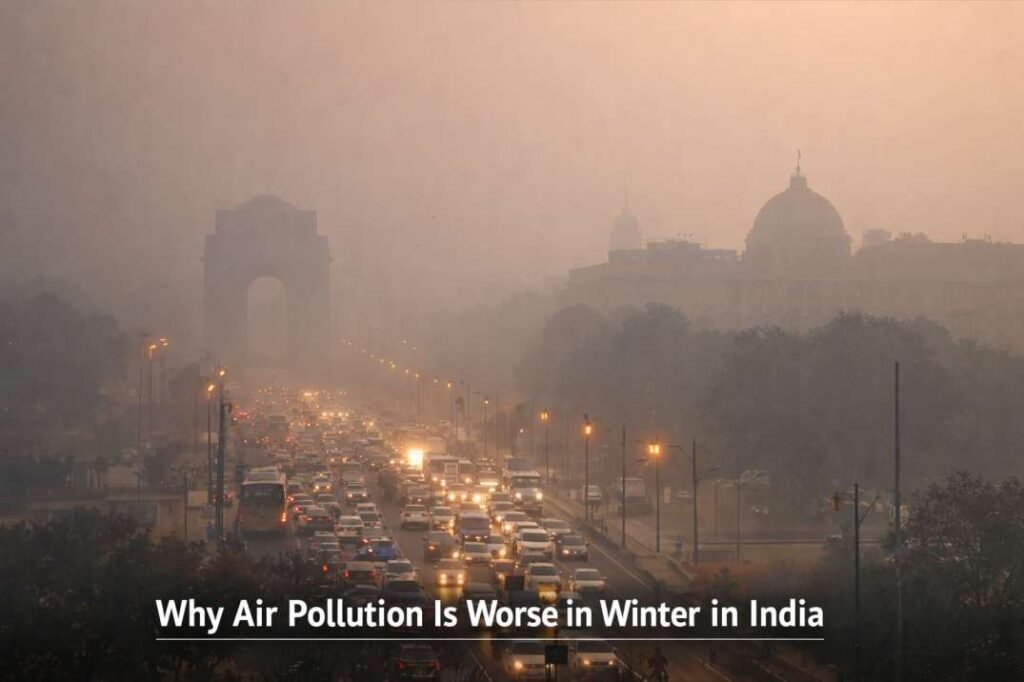
Why air pollution is worse in winter in India is mainly due to atmospheric conditions such as low wind speeds, temperature inversion, and reduced vertical mixing that trap pollutants near the ground.
In simple terms, pollution is always present—but during winter, the atmosphere loses its ability to disperse it effectively, causing rapid AQI increases.
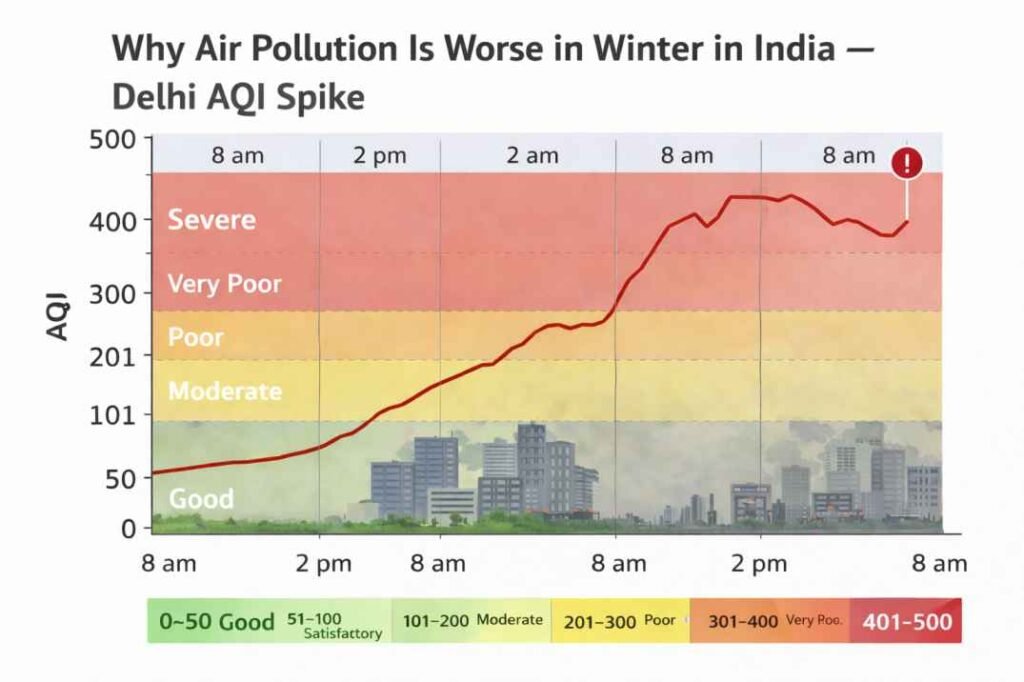
In cities like Delhi, AQI can rise from around 150 (moderate) to over 400 (severe) within just 24–48 hours—even when emissions remain similar.
According to data from the Central Pollution Control Board (CPCB), winter months consistently record the highest pollution levels across Indian cities, often exceeding limits recommended by the World Health Organization (WHO).
This explanation is based on CPCB monitoring data and atmospheric science principles used in air quality analysis in India.
In many North Indian cities, winter AQI levels frequently remain in the “Very Poor” to “Severe” category for multiple consecutive days according to CPCB data.
What You Will Learn
- Why air pollution becomes severe in winter
- How weather affects AQI levels in India
- The role of temperature inversion and wind
- Why pollution builds up over multiple days
- How to interpret winter AQI patterns
Real-World Example (India Winter AQI)
In cities like Delhi, AQI levels can rise from around 150 (Moderate) to over 400 (Severe) within 24–48 hours during winter due to atmospheric conditions.
These rapid increases occur even when emission sources remain relatively stable, highlighting the role of weather in pollution buildup.
Why Air Pollution Is Worse in Winter in India (Quick Answer)
Air pollution becomes worse in winter because:
- wind speeds are lower
- vertical air mixing is reduced
- temperature inversion traps pollutants
- atmospheric dispersion weakens
👉 As a result, pollutants accumulate instead of dispersing, leading to rapid AQI increase and multi-day pollution episodes.
The Core Idea: Winter Pollution Is a Dispersion Problem
A common misconception is that winter pollution occurs because emissions increase significantly.
This is only partly true.
The primary reason is not increased pollution—but reduced dispersion capacity of the atmosphere.
Winter pollution = poor dispersion + accumulation
One important insight: winter pollution often becomes dangerous before it becomes visible.
Air may appear normal initially, but pollutants are already accumulating. By the time smog becomes visible, AQI is often already in the “Very Poor” or “Severe” category.
Winter pollution is not a production problem—it is a dispersion failure.
This explains why:
- AQI can rise sharply even without major emission changes
- pollution persists for multiple days
- sudden spikes occur without obvious local causes
In many North Indian cities, winter mornings often appear visibly hazy even when traffic levels seem normal—this is a clear sign of pollutants being trapped near the surface due to stable atmospheric conditions.
For a deeper explanation, read: Why Air Pollution Changes Daily in India (AQI + Weather Explained)
What Changes in Winter Atmosphere? (Scientific Breakdown)
Winter alters the atmosphere in several ways that directly affect pollution behavior.
Low Wind Speeds Reduce Horizontal Dispersion
Wind is the primary mechanism that removes pollutants from a region.
- Strong winds → dilute and transport pollutants
- Weak winds → allow pollutants to accumulate locally
During winter:
- wind speeds across North India often drop significantly
- stable atmospheric conditions reduce air movement
👉 This creates stagnant air conditions, where pollutants remain concentrated over cities.
Temperature Inversion Traps Pollution Near the Ground
Under normal conditions:
- warm air near the surface rises
- pollutants are carried upward and dispersed
In winter:
- cold air stays near the ground
- a layer of warmer air forms above it
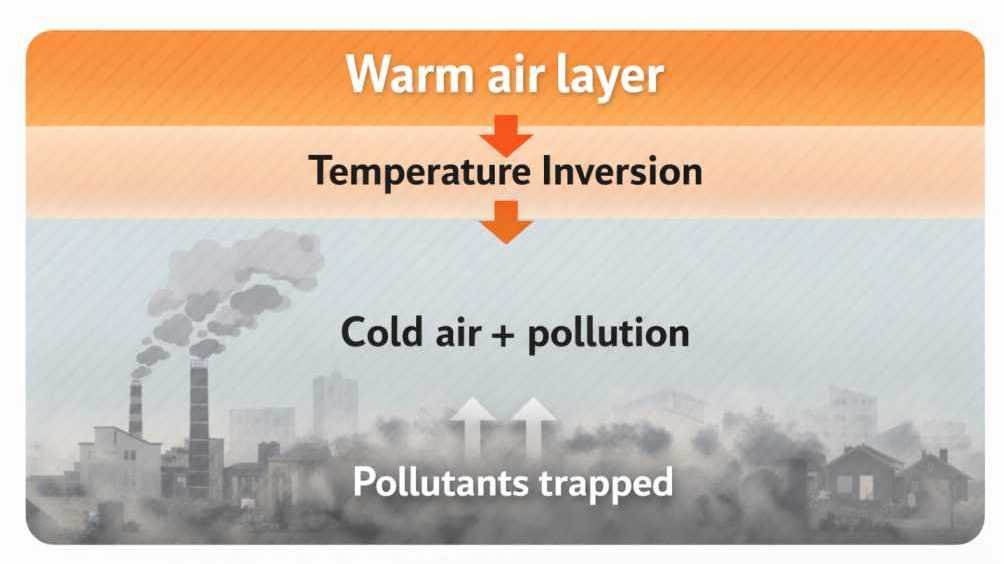
This is called temperature inversion.
👉 It acts like a lid:
- prevents vertical mixing
- traps pollutants at breathing level
- leads to rapid pollution buildup
This is one of the most critical reasons for severe winter smog in India.
Simple visualization:
Warm air layer (top)
↓ acts like a lid
Cold air + pollution (bottom)
Result: pollutants cannot rise and remain trapped near the ground.
Shallow Mixing Layer Concentrates Pollutants
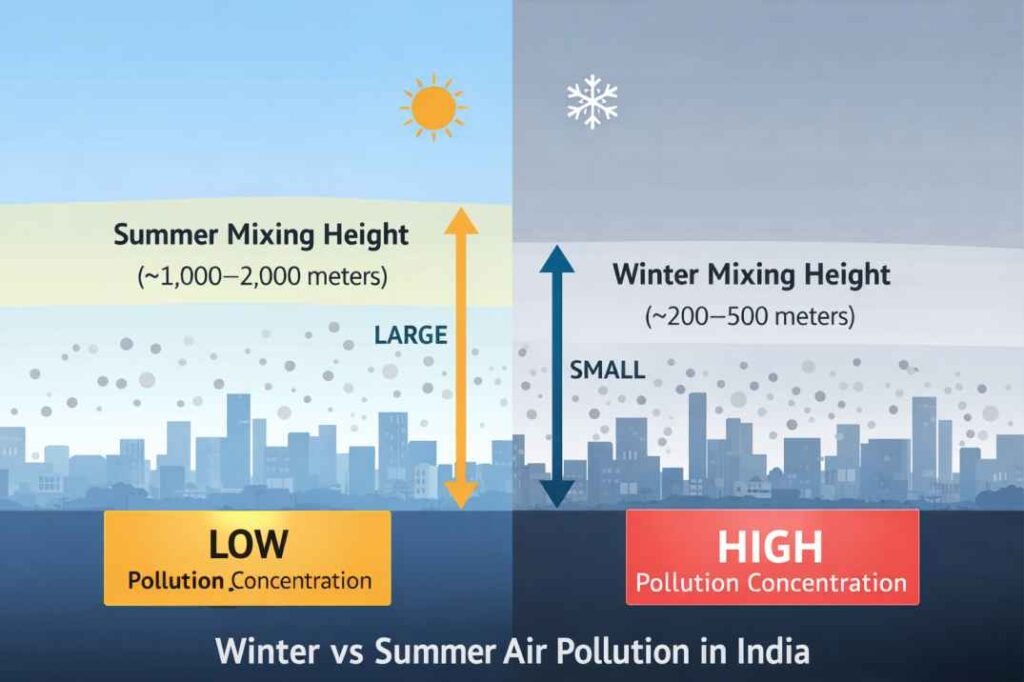
The mixing layer (or boundary layer) determines how much vertical space pollutants have to disperse.
Typical values:
- Summer → mixing height ~1000–2000 meters
- Winter → mixing height ~200–500 meters
This means the available space for pollutants can shrink by nearly 70–80% in winter, significantly increasing their concentration even if emissions remain unchanged.
Same emissions combined with reduced atmospheric space lead to higher pollution concentration.
This reduction in mixing height means the same amount of pollution is compressed into a much smaller volume of air. In practical terms, this is similar to releasing smoke inside a small room instead of an open field.
As a result, even normal daily emissions can lead to rapid increases in pollutant concentration during winter.
Weak Sunlight Reduces Atmospheric Mixing
Sunlight heats the ground and drives vertical air movement.
In winter:
- sunlight is weaker
- daylight hours are shorter
- surface heating is reduced
👉 Result:
- weaker convection
- reduced mixing
- slower pollutant dispersion
This is why afternoon improvement is limited in winter compared to summer.
High Humidity and Fog Increase Smog Formation
Winter air often contains:
- higher humidity
- frequent fog events
This leads to:
- growth of fine particles (PM2.5 absorbs moisture)
- formation of dense haze
- reduced visibility
Secondary Pollution Formation (Advanced Insight)
Humidity also enhances chemical reactions in the atmosphere.
Pollutant gases like:
- sulfur dioxide (SO₂)
- nitrogen oxides (NOₓ)
react to form secondary particles.
This means:
pollution can increase even without new emissions
Winter vs Summer: Why the Difference Is So Large
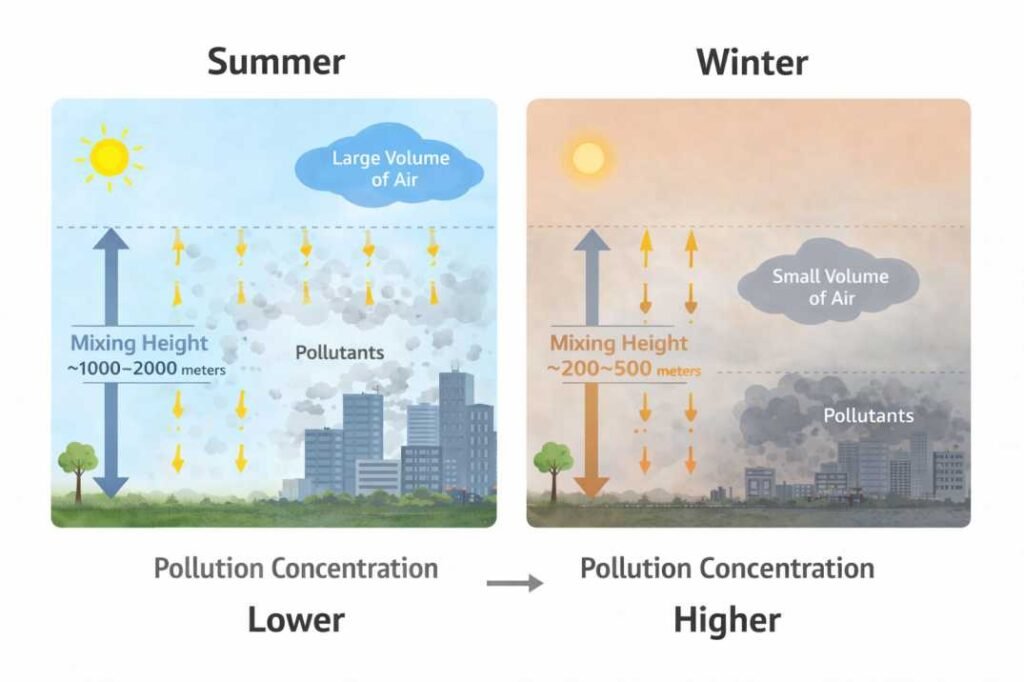
The contrast between winter and summer pollution levels clearly shows the role of atmospheric conditions in determining air quality.
In summer:
- stronger sunlight heats the ground and drives vertical air movement
- higher mixing height allows pollutants to disperse over a larger volume
- stronger and more consistent winds help transport pollutants away
As a result, pollutants are diluted more effectively, and air quality tends to improve despite ongoing emissions.
In winter:
- weaker sunlight reduces atmospheric heating and limits vertical mixing
- lower mixing height compresses pollutants into a smaller air volume
- calm or slow winds reduce horizontal dispersion
These combined effects allow pollutants to accumulate rapidly and persist for longer periods.
This is why the same city, with similar emission sources, can experience relatively cleaner air in summer but severe pollution in winter.
Winter vs Summer Pollution (Typical Pattern in India)
| Factor | Summer | Winter | Impact on AQI |
|---|---|---|---|
| Mixing height | High | Low | Higher concentration |
| Wind | Strong | Weak | Accumulation |
| Sunlight | Strong | Weak | Less dispersion |
| AQI behavior | Stable | Spikes | Severe episodes |
Why Indian Cities Are More Affected
Winter pollution is particularly severe in India due to a combination of geography, emissions, and seasonal factors.
Indo-Gangetic Plain Geography
Many major cities are located in the Indo-Gangetic Plain, a land-locked region bordered by the Himalayas.
This geography:
- restricts air movement
- reduces natural ventilation
- allows pollutants to accumulate
Crop Residue Burning
During post-monsoon months:
- farmers burn crop residue in Punjab and Haryana
- smoke travels long distances
This significantly increases pollution levels across North India.
Urban Emissions Continue Year-Round
Sources like:
- vehicles
- industries
- construction
continue to emit pollutants throughout the year.
In addition to geography, population density and urban activity levels also play a major role. Indian cities often have high emission intensity due to traffic congestion, construction activity, and energy use.
Because of these combined factors, Indian cities often require seasonal pollution control strategies such as stricter emission controls and emergency response plans during winter months.
When these emissions combine with unfavorable winter atmospheric conditions, the result is a rapid and sustained increase in pollution levels.
Why Winter Requires Special Pollution Control Measures
Because pollution builds up rapidly during winter, authorities implement seasonal control strategies.
In cities like Delhi, the Graded Response Action Plan (GRAP) is used to respond to rising pollution levels.
These measures may include:
• Restrictions on construction activity
• Limits on industrial emissions
• Traffic control measures
• Emergency actions during severe AQI levels
These policies are necessary because reducing emissions becomes more critical when the atmosphere cannot disperse pollutants effectively.
Why Winter Pollution Lasts for Days (Accumulation Effect)
Winter pollution follows a cumulative pattern:
- Day 1 → slight increase
- Day 2 → previous pollution remains
- Day 3 → severe levels
Because:
- atmosphere cannot clear pollutants efficiently
- emissions continue daily
Each day adds to the previous day’s pollution load
This leads to multi-day pollution episodes, often lasting a week or more.
This cumulative effect is why pollution episodes in winter often last for several consecutive days, even if daily emissions remain relatively stable.
Why AQI Increases Suddenly in Winter
AQI can increase rapidly in winter because pollutants accumulate over multiple days under stable atmospheric conditions.
Even if daily emissions remain similar, low wind speeds and temperature inversion prevent dispersion. As a result, pollution builds up continuously, leading to sudden spikes in AQI.
Daily Pattern of Winter Pollution (AQI Variation)
Even in winter, pollution follows a daily cycle:
Morning:
- high pollution
- low mixing
- traffic emissions
Afternoon:
- slight improvement
- sunlight increases mixing
Evening/Night:
- pollution rises again
- air becomes stable
However, winter improvement is weaker compared to other seasons.
Why Pollution Is Worse at Night in Winter
Pollution levels often increase at night during winter because the atmosphere becomes more stable.
Wind speeds drop, temperature inversion strengthens, and vertical mixing almost stops. This traps pollutants close to the ground, causing AQI levels to rise overnight.
AQI Levels in India (CPCB Framework)
India uses the Air Quality Index (AQI) system defined by CPCB:
| AQI | Category |
|---|---|
| 0–50 | Good |
| 51–100 | Satisfactory |
| 101–200 | Moderate |
| 201–300 | Poor |
| 301–400 | Very Poor |
| 401–500 | Severe |
This AQI classification system is defined and monitored by the Central Pollution Control Board (CPCB) in India. To understand how AQI levels are calculated and categorized in India, see our detailed guide on AQI explained.
👉 Winter pollution often pushes AQI into:
- Very Poor (301–400)
- Severe (401–500)
for multiple consecutive days.
A Simple Mental Model (Best Way to Understand)
Think of the atmosphere as a container:
- Summer → open container (pollution escapes)
- Winter → closed container (pollution trapped)
Or:
- Pollution = smoke
- Atmosphere = room
If ventilation stops:
smoke accumulates rapidly
How Weather Controls AQI in India
Air quality in India is strongly influenced by weather conditions.
Key factors include:
- wind speed (controls horizontal dispersion)
- temperature (affects vertical movement)
- mixing height (determines available air volume)
- humidity (affects particle formation)
This means AQI is not determined by emissions alone—weather plays a critical role in how pollution behaves.
What This Means for You
Understanding winter pollution helps you:
- interpret AQI more accurately
- identify high-risk times
- reduce exposure
- plan daily activities better
For more detail, see: Health Effects of Different AQI Levels in India
Winter pollution is particularly concerning because exposure often occurs over extended periods. When high AQI levels persist for several days, the cumulative exposure increases health risks significantly.
Fine particles such as PM2.5 can penetrate deep into the lungs and even enter the bloodstream. Prolonged exposure during winter therefore poses greater health risks compared to short-term pollution spikes.
This makes it especially important to monitor AQI trends and reduce exposure during sustained pollution episodes.
This information is for educational purposes only and should not be considered medical advice.
What You Should Do During Winter Pollution
When air pollution increases during winter, reducing exposure becomes essential.
Simple actions:
• Check AQI daily using the (CPCB) website or apps
• Avoid outdoor activities when AQI is above 300 (Very Poor or Severe)
• Use a well-fitted N95 mask in high pollution conditions
• Keep windows closed during peak pollution hours (morning and late evening)
• Use indoor air purifiers or improve ventilation when air quality improves
Understanding how pollution behaves in winter helps you take preventive action before conditions become severe.
Key Takeaway
Air pollution is worse in winter not because more pollution is produced—but because the atmosphere traps it.
Low wind speeds, temperature inversion, shallow mixing layers, and humidity combine to reduce dispersion and increase pollutant concentration.
Conclusion
Air pollution in winter is driven mainly by atmospheric conditions rather than emissions alone. Weather patterns like temperature inversion, low wind speeds, and reduced mixing limit the atmosphere’s ability to disperse pollutants.
Combined with geographic and human factors in India, this leads to severe and long-lasting pollution episodes during winter.
Understanding this seasonal pattern is important because it explains why pollution control measures often need to be stricter during winter months. It also highlights the importance of weather forecasting in predicting pollution episodes.
Recognizing that winter pollution is driven by atmospheric conditions—not just emissions—can lead to better policies, improved planning, and more effective public awareness.
One important point: winter pollution can become severe even when daily activity appears normal.
This is because pollution builds up gradually under stable atmospheric conditions, often without obvious visible changes in the early stages. By the time pollution becomes clearly noticeable, concentrations may already be dangerously high.
This is why winter-specific measures such as the Graded Response Action Plan (GRAP) are implemented in cities like Delhi to control pollution during peak episodes.
Understanding how weather affects pollution is essential because AQI levels can rise rapidly even without visible warning signs.
Frequently Asked Questions
Why is air pollution worse in winter in India?
Because atmospheric conditions trap pollutants near the ground instead of allowing them to disperse.
What is temperature inversion?
It is a condition where warm air sits above cold air, preventing pollutants from rising.
Does cold weather create pollution?
No, it reduces dispersion, which increases concentration.
Why is Delhi pollution severe in winter?
Due to inversion, crop burning, geography, and low wind speeds.
Does fog increase pollution?
Yes, it increases particle size and contributes to smog formation.
Can wind reduce pollution?
Yes, strong winds help disperse pollutants and improve air quality.
Why does AQI suddenly increase in winter in India?
AQI increases rapidly in winter because pollutants accumulate under low wind speeds and temperature inversion, even if emissions remain similar.
Why is air pollution worse at night during winter?
At night, the atmosphere becomes more stable, wind speeds drop, and vertical mixing reduces, causing pollutants to remain trapped near the ground.
How long does winter air pollution last in India?
Winter pollution episodes in India can last for several days to over a week because pollutants accumulate daily under stable atmospheric conditions with limited dispersion.
This article is based on publicly available data from CPCB, MoEFCC, WHO, and atmospheric science research sources relevant to air pollution in India.
References
World Bank. Air Pollution and Health Impacts in South Asia
https://www.worldbank.org/en/topic/environment/brief/air-pollution
Central Pollution Control Board (CPCB). Air Quality Index (AQI) Framework
https://cpcb.nic.in/air-quality-index/
Central Pollution Control Board (CPCB). National Air Monitoring Programme (NAMP)
https://cpcb.nic.in/namp/
Ministry of Environment, Forest and Climate Change (MoEFCC). National Clean Air Programme (NCAP)
https://moef.gov.in/en/air-pollution/national-clean-air-programme/
World Health Organization (WHO). Ambient Air Pollution
https://www.who.int/health-topics/air-pollution
World Health Organization (WHO). Global Air Quality Guidelines (2021)
https://www.who.int/publications/i/item/9789240034228
NASA Earth Observatory. Air Pollution and Atmospheric Processes
https://earthobservatory.nasa.gov/
Indian Institute of Tropical Meteorology (IITM). Air Quality Early Warning System (Delhi)
https://aqews.tropmet.res.in/
SAFAR (System of Air Quality and Weather Forecasting and Research), India
https://safar.tropmet.res.in/
United States Environmental Protection Agency (EPA). Air Pollution Basics
https://www.epa.gov/air-pollution

His work focuses specifically on India’s CPCB monitoring systems and real-world pollution exposure. He simplifies complex air quality science for Indian households and policy understanding.