
Introduction
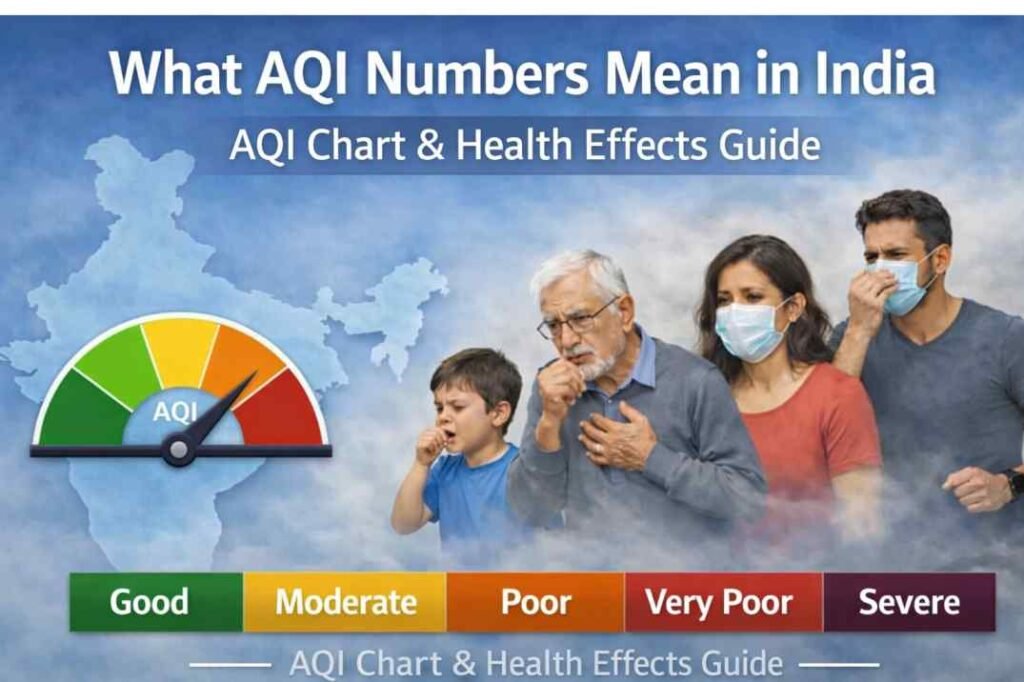
Air Quality Index (AQI) is one of the most commonly reported indicators of air pollution in India. Understanding AQI interpretation in India helps you know what these numbers mean and how they affect your health. From “Good” to “Severe,” each AQI category represents a different level of pollution risk.
AQI is not just a number. It reflects how polluted the air is and how it may affect people, especially children, the elderly, and those with respiratory or heart conditions. In India, it is calculated using data from air pollution monitoring systems operated by agencies such as the Central Pollution Control Board (CPCB).
For example, if the AQI in your city is 250 today, is it safe to go outside? Should you exercise, wear a mask, or stay indoors?
This guide answers those questions by explaining how to interpret AQI levels in India, what each category means for your health, and what actions to take at different pollution levels.
If you want to understand how these values are derived, see our guide on how AQI is calculated in India.
What AQI Numbers Mean in India (Simple Explanation)
AQI (Air Quality Index) is a number between 0 and 500 that shows how polluted the air is and how it may affect your health. Lower values indicate clean air, while higher values mean increasing pollution levels and greater health risks.
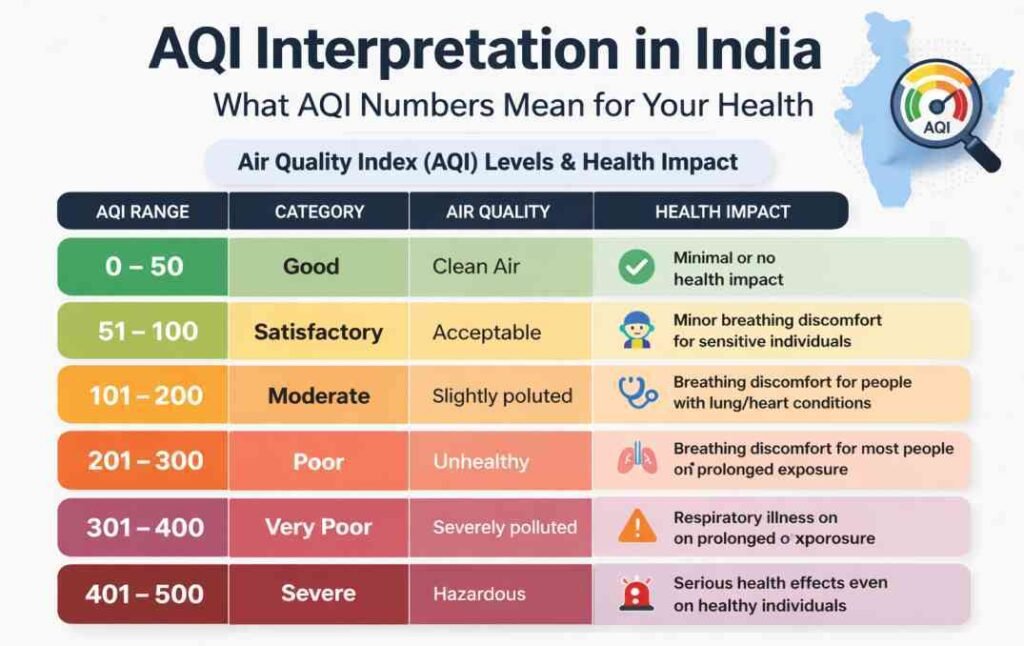
AQI values in India are divided into categories defined by the Central Pollution Control Board (CPCB), ranging from Good to Severe. Each category represents a different level of air pollution and its potential impact on health.
In simple terms, AQI converts complex air pollution data into a single number that is easy to understand and use for daily decisions.
👉 AQI Levels Explained Simply
0–50 (Good) → Clean air, no health risk
51–100 (Satisfactory) → Acceptable air, minor discomfort for sensitive individuals
101–200 (Moderate) → Slightly polluted, affects people with lung or heart conditions
201–300 (Poor) → Unhealthy air, discomfort for many people
301–400 (Very Poor) → Severe pollution, increased risk of illness
401–500 (Severe) → Hazardous air, serious health effects even for healthy individuals
👉 As the AQI value increases, both pollution levels and health risks also increase.
AQI Categories in India
These categories are based on real-time data collected from air pollution monitoring systems across India.
| AQI Range | Category | What It Means | Health Impact |
|---|---|---|---|
| 0–50 | Good | Air quality is clean | Minimal or no health impact |
| 51–100 | Satisfactory | Air quality is acceptable | Minor breathing discomfort for sensitive individuals |
| 101–200 | Moderate | Air quality is slightly polluted | Breathing discomfort for people with lung or heart conditions |
| 201–300 | Poor | Air quality is unhealthy | Breathing discomfort for most people on prolonged exposure |
| 301–400 | Very Poor | Air quality is severely polluted | Respiratory illness on prolonged exposure |
| 401–500 | Severe | Air quality is hazardous | Serious health effects even on healthy individuals |
👉 Higher AQI values indicate worse air quality and greater health risk.
What AQI Level Is Dangerous?
AQI levels above 200 are considered unhealthy. At this range, both sensitive groups and some healthy individuals may experience breathing discomfort, fatigue, and respiratory symptoms. When AQI crosses 300, pollution becomes severe and outdoor activity should be minimized. AQI above 400 is considered hazardous and may affect even healthy individuals.
Health Effects at Different AQI Levels
Air pollution affects people differently depending on the AQI level and individual sensitivity. While healthy individuals may tolerate mild pollution, vulnerable groups—such as children, the elderly, and people with asthma or heart disease—are affected at much lower AQI levels.
👉 Why Air Pollution Affects the Body
Fine particulate matter (PM2.5) is small enough to penetrate deep into the lungs and reach the alveoli, where oxygen exchange occurs. These particles can enter the bloodstream and trigger inflammation, affecting both respiratory and cardiovascular systems.
👉 Health Impact by AQI Category
Good (0–50)
Air quality is clean and poses little or no health risk.
All outdoor activities are safe.
Satisfactory (51–100)
Air quality is acceptable.
Sensitive individuals may experience mild breathing discomfort.
Moderate (101–200)
Air pollution begins to affect sensitive groups.
Possible symptoms include:
- coughing
- throat irritation
- shortness of breath
People with asthma or heart conditions should reduce outdoor exposure.
Poor (201–300)
Health effects become more noticeable.
Both sensitive groups and some healthy individuals may experience:
- breathing difficulty
- chest discomfort
- fatigue
Prolonged outdoor exposure should be avoided.
Very Poor (301–400)
Serious health effects may occur, especially with prolonged exposure.
Possible impacts include:
- worsening asthma
- reduced lung function
- increased respiratory illness
Outdoor activity should be minimized for everyone.
Severe (401–500)
Air quality is hazardous and may impact even healthy individuals.
Air quality is hazardous and affects even healthy individuals.
Health risks include:
- severe respiratory distress
- increased cardiovascular risk
- long-term health damage with repeated exposure
People should avoid outdoor activities and stay indoors.
Key Insight
As AQI increases, both the severity of health effects and the number of people affected also increase.
Even if symptoms are not immediately noticeable, long-term exposure to high AQI levels can still harm your health.
These health impacts are based on CPCB AQI guidelines and global research from organizations such as the World Health Organization (WHO).
What Should You Do at Different AQI Levels?
AQI is not just an indicator—it helps guide daily decisions to reduce exposure to air pollution. The actions you take should depend on both the AQI level and your personal health condition.
Recommended Actions by AQI Level
| AQI Range | Category | What You Should Do |
|---|---|---|
| 0–100 | Good / Satisfactory | Safe for normal outdoor activities. Keep windows open and enjoy fresh air. |
| 101–200 | Moderate | Sensitive groups (children, elderly, asthma patients) should reduce prolonged outdoor activity. Prefer short outdoor exposure. |
| 201–300 | Poor | Avoid outdoor exercise. Limit time outside, especially near traffic. Use a well-fitted mask (N95) if needed. |
| 301–400 | Very Poor | Stay indoors as much as possible. Keep windows closed during peak pollution hours. Use air purifiers if available. |
| 401–500 | Severe | Avoid all outdoor activity. Follow health advisories. Schools may close and outdoor movement should be minimized. |
👉 Real-Life Example
If the AQI in Delhi is around 280 (Poor category):
- Avoid morning walks or outdoor exercise
- Reduce time spent in traffic-heavy areas
- Wear an N95 mask when stepping outside
- Children and elderly should stay indoors
👉 Priority Actions (Most Important First)
If AQI is above 200, focus on these actions first:
- Reduce outdoor exposure
- Avoid physical exertion outdoors
- Protect vulnerable individuals
- Use masks or indoor air control if needed
Key Tips to Reduce Exposure
- Check daily AQI updates before planning outdoor activities
- Avoid outdoor exercise during peak pollution hours
- Use certified masks (such as N95) in polluted environments
- Reduce indoor pollution sources (cooking smoke, dust, etc.)
- Pay extra attention to children, elderly, and people with health conditions
👉 These actions become especially important during winter months in many Indian cities, when pollution levels tend to rise significantly.
These recommendations are based on CPCB AQI advisories and public health guidelines.
Why AQI Changes Daily
AQI values are not constant—they can change from day to day, and sometimes even within a few hours. These changes occur because air pollution levels are influenced by multiple dynamic factors. These variations are closely linked to how air pollution is measured and monitored in real time.
Weather Conditions
Weather plays a major role in how pollutants behave in the atmosphere.
- Wind can disperse pollutants and improve air quality
- Calm conditions can trap pollutants near the ground
- Temperature inversions can prevent pollutants from rising, leading to higher AQI
Human Activities
Daily activities such as traffic, industrial operations, and construction directly affect pollution levels.
- Rush hour traffic increases emissions
- Industrial output varies throughout the day
- Construction activity can raise dust levels
Seasonal Effects
AQI often changes with seasons due to differences in weather and emission patterns.
- Winter: higher pollution due to inversion and stagnant air
- Summer: better dispersion due to higher temperatures and wind
- Post-monsoon: spikes due to crop residue burning in North India
Regional and External Sources
Pollution is not always local. It can travel from other regions.
- Crop burning smoke can affect cities far away
- Dust storms can increase particulate matter levels
- Industrial emissions from nearby areas can spread across regions
👉 Because of these factors, AQI is a dynamic indicator that reflects real-time air quality conditions rather than a fixed value.
To understand these changes in more detail, read our article on why air pollution changes daily.
Why PM2.5 Often Dominates AQI
In many Indian cities, PM2.5 (fine particulate matter) is often the pollutant that determines the final AQI value.
This happens because AQI is based on the highest sub-index among all pollutants. Since PM2.5 levels are frequently higher than other pollutants, it often becomes the dominant factor in AQI calculation.
PM2.5 particles are extremely small—about 30 times smaller than the width of a human hair—which allows them to penetrate deep into the lungs and even enter the bloodstream. As a result, even moderate increases in PM2.5 concentration can significantly raise the AQI.
In urban areas like Delhi, Kolkata, and Mumbai, common sources of PM2.5 include:
- vehicle emissions
- construction dust
- industrial activities
- biomass and waste burning
Because of these widespread sources, PM2.5 levels tend to remain elevated, especially during winter months when weather conditions trap pollutants near the ground.
To understand how different pollutants contribute to air pollution, see our guide on criteria pollutants such as PM2.5, PM10, NO₂, SO₂, and ozone.
👉 Key takeaway: Even if other pollutants are at safe levels, high PM2.5 alone can push the AQI into “Poor” or “Severe” categories.
AQI vs Actual Risk: What You Should Know
While AQI is a useful indicator of air quality, it is a simplified index and does not capture the full picture of real-world exposure.
AQI Is a Simplified Indicator
AQI converts complex pollution data into a single number for easy understanding. However, it does not reflect detailed variations in pollutant levels across different locations or times of day.
It Does Not Reflect Personal Exposure
AQI represents outdoor air quality measured at monitoring stations. Your actual exposure can vary depending on:
- time spent outdoors
- proximity to traffic or industrial areas
- indoor air conditions
For example, someone living near a busy road may experience higher pollution levels than what the city-wide AQI suggests.
India AQI vs WHO Guidelines
While AQI categories provide general guidance, the World Health Organization (WHO) recommends much lower exposure limits for pollutants like PM2.5.
This means that even “Moderate” AQI levels in India may still carry health risks over long-term exposure.
Key Takeaway
AQI is useful for understanding general air quality trends, but it should not be treated as an exact measure of personal health risk.
Common Misunderstandings About AQI
Even though AQI is widely used, it is often misunderstood. Clarifying these misconceptions helps in interpreting air quality more accurately.
AQI Is the Same Everywhere
AQI can vary significantly across different parts of a city. Pollution levels depend on local sources such as traffic, construction, and industries.
Monitoring stations measure air quality at specific locations—not the entire city.
AQI Represents Exact Health Risk
AQI provides a general indication of health risk, but it does not predict exact health outcomes for individuaAQI provides a general indication of health risk, but it does not predict exact outcomes.
People respond differently based on age, health condition, and exposure duration.
Only PM2.5 Matters
PPM2.5 is often dominant, but AQI includes multiple pollutants such as PM10, NO₂, SO₂, CO, and O₃.
In some situations, gases like ozone or nitrogen dioxide may determine the AQI.
In Short (Summary)
- AQI indicates how polluted the air is and its potential health impact
- Higher AQI values mean worse air quality and greater health risks
- Each AQI category—from Good to Severe—represents increasing pollution levels
- Health effects range from mild discomfort to serious respiratory problems
- The pollutant with the highest concentration determines the final AQI
Conclusion
Understanding AQI levels in India helps you make informed decisions about your daily activities and health. AQI provides a simple way to interpret complex air pollution data, but its real value lies in guiding your actions.
As AQI increases, health risks become more serious—especially for children, the elderly, and individuals with existing health conditions. Taking timely precautions, such as limiting outdoor exposure or using protective measures, can significantly reduce these risks.
While AQI is a simplified indicator, combining it with awareness of pollution sources, weather conditions, and personal exposure gives a more complete understanding of air quality.
In practical terms: higher AQI means higher risk—and informed action helps protect your health.
To understand how pollution sources contribute to these differences, see our guide on sources of air pollution in India.
Frequently Asked Questions (FAQ)
What AQI is safe?
An AQI between 0 and 50 is considered safe. This range indicates clean air with little or no health risk, and outdoor activities can be performed normally.
Is AQI 200 dangerous?
An AQI of 200 falls in the Moderate to Poor range and may affect sensitive groups. Prolonged exposure can cause breathing discomfort, especially for people with respiratory conditions.
What AQI level is unhealthy?
AQI levels above 200 are generally considered unhealthy. At this level, both sensitive groups and some healthy individuals may experience health effects.
What AQI should you stay indoors?
When AQI exceeds 300, outdoor activity should be minimized. Above 400, staying indoors is recommended.
Is AQI 500 hazardous?
Yes. AQI above 400 is hazardous and can affect even healthy individuals.
Why AQI differs by city?
AQI varies due to differences in pollution sources, weather conditions, population density, and geography. Factors like traffic, industry, and seasonal changes influence air quality.
Sources and References
This article is based on official guidelines and scientific resources related to air quality assessment in India:
Research studies and reports by Indian Institutes of Technology (IITs) and environmental research institutions on air pollution and AQI systems
Central Pollution Control Board (CPCB) – National Air Quality Index (NAQI)
https://cpcb.nic.in/national-air-quality-index/
CPCB AQI Breakpoints and Methodology Document
https://cpcb.nic.in/displaypdf.php?id=QVFJX0Jhc2ljX0luZm9ybWF0aW9uLnBkZg
National Clean Air Programme (NCAP), Government of India
https://cpcb.nic.in/national-clean-air-programme/
Ministry of Environment, Forest and Climate Change (MoEFCC)
https://moef.gov.in/
World Health Organization (WHO) – Air Quality Guidelines
https://www.who.int/publications/i/item/9789240034228

- Health Effects of Air Pollution: Short-Term and Long-Term Impacts - March 24, 2026
- What AQI Numbers Mean in India (AQI Chart + Health Effects Guide) - March 22, 2026
- Emission Inventory in India: How Pollution Sources Are Measured (Complete Guide) - March 21, 2026