
Author: Soumen Chakraborty
Founder, GreenGlobe25 — an educational platform explaining air pollution monitoring and environmental policy in India.
Last Updated: March 2026
This article synthesises publicly available information from the Central Pollution Control Board (CPCB), WHO Air Quality Guidelines, and Indian environmental policy reports.
Introduction
Vehicular emissions in Indian cities are a major contributor to urban air pollution. Cars, buses, trucks, and two-wheelers release gases and particulate matter that affect air quality along busy roads and transport corridors.
Cars, buses, trucks, and two-wheelers emit gases and particulate matter that can accumulate along busy roads and transport corridors. Road transport is one of several sources of air pollution in Indian cities, alongside industry, construction dust, and household fuel combustion.
These pollutants include particulate matter (PM₂.₅ and PM₁₀), nitrogen dioxide (NO₂), carbon monoxide (CO), and volatile organic compounds (VOCs).
Many of these pollutants are included in India’s Air Quality Index (AQI) framework, meaning traffic emissions can influence daily air quality conditions in urban areas. Source-apportionment studies in Delhi suggest road transport may contribute roughly 20–40% of PM₂.₅ pollution depending on season.
This guide explains:
• what vehicular emissions are
• how vehicles produce air pollution
• which pollutants traffic releases
• how traffic pollution is monitored in India
Understanding these processes helps explain why road transport is an important component of urban air pollution in many Indian cities.
What Are Vehicular Emissions in Indian Cities?
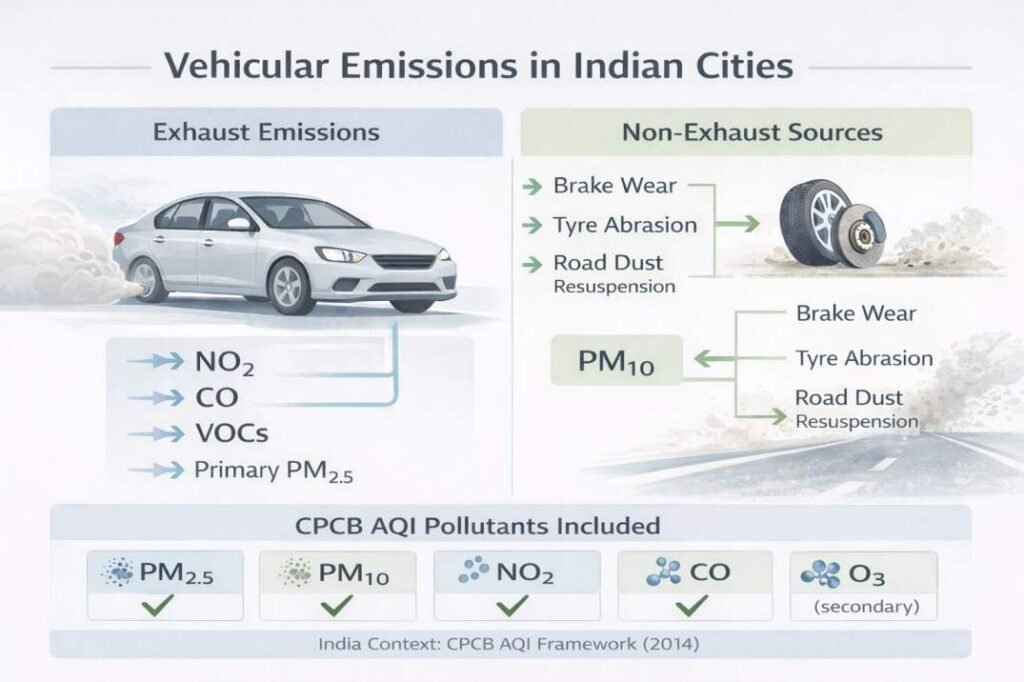
Vehicular emissions in Indian cities refer to pollutants released by road vehicles during fuel combustion and vehicle operation. These emissions include particulate matter (PM₂.₅ and PM₁₀), nitrogen oxides, carbon monoxide, and volatile organic compounds that contribute to urban air pollution and influence India’s Air Quality Index (AQI).
Vehicular emissions refer to pollutants released from road vehicles during the combustion of fuel and normal vehicle operation.
These emissions include:
• gases such as nitrogen oxides (NOₓ), carbon monoxide (CO), and volatile organic compounds (VOCs)
• particulate matter generated from exhaust gases, brake wear, tyre abrasion, and road dust resuspension
In urban environments, these emissions contribute to the pollutant mixture measured by air quality monitoring systems and reported through the Air Quality Index.
Why Vehicular Emissions Are a Major Source of Air Pollution in Indian Cities
India has experienced rapid growth in road transport over recent decades. National transport statistics indicate that the country now has over 300 million registered vehicles, including two-wheelers, passenger cars, buses, and freight trucks.
Because many of these vehicles operate in dense urban traffic, their emissions can influence pollutant levels measured in cities.
Indian vehicle fleets are also highly diverse and typically include:
• two-wheelers
• passenger cars
• auto-rickshaws
• buses
• freight vehicles
This mixture produces varied emission patterns that differ from those observed in many cities in Europe or North America.
Traffic emissions can also interact with seasonal weather conditions. During winter, reduced atmospheric mixing can allow pollutants to accumulate near the ground, increasing pollution levels in some urban areas.
Source-apportionment studies in Delhi, for example, have estimated that road transport can contribute roughly 20–40% of PM₂.₅ emissions depending on season and location.
Road transport activity has grown rapidly across India over recent decades. As a result, vehicular emissions in Indian cities are now recognised as an important contributor to urban air pollution.
How Do Vehicles Produce Air Pollution in Cities? (Step-by-Step)
Vehicular emissions in Indian cities result from a sequence of processes involving fuel combustion, pollutant release, and atmospheric chemical reactions.
- Fuel combustion releases gases from vehicle engines
- High temperatures form nitrogen oxides (NOx)
- Incomplete combustion produces carbon monoxide (CO)
- Vehicle exhaust releases pollutants into the atmosphere
- Sunlight reactions create secondary pollutants such as ozone
1. Fuel Combustion
Petrol or diesel fuel is burned inside the engine to produce energy that powers the vehicle.
2. High-Temperature Reactions
Combustion occurs at very high temperatures, allowing nitrogen and oxygen in the air to react and form nitrogen oxides.
3. Incomplete Combustion
When combustion is imperfect, some fuel molecules are only partially oxidised, producing pollutants such as carbon monoxide and hydrocarbons.
4. Pollutant Release
These gases and particles are emitted through the vehicle’s exhaust system or released through non-exhaust processes.
5. Atmospheric Chemistry
After entering the atmosphere, some pollutants react with sunlight and other chemicals, producing secondary pollutants such as ground-level ozone.
Combustion Chemistry in Vehicle Engines
Most vehicular emissions originate from the combustion of hydrocarbon fuels.
In ideal complete combustion, fuel converts mainly into carbon dioxide (CO₂) and water vapour. However, real engines often operate under variable conditions.
Changes in engine load, fuel-air ratios, and driving behaviour can lead to incomplete combustion and the formation of additional pollutants.
Two important processes occur:
Carbon monoxide formation
Carbon monoxide forms when carbon compounds are only partially oxidised.
Nitrogen oxide formation
Nitrogen oxides form when nitrogen and oxygen react at high temperatures inside the engine.
These reactions occur during normal engine operation, meaning vehicles continuously release small amounts of these pollutants during driving.
What Pollutants Do Vehicles Emit?
Traffic emissions contain several pollutants that influence urban air quality.
Particulate Matter (PM₂.₅ and PM₁₀)
Fine particles originate from:
• diesel exhaust
• brake wear
• tyre abrasion
• road dust resuspension
These particles are important components of urban air pollution because they can remain suspended in the air and affect AQI levels. To understand this pollutant in more detail, see our guide on what PM2.5 air pollution is and why it matters.
Nitrogen Oxides (NOₓ)
Nitrogen oxides form during high-temperature combustion and contribute to nitrogen dioxide concentrations measured in cities.
Carbon Monoxide (CO)
Carbon monoxide is produced when fuel combustion is incomplete. Traffic congestion and idling can increase CO emissions.
Volatile Organic Compounds (VOCs)
These hydrocarbons originate from fuel evaporation and exhaust emissions.
Diesel vs Petrol Vehicle Emissions
Different fuel types produce different emission profiles.
Diesel engines
• emit higher levels of particulate matter
• produce significant nitrogen oxide emissions
Petrol engines
• generally emit higher levels of carbon monoxide
• release more volatile organic compounds
Because Indian cities contain a mix of petrol and diesel vehicles, both types contribute to urban pollution patterns.
Pollutant Classification
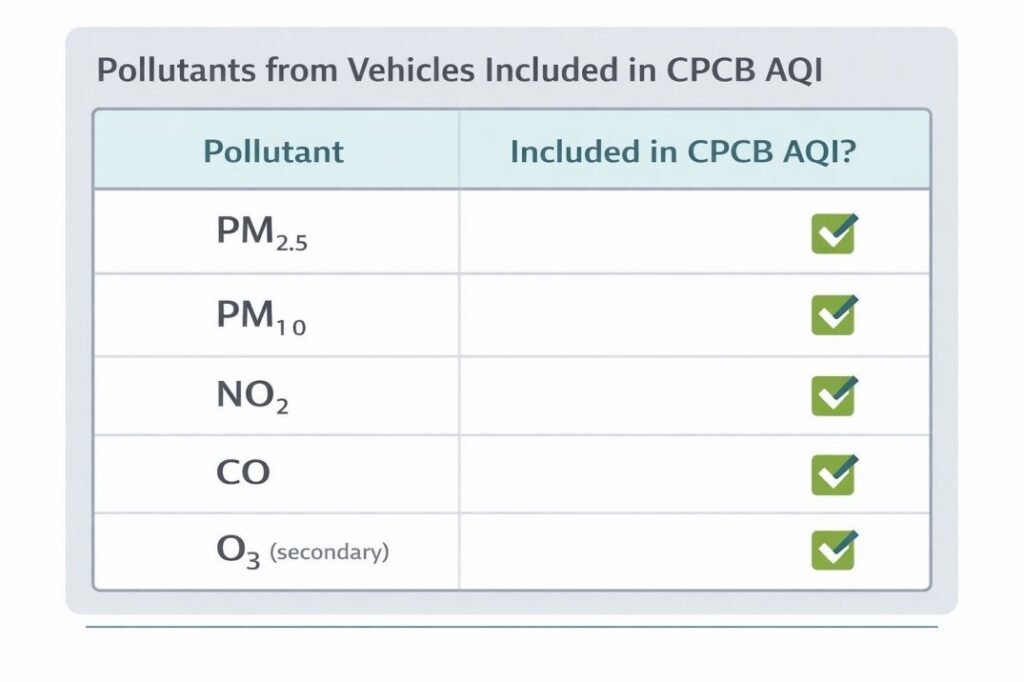
| Pollutant | Vehicular Source Type | Included in CPCB AQI? |
|---|---|---|
| PM2.5 | Exhaust + brake/tyre wear + resuspension | Yes |
| PM10 | Road dust + non-exhaust + coarse particles | Yes |
| NO2 | High-temperature combustion producing NOx (reported as NO2 in AQI) | Yes |
| CO | Incomplete combustion | Yes |
| O3 | Secondary pollutant (NOx + VOC chemistry) | Yes |
Source: CPCB National Air Quality Index Framework (2014).
Emission Control Technologies
Modern vehicles are equipped with technologies designed to reduce pollutant emissions before exhaust gases are released.
Examples include:
Catalytic converters
These devices convert harmful gases such as carbon monoxide, nitrogen oxides, and hydrocarbons into less harmful substances.
Diesel particulate filters (DPF)
These filters capture fine particles from diesel exhaust before they enter the atmosphere.
Selective catalytic reduction (SCR)
SCR systems reduce nitrogen oxide emissions by converting them into nitrogen and water using chemical reactions.
These technologies are an important part of modern emission control strategies.
Secondary Pollutant Formation
Not all traffic-related pollutants are emitted directly from vehicles.
Some pollutants form through chemical reactions after emissions enter the atmosphere.
A key example is ground-level ozone (O₃).
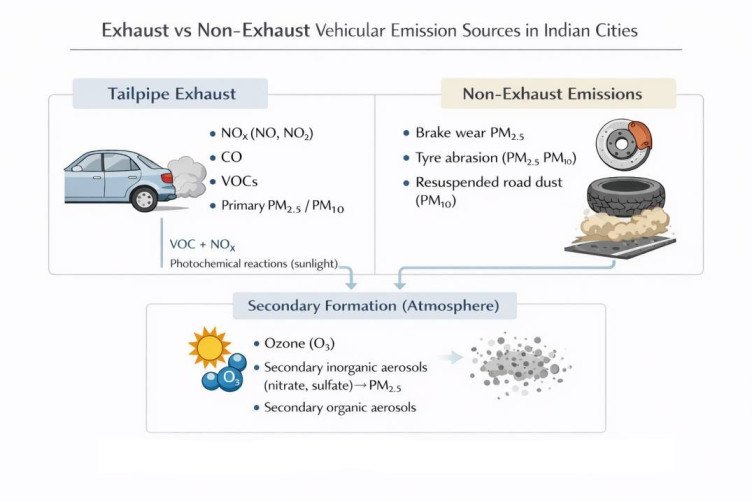
Ozone forms when nitrogen oxides and volatile organic compounds react in the presence of sunlight. These photochemical reactions are common in urban environments.
Secondary particulate matter can also form when nitrogen oxides are converted into nitrate aerosols.
These processes mean that traffic emissions can influence air pollution both directly and indirectly.
Non-Exhaust Sources of Vehicular Pollution
Vehicle-related pollution is not limited to exhaust gases.
Important non-exhaust sources include:
• brake wear particles
• tyre abrasion particles
• road dust resuspension caused by vehicle movement
These sources can contribute significantly to particulate matter concentrations in cities with heavy traffic and dusty road conditions.
How Traffic Conditions Affect Emissions
Driving conditions can strongly influence vehicle emissions.
Several traffic patterns increase pollutant output:
Congestion
Stop-and-go traffic increases fuel consumption and emissions.
Idling
Vehicles waiting in traffic continue emitting pollutants even when stationary.
Frequent acceleration
Rapid acceleration increases fuel combustion and pollutant production.
These conditions are common in many Indian cities and can amplify the impact of vehicular emissions on air quality.
How India Monitors Traffic-Related Air Pollution
Urban air pollution in India is evaluated primarily through ambient monitoring systems. These monitoring systems help scientists analyse how vehicular emissions in Indian cities influence urban air quality patterns.
Key national monitoring programmes include:
• National Air Monitoring Programme (NAMP)
• Continuous Ambient Air Quality Monitoring Stations (CAAQMS)
These monitoring networks measure pollutant concentrations across cities and support public reporting through the Air Quality Index (AQI).
Monitoring stations provide city-level indicators of pollution levels, although concentrations near busy roads may sometimes exceed those measured at fixed monitoring locations.
Traffic Pollution and the Air Quality Index
India’s Air Quality Index incorporates several pollutants linked to vehicular emissions:
• PM₂.₅
• PM₁₀
• nitrogen dioxide (NO₂)
• carbon monoxide (CO)
• ozone (O₃)
The AQI is calculated using pollutant-specific sub-indices, and the overall index is determined by the pollutant with the highest value.
Because traffic emissions contribute to several of these pollutants, changes in traffic conditions can influence daily AQI levels in many urban areas.
Urban Traffic Corridors and Pollution Levels
Air pollution levels often vary across different parts of a city.
Pollutant concentrations tend to be higher:
• along major roads
• near congested intersections
• in dense commercial transport corridors
Monitoring studies in cities such as Delhi, Mumbai, and Bengaluru have frequently reported elevated nitrogen dioxide and particulate matter levels near busy traffic corridors compared with background urban locations.
These patterns illustrate how traffic emissions can shape local air quality conditions.
Health Evidence and Exposure
Vehicular emissions contribute to mixtures of pollutants widely studied in environmental health research.
International health assessments identify fine particulate matter (PM₂.₅) and ground-level ozone as pollutants associated with population-level risks for respiratory and cardiovascular health outcomes.
These relationships are generally studied using epidemiological research that examines pollution exposure across populations rather than attributing specific health outcomes to individual emission sources.
In Indian cities, traffic emissions represent one component of the broader mixture of pollutants measured through urban air quality monitoring systems.
Why Measuring Traffic Pollution Is Difficult
Although vehicular emissions are recognised as an important source of pollution, determining their exact contribution to urban air quality can be challenging.
Multiple Urban Sources
Cities contain many pollution sources including industry, construction dust, household fuel combustion, and seasonal biomass burning.
Spatial Variability
Pollutant concentrations can vary significantly between roadside environments, residential areas, and suburban locations.
Emission Inventory Uncertainty
Emission estimates depend on assumptions about vehicle fleets, fuel use, and driving patterns.
Atmospheric Chemistry
Secondary pollutants such as ozone depend heavily on weather conditions and chemical reactions in the atmosphere.
Because of these factors, traffic pollution is usually analysed as part of a broader urban pollution mixture.
Policy Context: Vehicle Emission Standards in India
India regulates vehicle emissions through the Bharat Stage (BS) emission standards.
Earlier standards such as BS-III and BS-IV were followed by the introduction of BS-VI regulations in 2020, which significantly tightened limits for nitrogen oxide and particulate emissions from new vehicles.
These regulations form part of broader national efforts to reduce urban air pollution.
Conclusion
Vehicular emissions are a major contributor to urban air pollution in Indian cities.
Road vehicles release pollutants such as particulate matter, nitrogen oxides, carbon monoxide, and volatile organic compounds through both exhaust and non-exhaust processes.
These emissions influence several pollutants included in India’s Air Quality Index, meaning traffic conditions can directly affect daily air quality levels in many urban areas.
Understanding vehicular emissions in Indian cities helps explain how traffic contributes to urban air pollution and why transport policies play a central role in improving air quality.
Sources
- Central Pollution Control Board (CPCB) – National Air Quality Monitoring Programme
- World Health Organization – Air Quality Guidelines
- Ministry of Environment, Forest and Climate Change (India)
Frequently Asked Questions
What pollutants do vehicles release into the air?
Road vehicles emit several pollutants including particulate matter (PM₂.₅ and PM₁₀), nitrogen oxides (NOₓ), carbon monoxide (CO), and volatile organic compounds (VOCs). These pollutants contribute to air pollution levels reported in the Air Quality Index.
Are diesel vehicles more polluting than petrol vehicles?
Diesel engines generally emit higher levels of particulate matter and nitrogen oxides, while petrol engines typically emit more carbon monoxide and volatile organic compounds. The overall impact depends on vehicle technology, fuel quality, and emission control systems.
How much air pollution in Indian cities comes from vehicles?
Source-apportionment studies suggest that road transport can contribute a significant share of urban pollution. In cities such as Delhi, traffic has been estimated to contribute roughly 20–40% of PM₂.₅ emissions depending on location and season.
Why is air pollution often higher near roads?
Vehicles release pollutants close to ground level along roads. In areas with heavy traffic, emissions from many vehicles can accumulate, especially during congestion or poor atmospheric dispersion conditions.
Do modern vehicles produce less pollution?
Yes. Modern vehicles are designed with emission control technologies such as catalytic converters, diesel particulate filters, and selective catalytic reduction systems. These technologies help reduce pollutants before they are released into the atmosphere.
References
World Health Organization (WHO). WHO Global Air Quality Guidelines: Particulate Matter (PM₂.₅ and PM₁₀), Ozone, Nitrogen Dioxide, Sulfur Dioxide and Carbon Monoxide. Geneva: World Health Organization, 2021.
https://www.who.int/publications/i/item/9789240034228
Central Pollution Control Board (CPCB). National Air Quality Index (AQI). Government of India.
https://cpcb.nic.in/National-Air-Quality-Index/
Ministry of Environment, Forest and Climate Change (MoEFCC). National Clean Air Programme (NCAP). Government of India, 2019.
https://mpcb.gov.in/sites/default/files/air-quality/National_Clean_Air_Programme09122019.pdf
Ministry of Road Transport and Highways (MoRTH). Road Transport Year Book / Road Transport Statistics of India. Government of India.
https://morth.nic.in/road-transport-year-book
World Health Organization (WHO). Questions and Answers: WHO Global Air Quality Guidelines.
https://www.who.int/news-room/questions-and-answers/item/who-global-air-quality-guidelines
Ganguly, T. et al. National Clean Air Programme (NCAP) for Indian Cities: Review and Outlook of Clean Air Action Plans. Atmospheric Environment: X.
https://doi.org/10.1016/j.aeaoa.2020.100096

- Vehicular Emissions in Indian Cities: How Traffic Causes Air Pollution - February 14, 2026
- Air Quality Index (AQI) Explained: Measurement Structure and Reporting Framework (India Context) - February 9, 2026
- How Air Quality Is Measured in India: Monitoring Systems and Indicators - February 5, 2026