
Introduction
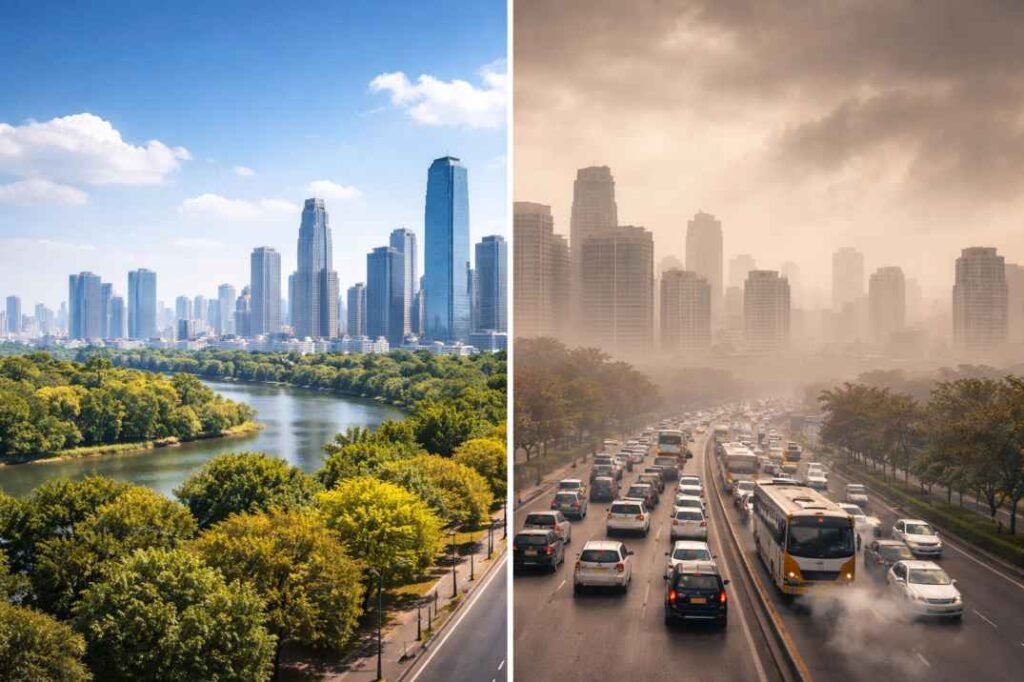
Air pollution happens when harmful particles or gases mix with the air we breathe. In many regions of the world, including parts of India, pollutant concentrations frequently exceed recommended health guidelines. These substances can come from vehicles, factories, burning fuels, construction dust, and natural sources such as wildfires or dust storms. When their concentration becomes high enough, air quality deteriorates and can affect health, visibility, and the environment.
In India, air pollution is commonly discussed through measurements such as PM2.5 levels and the Air Quality Index (AQI). Cities such as Delhi, Mumbai, and Kolkata face both seasonal and year-round air quality challenges.
Understanding what air pollution means is the first step before exploring its causes, health effects, and monitoring systems.
Air Pollution Knowledge Hub
This article provides a foundational overview of air pollution and how it affects environmental and public health systems. If you want to explore specific topics in more detail, the following guides explain key aspects of air pollution science and monitoring.
- Sources of Air Pollution – detailed explanation of emission sources in cities and rural regions
- Types of Air Pollutants – classification of pollutants such as particulate matter, gases, and chemical compounds
- PM2.5 Explained – how fine particulate matter forms and why it affects health
- Air Quality Index (AQI) – how pollution measurements are converted into public air quality categories
- Health Effects of Air Pollution – how long-term exposure influences respiratory and cardiovascular health
These guides expand on the concepts introduced in this article and provide deeper explanations of specific air pollution topics.
What Is Air Pollution? (Simple Definition)
Air pollution refers to the presence of unwanted or harmful substances in the air at levels that can affect living beings, infrastructure, or the natural environment.
The air around us naturally contains nitrogen, oxygen, and small amounts of other gases. Problems begin when additional substances—such as smoke, fine dust particles, chemical fumes, or exhaust gases—enter the atmosphere in large quantities. When these pollutants accumulate beyond normal levels, air quality declines.
For example:
- Vehicle exhaust releases nitrogen dioxide and fine particles.
- Construction activities release dust into the air.
- Burning coal or biomass releases smoke and chemical gases.
- Industrial emissions add various pollutants depending on the process.
Air pollution is therefore not just “dirty air.” It is measurable, monitored, and classified using scientific methods.
Air pollution is not a new environmental problem. Historical records show that urban air pollution increased significantly during the industrial revolution as coal burning expanded in growing cities. Over time, advances in environmental science have made it possible to measure pollutant concentrations precisely and study how pollutants move through the atmosphere. Today, air pollution is monitored using standardized indicators such as particulate matter levels and national air quality indices.
What Causes Air Pollution in India?
Air pollution in India results from a combination of urban growth, energy use, transportation patterns, and seasonal factors.
Air pollution in India is rarely caused by a single source. Instead, it usually results from a combination of multiple emission sources interacting with weather conditions and urban geography. For example, transport emissions, industrial activity, and construction dust may all contribute simultaneously in large metropolitan regions. Seasonal factors such as crop residue burning and winter temperature inversions can further intensify pollution levels by trapping pollutants close to the ground. Because of this complex interaction, managing air pollution requires coordinated policies across transportation, energy, agriculture, and urban planning sectors.
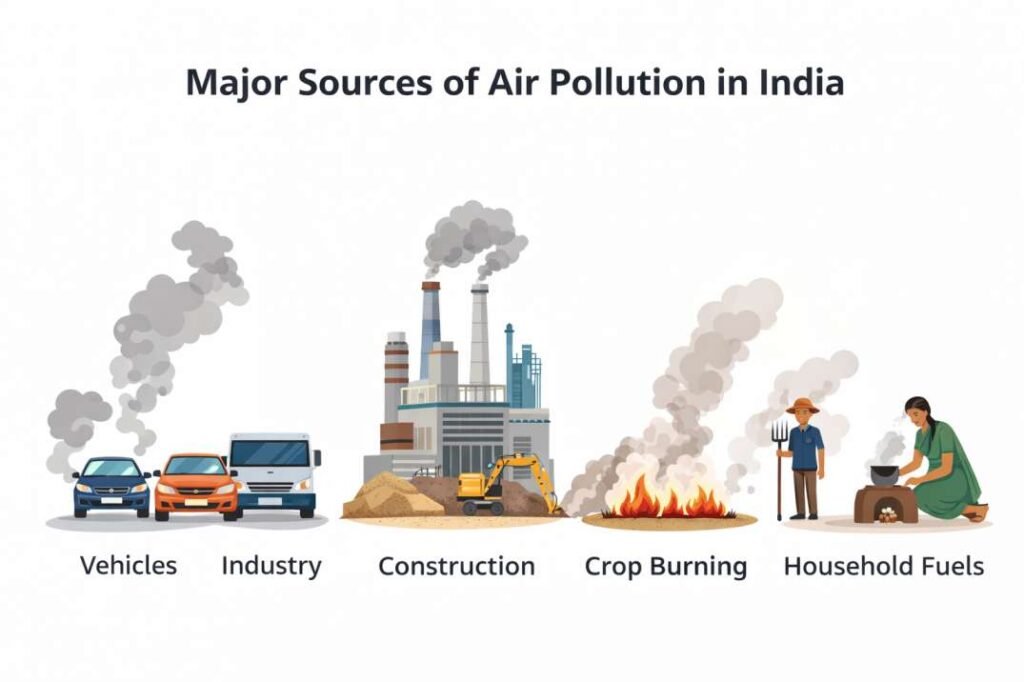
Major contributors include:
1. Vehicular Emissions
Cars, buses, trucks, and two-wheelers emit nitrogen oxides, carbon monoxide, and fine particulate matter. In large cities with heavy traffic congestion, transport is a major pollution source.
2. Industrial Activities
Thermal power plants, manufacturing units, brick kilns, and refineries release gases and particulate matter into the atmosphere.
3. Construction and Road Dust
Rapid urban development generates large amounts of dust. Unpaved roads and debris can significantly increase PM10 levels.
4. Crop Residue Burning
In parts of northern India, agricultural burning during certain seasons contributes to regional pollution episodes.
5. Household Fuels
In some areas, the use of solid fuels such as wood or coal for cooking contributes to indoor and local outdoor pollution.
These sources vary by region and season. For example, coastal cities may experience different pollution patterns compared to northern inland cities during winter.
A detailed breakdown of the major sources of air pollution in India explains how each source affects urban and rural air quality.
Natural and Human Sources of Air Pollution
Air pollution can originate from both natural processes and human activities.
Natural sources include dust storms, forest fires, volcanic eruptions, and sea salt particles carried by wind. These processes have existed for thousands of years and are part of natural atmospheric cycles.
Human-made sources, however, have increased significantly over the last century. These include emissions from vehicles, power plants, industrial manufacturing, construction activities, and the burning of fossil fuels or biomass. In many modern cities, human activities are the dominant contributors to persistent air pollution.
Understanding this distinction helps researchers identify which pollution sources can be controlled through policy and technology.
How Air Pollution Forms in the Atmosphere
Air pollution does not always remain in the same form as when it is emitted. After pollutants enter the atmosphere, they can undergo chemical reactions, physical transformation, and long-distance transport.
Several atmospheric processes influence how pollution develops:
1. Chemical reactions
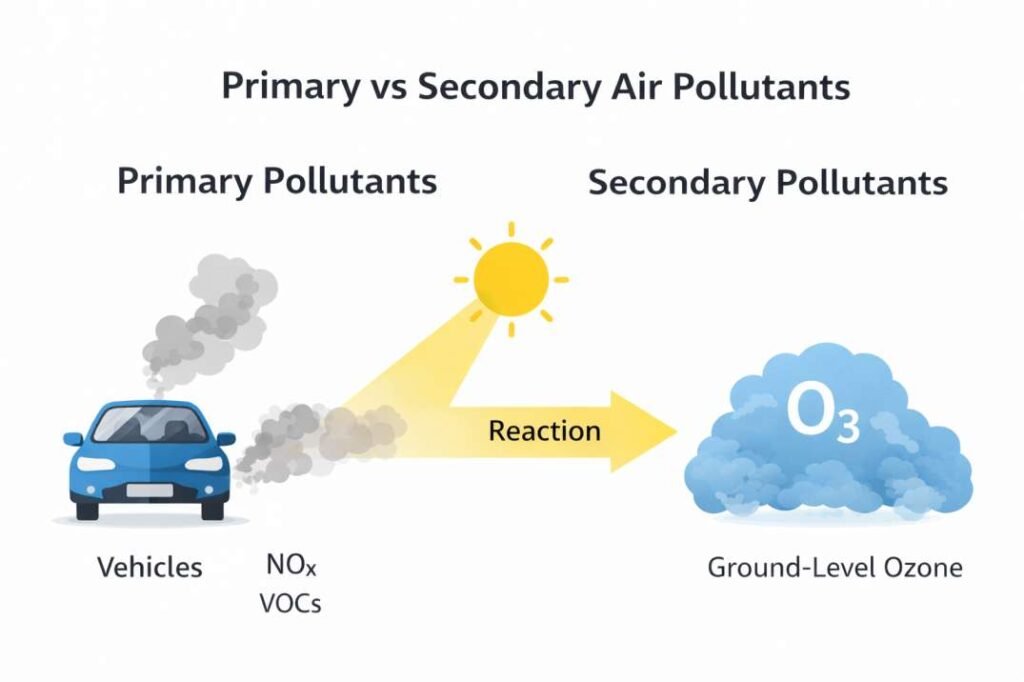
Certain pollutants react with sunlight and other atmospheric compounds. For example, nitrogen oxides and volatile organic compounds react under sunlight to form ground-level ozone.
2. Particle formation
Gases such as sulfur dioxide and nitrogen oxides can transform into fine particulate matter through atmospheric reactions.
3. Transport by wind
Air pollutants can travel long distances. Emissions produced in one region may affect air quality hundreds of kilometers away.
4. Atmospheric trapping
Weather conditions sometimes prevent pollutants from dispersing. During temperature inversions, warmer air above traps cooler polluted air near the surface, increasing pollution concentrations.
Understanding these processes helps scientists explain why pollution levels can change even when emission sources remain similar.
Types of Air Pollution
Air pollution can be understood in different ways depending on where it occurs and how pollutants behave in the atmosphere.
Outdoor (Ambient) Air Pollution
Outdoor air pollution refers to contamination of the air in open environments such as cities, highways, industrial areas, and rural regions.
This is the type most commonly reported in news updates and government dashboards. In India, outdoor air pollution levels are tracked by monitoring stations operated under national systems and reported using the Air Quality Index (AQI).
During winter months, several Indian cities regularly record particulate matter levels above national air quality standards, particularly in densely populated urban areas.
Indoor Air Pollution
Indoor air pollution occurs inside homes, offices, schools, and other enclosed spaces.
It can result from:
- Cooking with solid fuels
- Tobacco smoke
- Poor ventilation
- Chemical products and cleaning agents
- Outdoor pollutants entering buildings
Indoor exposure can be especially significant because people spend a large portion of their time indoors.
Indoor exposure can differ significantly from outdoor pollution patterns. Learn more about indoor air pollution in Indian homes and how it develops in enclosed environments.
Air pollution has become one of the most widely discussed environmental challenges in India. Several Indian cities regularly record particulate matter concentrations above recommended health guidelines. Urban growth, transportation emissions, and energy demand have contributed to increasing pollution levels in many regions.
Primary and Secondary Pollutants
Pollutants are also classified based on how they enter the atmosphere.
Primary Pollutants
These are released directly from a source.
Examples:
- Vehicle exhaust gases
- Smoke from burning fuels
- Dust from construction sites
Secondary Pollutants
These form in the atmosphere when primary pollutants react with sunlight or other atmospheric components.
For example, ground-level ozone forms when nitrogen oxides react with volatile organic compounds in the presence of sunlight.
This distinction explains why pollution can worsen even when direct emissions appear stable.
A more detailed explanation of pollutant classification is available in our guide on air pollutant categories.
Example: How Air Pollution Develops in a City
Air pollution often results from several sources interacting at the same time.
For example, consider a large city during a winter morning:
- Vehicles release exhaust gases and fine particles during rush-hour traffic.
- Construction activities add dust to the air.
- Industrial emissions contribute additional gases such as sulfur dioxide and nitrogen oxides.
- Cold weather conditions reduce air circulation and slow the dispersion of pollutants.
As these pollutants accumulate in the atmosphere, air quality deteriorates and particulate concentrations increase. This combination of emissions and weather conditions often leads to visible haze or smog in urban areas.
Major Air Pollutants Measured in India
Air pollution is monitored through specific measurable pollutants. In India, national reporting systems track several key indicators.
These pollutants are monitored because they have measurable impacts on air quality and human health. Particulate matter such as PM2.5 can penetrate deep into the respiratory system, while gases such as nitrogen dioxide and sulfur dioxide contribute to chemical reactions that form secondary pollutants like ozone. Monitoring multiple pollutants allows environmental agencies to identify dominant pollution sources and design appropriate control strategies. In India, pollutant monitoring is conducted through a network of stations operating under national environmental regulations.
Particulate Matter (PM2.5 and PM10)
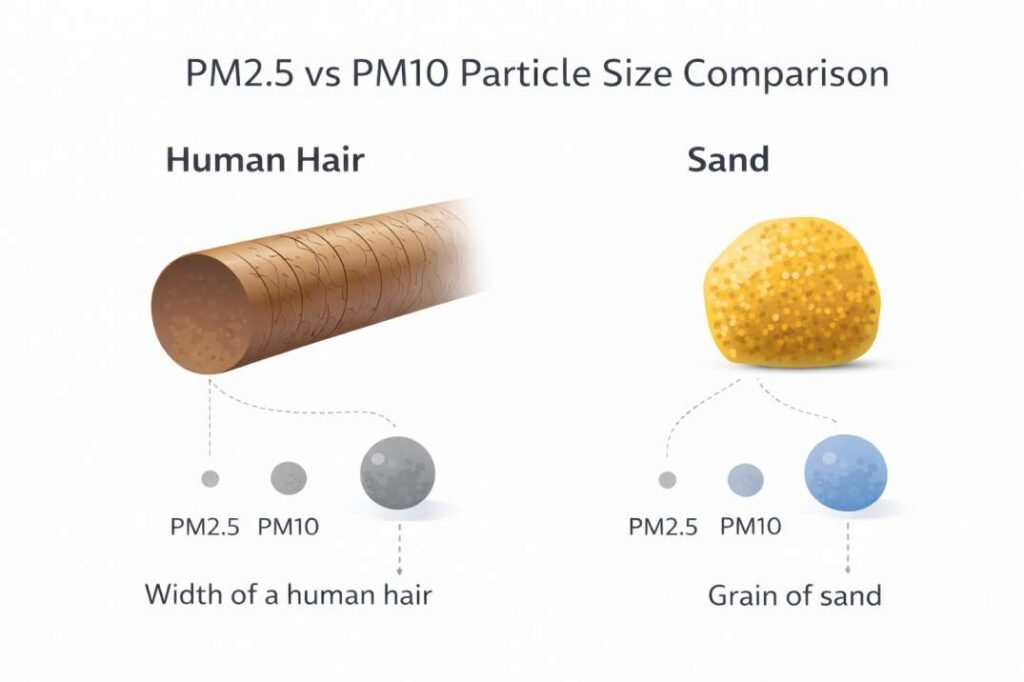
Particulate matter consists of tiny solid or liquid particles suspended in air.
- PM10 includes larger particles such as dust.
- PM2.5 refers to much finer particles that can penetrate deep into the lungs. Because of their small size, these particles can remain suspended in the air for extended periods.
PM2.5 is often considered more harmful because of its small size and ability to enter the bloodstream.
Nitrogen Dioxide (NO₂)
Produced mainly from vehicle engines and industrial processes, nitrogen dioxide contributes to urban smog and respiratory irritation.
Sulphur Dioxide (SO₂)
Commonly linked to coal-based power generation and industrial combustion.
Ozone (O₃)
Ground-level ozone is not emitted directly. It forms when pollutants react under sunlight.
Carbon Monoxide (CO)
An invisible gas produced from incomplete combustion of fuels.
These pollutants form the basis of India’s national air quality reporting framework.
Comparison of Major Air Pollutants Monitored in India
The following table summarises several important pollutants monitored under India’s national air quality reporting framework.
| Pollutant | Main Source | Impact |
|---|---|---|
| PM2.5 | combustion, vehicles | lung and heart disease |
| PM10 | dust, construction | respiratory irritation |
| NO₂ | vehicle exhaust | smog formation |
| SO₂ | coal burning | acid rain |
| CO | incomplete combustion | reduces oxygen delivery |
Air Pollution in India: Key Statistics
Air pollution has become one of the most widely discussed environmental challenges in India. Several national and international studies provide insight into the scale of the issue.
Some key observations include:
• Many Indian cities regularly report PM2.5 levels above international health guidelines.
• Urban regions in the Indo-Gangetic Plain often experience seasonal pollution episodes during winter.
• Air quality monitoring networks now operate in hundreds of cities across India through the Central Pollution Control Board (CPCB).
• Pollution sources vary significantly across regions, including transportation emissions, industrial activity, household fuels, and agricultural burning.
These statistics highlight the importance of continuous monitoring and policy measures aimed at improving air quality.
Why Air Pollution Is a Serious Issue in India
Air pollution affects more than the environment. It also influences public health, productivity, and daily life.
Air pollution has become one of the most widely discussed environmental challenges in India. Studies by international health organizations and environmental agencies have consistently shown that several Indian cities experience particulate matter levels significantly above recommended health guidelines. Rapid urbanization, energy demand, and transportation growth have contributed to increasing emission levels in many regions. As a result, improving air quality has become a major focus of national environmental programs and urban policy initiatives.
When pollutant levels rise, especially fine particles like PM2.5, they can enter the respiratory system through normal breathing. Short-term exposure may cause symptoms such as coughing, throat irritation, breathing discomfort, or eye irritation. Sensitive individuals may feel these effects more quickly.
Long-term exposure over months or years is associated with increased risk of respiratory and cardiovascular problems. While health outcomes depend on multiple factors, sustained exposure to polluted air is widely recognised as a public health concern.
Children and Vulnerable Groups
Children are often more vulnerable to air pollution because:
- Their lungs are still developing
- They breathe more rapidly than adults
- They spend time outdoors in schools and playgrounds
Older adults and people with pre-existing respiratory conditions may also experience stronger effects during high pollution periods.
For a deeper discussion, see our detailed guide on the health effects of air pollution.
Seasonal Pollution Episodes in India
In northern India, especially across the Indo-Gangetic Plain—a region that includes parts of Punjab, Haryana, Uttar Pradesh, Bihar, and Delhi—winter months often bring visible smog episodes.
For example, Delhi frequently experiences elevated particulate matter levels during late autumn and winter. Weather conditions such as lower wind speed and temperature inversion can trap pollutants close to the ground, allowing concentrations to rise.
Seasonal episodes show that weather conditions can significantly influence pollution levels.
Meteorological conditions play a major role in determining how pollutants behave in the atmosphere. During winter months, cooler air near the surface can become trapped under a layer of warmer air above, a phenomenon known as temperature inversion. When this occurs, pollutants released from vehicles, industries, and other sources cannot disperse easily into the upper atmosphere. Instead, they accumulate near the ground, leading to higher pollution concentrations and visible smog in urban areas.
How Air Pollution Is Measured in India
Air pollution is quantified using standardized monitoring systems rather than subjective perception.
India monitors ambient air quality through a national network coordinated by the Central Pollution Control Board (CPCB). Monitoring stations across cities measure pollutant concentrations such as PM2.5, PM10, nitrogen dioxide, sulphur dioxide, ozone, and carbon monoxide.
Air quality monitoring stations collect pollutant samples using specialized instruments that measure the concentration of particles and gases in micrograms per cubic meter of air. These measurements are recorded continuously and transmitted to centralized environmental monitoring systems. Scientists and regulators analyze these data to identify pollution trends, detect high-pollution episodes, and inform public advisories. This systematic monitoring approach allows governments and researchers to track air quality changes over time and evaluate the effectiveness of pollution control policies.
These measured values are then converted into a simplified reporting format called the Air Quality Index (AQI).
What Is AQI?
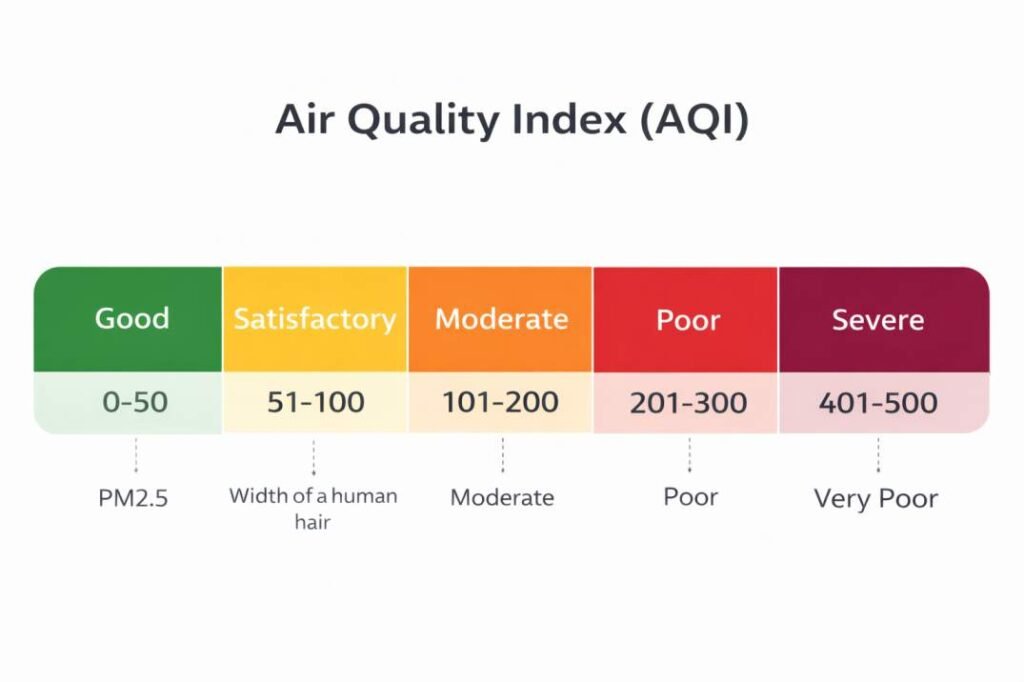
The Air Quality Index is a scale that translates pollutant concentrations into categories such as:
- Good
- Satisfactory
- Moderate
- Poor
- Very Poor
- Severe
Instead of showing multiple pollutant numbers separately, AQI provides a single index value based on the pollutant with the highest impact at that time.
This makes it easier for the public to understand overall air quality conditions without interpreting raw concentration data.
To understand how pollutant concentrations are converted into public categories, see how India’s Air Quality Index (AQI) framework is structured and calculated.
Frequently Asked Questions
Is air pollution only a problem in big cities?
No. While large cities often receive more attention, smaller towns and rural areas can also experience pollution from industry, transport, burning practices, and household fuel use.
Is air pollution visible?
Not always. Smog or haze can be visible, but many harmful pollutants are invisible and can only be detected through monitoring instruments.
What is the difference between AQI and pollution levels?
Pollution levels refer to measured concentrations of specific pollutants. AQI is an index that converts those measurements into an easier-to-understand category.
Is indoor air pollution different from outdoor pollution?
Yes. Indoor pollution occurs inside buildings and may result from cooking fuels, tobacco smoke, or poor ventilation. Outdoor pollution refers to air contamination in open environments.
Why does air pollution increase in winter in many Indian cities?
Air pollution often increases during winter because weather conditions reduce the dispersion of pollutants. Lower wind speeds and temperature inversions can trap polluted air close to the ground, allowing particulate matter and other pollutants to accumulate. Seasonal activities such as crop residue burning can also contribute to higher pollution levels during this period.
Understanding air pollution requires examining both its scientific causes and its real-world impacts. By identifying pollution sources, measuring pollutant concentrations, and studying atmospheric processes, environmental researchers can better explain how air quality changes over time. Public awareness of these factors is essential because informed citizens, policymakers, and institutions all play a role in improving air quality and reducing environmental health risks.
Key Takeaways
• Air pollution occurs when harmful particles or gases accumulate in the atmosphere.
• Major sources include vehicles, industry, dust, and fuel combustion.
• PM2.5 particles are especially harmful because they penetrate deep into the lungs.
• India monitors pollution using the Air Quality Index (AQI).
• Weather conditions such as temperature inversion can intensify pollution episodes.
Conclusion
Air pollution is a measurable environmental condition shaped by emission sources, atmospheric processes, and human activity. In India, it is systematically monitored and publicly reported through structured frameworks such as the Air Quality Index.
A clear understanding of its causes, pollutant types, and measurement systems helps readers interpret air quality information accurately and explore deeper topics within this air pollution knowledge hub.
Last update: February 2026
References & Further Reading
Official Indian Sources
Central Pollution Control Board (CPCB)
Official authority responsible for air quality monitoring and regulation in India.
https://cpcb.nic.in/
National Air Quality Index (NAQI) – CPCB
Explains how India’s Air Quality Index is structured and calculated.
https://cpcb.nic.in/National-Air-Quality-Index/
National Ambient Air Quality Standards (NAAQS) – CPCB Notification
Official pollutant limits prescribed under Indian environmental law.
https://cpcb.nic.in/uploads/National_Ambient_Air_Quality_Standards.pdf
National Clean Air Programme (NCAP) – Ministry of Environment, Forest and Climate Change
India’s national framework for reducing particulate pollution in non-attainment cities.
https://moef.gov.in/en/division/air-pollution/national-clean-air-programme/
Real-Time Air Quality Data Portal – Government of India
Public dashboard for city-level AQI data.
https://app.cpcbccr.com/AQI_India/
International & Scientific References
World Health Organization (WHO) – Air Pollution Overview
Global health perspective on air pollution and exposure risks.
https://www.who.int/health-topics/air-pollution
WHO Global Air Quality Guidelines
Updated scientific recommendations on pollutant exposure levels.
https://www.who.int/publications/i/item/9789240034228
United States Environmental Protection Agency (EPA) – Air Quality Basics
Clear explanation of pollutants and AQI structure.
https://www.epa.gov/air-quality-management-process
AirNow – Air Quality Index Basics
Public-friendly explanation of AQI categories and interpretation.
https://www.airnow.gov/aqi/aqi-basics/

- Continuous Ambient Air Quality Monitoring Systems (CAAQMS) in India: How Real-Time Air Quality Monitoring Works - March 17, 2026
- Air Pollution Monitoring Stations: How Sensors Measure Air Pollutants - March 12, 2026
- Vehicular Emissions in Indian Cities: How Traffic Causes Air Pollution - February 14, 2026