
Introduction
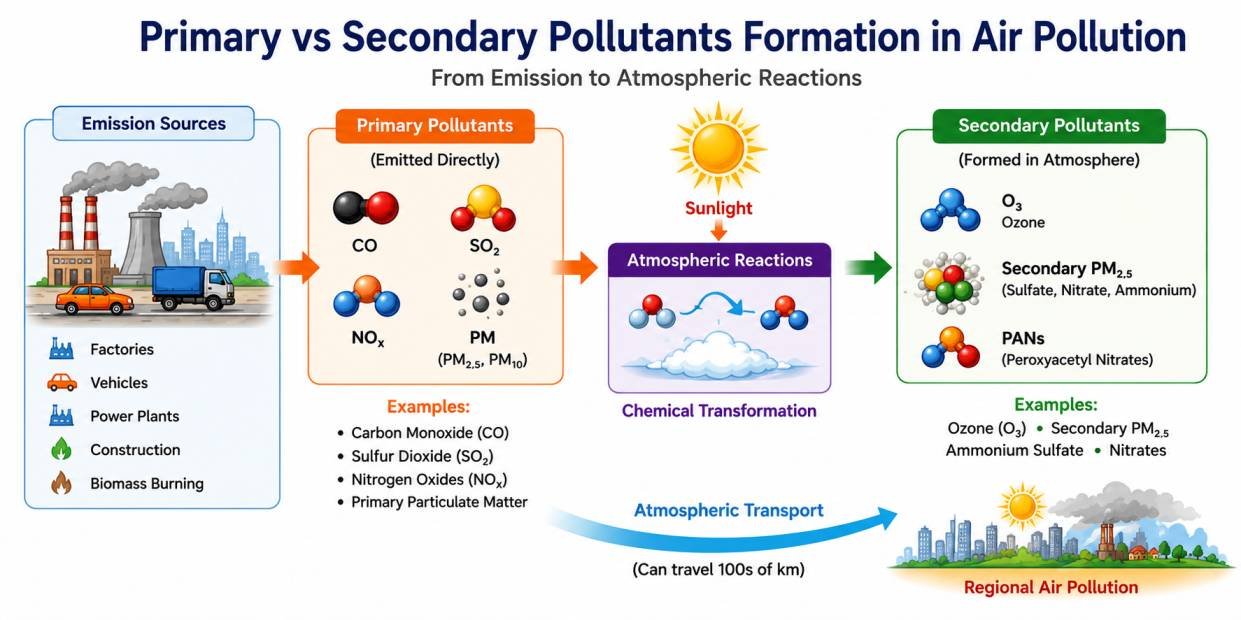
Many people assume every air pollutant comes directly from a chimney, vehicle, or factory. In reality, some of the most harmful pollutants are formed later through chemical reactions in the atmosphere.
This difference is explained by primary and secondary pollutants.
For example, smoke from vehicle exhaust is a primary pollutant because it enters the atmosphere directly. In contrast, ground-level ozone forms later when gases such as nitrogen oxides (NOₓ) react in sunlight, making it a secondary pollutant.
Understanding this distinction helps explain why smog develops, how PM₂.₅ forms, and why AQI levels can remain high even after emissions decrease.
Quick Answer: Primary vs. Secondary Pollutants
| Type | Meaning | Example |
|---|---|---|
| Primary pollutants | Air pollutants released directly into the atmosphere from emission sources. | Carbon monoxide (CO), sulfur dioxide (SO₂) |
| Secondary pollutants | Air pollutants formed in the atmosphere through chemical reactions involving precursor pollutants. | Ground-level ozone (O₃), sulfate particles |
Primary and secondary air pollutants are the two main categories used to describe whether a pollutant is emitted directly or formed later in the atmosphere.
Why This Distinction Matters in India
Many Indian cities experience high PM₂.₅ levels even after visible emissions decrease because secondary pollutants continue to form through atmospheric reactions.
For example, during severe winter pollution episodes, Delhi and several North Indian cities have recorded AQI values above 300, indicating Very Poor or Severe air quality.
Primary vs Secondary Pollutants: Key Differences
| Feature | Primary Pollutants | Secondary Pollutants |
|---|---|---|
| Definition | Pollutants released directly from a source | Pollutants formed in the atmosphere through chemical reactions |
| Formation | Emitted directly from sources such as vehicles, factories, fires, or other combustion processes | Form when precursor pollutants react in the atmosphere, often involving sunlight, oxygen, or other atmospheric conditions |
| Examples | Carbon monoxide (CO), sulfur dioxide (SO₂), nitrogen monoxide (NO), and some directly emitted particulate matter | Ground-level ozone (O₃), sulfate particles, nitrate particles, and some secondary particulate matter |
| Typical Spatial Pattern | Often highest near emission sources | Some can affect areas far from their formation or emission sources |
| Control Approach | Reduce emissions directly at the source | Reduce the precursor pollutants that contribute to their formation |
| Key Idea | Emitted directly | Formed in the atmosphere |
A simple way to remember the difference:
- Primary pollutants = emitted directly into the air
- Secondary pollutants = formed later through atmospheric chemical reactions
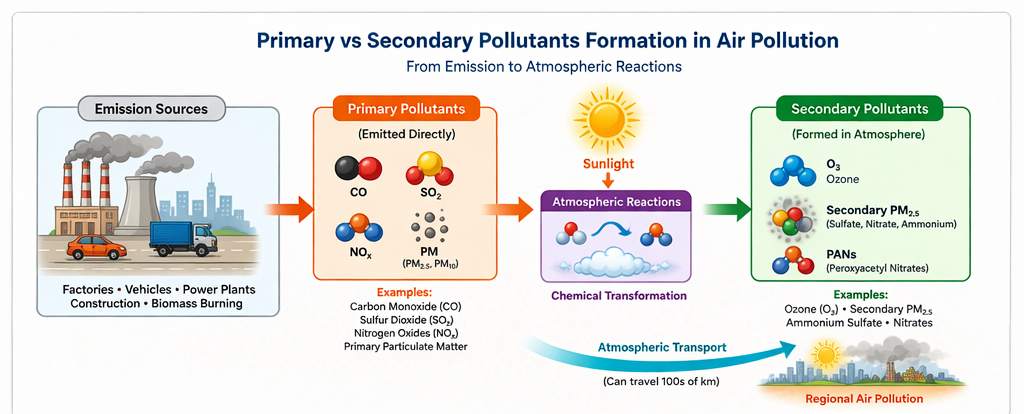
Not all air pollutants behave the same way after entering the atmosphere. Some remain close to their emission sources, while others form through atmospheric chemical reactions and can spread far from where they were originally emitted.
Selected AQI Pollutants: Primary vs Secondary
India’s Air Quality Index (AQI) includes several pollutants. The selected examples below illustrate how some pollutants are emitted directly from sources, while others can form through atmospheric chemical reactions. CPCB’s National AQI framework considers eight pollutants for AQI calculation.
| Pollutant | Primary | Secondary | Why? |
|---|---|---|---|
| PM₂.₅ | ✓ | ✓ | Some particles are emitted directly, while others form in the atmosphere from precursor gases. |
| PM₁₀ | ✓ | — | Primarily emitted directly from dust, construction, road dust, and other sources. |
| Nitrogen Dioxide (NO₂) | ✓ | Can form secondarily | Directly emitted from combustion and can also form through atmospheric reactions. |
| Sulfur Dioxide (SO₂) | ✓ | — | Directly emitted mainly from burning sulfur-containing fuels and industrial processes. |
| Carbon Monoxide (CO) | ✓ | — | Produced directly by incomplete combustion of fuels and biomass. |
| Ozone (O₃) | — | ✓ | Forms in the atmosphere through chemical reactions involving precursor gases such as NOₓ and VOCs, often in sunlight. |
Understanding which AQI pollutants are primary and secondary helps explain why air quality does not always improve immediately after emissions are reduced.
What Are Primary Pollutants?
Primary pollutants are air pollutants that enter the atmosphere directly from identifiable emission sources.
Common sources include:
- Vehicle exhaust
- Industrial emissions
- Coal combustion
- Construction dust
- Biomass burning
In Indian cities, transport emissions, coal-based power plants, and road dust are major contributors to primary pollution.
Because primary pollutants are emitted directly, their concentrations are often highest near their emission sources.
Major Sources of Primary Pollutants in Indian Cities
Different emission sources release different primary pollutants. Understanding these sources helps explain why pollution patterns vary across cities and seasons.
| Source | Common Pollutants Released |
|---|---|
| Vehicle Exhaust | Carbon Monoxide (CO), Nitrogen Oxides (NOₓ), PM₂.₅ |
| Coal Power Plants | Sulfur Dioxide (SO₂), Nitrogen Oxides (NOₓ) |
| Construction Activities | PM₁₀, PM₂.₅ |
| Road Dust | PM₁₀ |
| Biomass Burning | PM₂.₅, Carbon Monoxide (CO) |
| Industrial Processes | SO₂, NOₓ, Particulate Matter |
In many Indian cities, transport emissions, road dust, industrial activities, and combustion sources collectively contribute to high primary pollutant levels.
What Are Secondary Pollutants? How Do They Form?
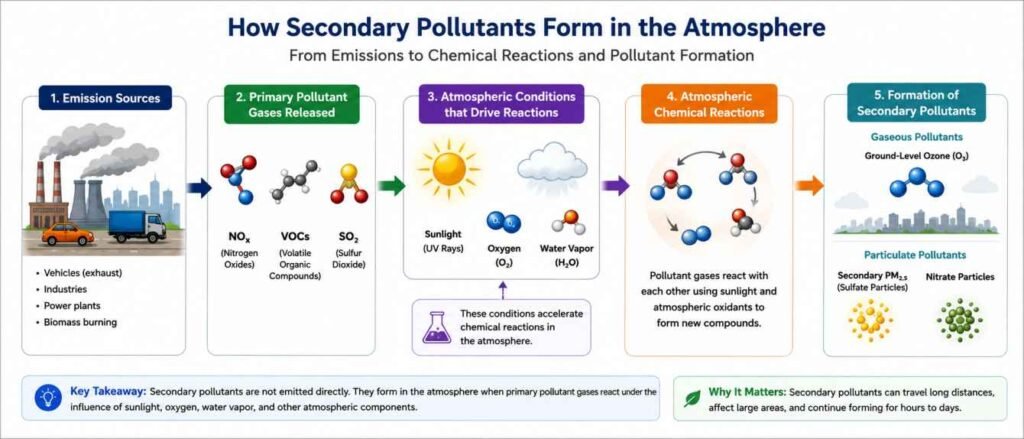
Secondary pollutants are not released directly into the air. Instead, they form when primary pollutants undergo chemical reactions in the atmosphere.
Examples of secondary pollutants include ground-level ozone, sulfate particles, nitrate particles, and some secondary PM₂.₅.
These reactions commonly involve precursor gases such as:
- Nitrogen oxides (NOₓ)
- Sulfur dioxide (SO₂)
- Volatile organic compounds (VOCs)
- Ammonia (NH₃)
These reactions are strongly influenced by sunlight, humidity, temperature, and other atmospheric conditions.
For example, nitrogen oxides and VOCs can react in the presence of sunlight to form ground-level ozone, while sulfur dioxide and nitrogen oxides can transform into sulfate and nitrate particles that contribute to PM₂.₅ pollution.
In simple terms, the formation process usually follows this pattern:
Emission of gases → Atmospheric chemical reactions → Formation of ozone or fine particles → Increased AQI and smog
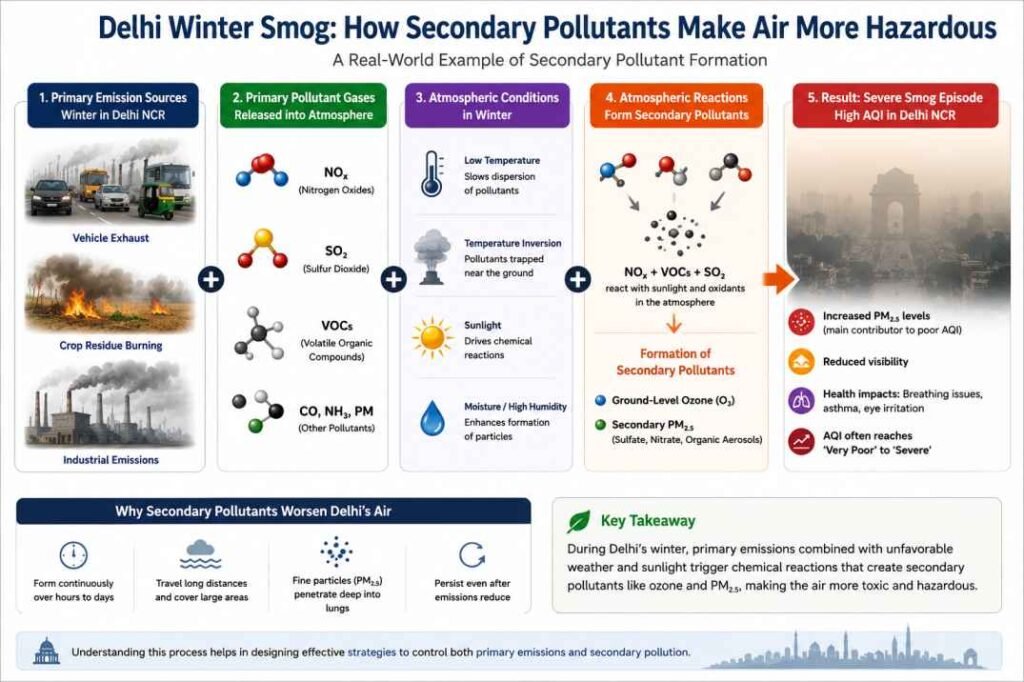
In Indian cities such as Delhi, winter conditions such as low wind speeds and temperature inversions can limit pollutant dispersion and allow pollutants and secondary particles to accumulate near the surface. The specific chemical processes involved depend on precursor concentrations, temperature, humidity, sunlight, and other atmospheric conditions.
Why Secondary Pollution Is a Major Concern in India
Secondary pollution contributes significantly to urban air quality problems because pollutants continue to form even after direct emissions occur.
For example, gases released from vehicles, industries, and power plants can remain in the atmosphere and react to form ground-level ozone and secondary PM₂.₅.
During winter, weather conditions such as low wind speeds and temperature inversions can limit pollutant dispersion and allow pollutants and secondary particles to accumulate near the surface.
Example: Why Delhi AQI Can Stay High Even After Traffic Reduces
Many people assume that lower traffic automatically means cleaner air. In reality, AQI can remain high because secondary pollutants continue to form in the atmosphere.
In Delhi and the surrounding NCR region, emissions of nitrogen oxides (NOₓ), sulfur dioxide (SO₂), and ammonia (NH₃) can react over time to produce secondary PM₂.₅ particles.
During winter, temperature inversions and low wind speeds can limit pollutant dispersion and allow pollutants and secondary particles to accumulate near the surface. As a result, AQI may remain elevated even when some direct emissions temporarily decrease.
As a result, AQI may remain in the Poor, Very Poor, or Severe categories despite lower traffic emissions.
How Monitoring Stations Detect Primary and Secondary Pollutants
Air-quality monitoring stations continuously measure pollutants that help scientists identify pollution sources and atmospheric chemical reactions. In India, many of these measurements are collected through Continuous Ambient Air Quality Monitoring Systems (CAAQMS) operated by the Central Pollution Control Board (CPCB) and State Pollution Control Boards.
Commonly monitored pollutants include:
- PM₂.₅
- PM₁₀
- Nitrogen Dioxide (NO₂)
- Sulfur Dioxide (SO₂)
- Carbon Monoxide (CO)
- Ozone (O₃)
When ozone or PM₂.₅ levels change alongside precursor gases and meteorological conditions, these observations can help scientists investigate the role of atmospheric chemical reactions in changing air quality.
These measurements provide data that can help air-quality agencies assess pollution patterns and investigate changes in air quality. Learn more about how Continuous Ambient Air Quality Monitoring Systems (CAAQMS) measure these pollutants in our detailed CAAQMS guide.
Photochemical Smog and Secondary PM₂.₅
Photochemical smog is a type of secondary pollution formed when sunlight triggers reactions between nitrogen oxides (NOₓ) and volatile organic compounds (VOCs).
This type of pollution is commonly observed in large urban areas with heavy traffic emissions and strong sunlight.
These reactions produce:
- Ground-level ozone
- Oxidizing chemicals
- Secondary particulate matter
Secondary PM₂.₅ also forms when gases such as sulfur dioxide (SO₂), nitrogen oxides (NOₓ), and ammonia (NH₃) transform into fine particles in the atmosphere.
In cities such as Delhi, winter conditions including low wind speeds and temperature inversions can limit pollutant dispersion and contribute to the accumulation of pollutants and secondary particles near the surface.
Why Secondary Pollution Can Be Harder to Control
Secondary pollution can be more challenging to control because it depends on atmospheric reactions involving precursor gases rather than emissions from a single direct source.
Unlike many primary pollutants, secondary pollutants can travel long distances and affect areas far from their emission sources. Ground-level ozone and secondary PM₂.₅ are common examples.
Weather conditions such as sunlight, humidity, wind speed, and temperature inversions strongly influence their formation. As a result, pollution levels may remain high even when direct emissions temporarily decrease.
Long-term exposure to fine particulate matter and ozone is associated with increased risks of respiratory and cardiovascular health effects. Learn more about the health effects of air pollution.
For air-quality management agencies, controlling secondary pollution requires reducing precursor gases such as nitrogen oxides (NOₓ), sulfur dioxide (SO₂), volatile organic compounds (VOCs), and ammonia (NH₃), rather than focusing only on direct emissions.
Key Insight
Reducing visible smoke does not always reduce AQI immediately.
Many severe pollution episodes in India are driven by atmospheric chemical reactions that continue after pollutants have been emitted. This is why controlling precursor gases such as NOₓ, SO₂, VOCs, and NH₃ is often just as important as reducing direct emissions.
Related Guide
Want to learn how these pollutants influence India’s Air Quality Index? Read our complete guide on How AQI Is Calculated.
Can a Pollutant Be Both Primary and Secondary?
Yes. Some pollutants can exist in both primary and secondary forms. PM₂.₅ is one of the most common examples.
PM₂.₅ can be emitted directly from sources such as vehicle exhaust, construction activities, industrial combustion, and biomass burning. In these cases, it is classified as a primary pollutant.
However, PM₂.₅ can also form in the atmosphere when gases such as sulfur dioxide (SO₂), nitrogen oxides (NOₓ), and ammonia (NH₃) undergo atmospheric chemical reactions and transform into fine particles.
As a result, PM₂.₅ pollution in Indian cities often consists of both directly emitted particles and particles formed through atmospheric chemical reactions.
Key Takeaways
- Primary pollutants are released directly into the atmosphere from sources such as vehicles, industries, and combustion processes.
- Secondary pollutants form later through atmospheric chemical reactions involving gases already present in the air.
- Ground-level ozone and photochemical smog are major examples of secondary pollution.
- PM₂.₅ can exist in both primary and secondary forms.
- Weather conditions such as sunlight, humidity, and temperature inversions strongly influence secondary pollution levels in Indian cities.
Related Air Pollution Guides
To better understand air quality in India, you may also find these guides useful:
- What Is Air Pollution?
- What AQI Is Dangerous in India?
- What Is a Safe AQI in India?
- Why Air Pollution Changes Daily
- Air Pollution Monitoring Stations Explained
Conclusion
Understanding the difference between primary and secondary pollutants is essential for interpreting air pollution, AQI, and smog formation.
Primary pollutants enter the atmosphere directly from sources such as vehicles, industries, and combustion activities. Secondary pollutants form later through atmospheric chemical reactions involving gases already present in the air.
In Indian cities, where emissions and weather conditions interact closely, distinguishing between these pollutant types helps explain severe pollution episodes and the formation of PM₂.₅.
Common Questions About Primary and Secondary Pollutants
What are secondary air pollutants?
Secondary air pollutants are pollutants that are not emitted directly into the atmosphere. Instead, they form when primary pollutants such as nitrogen oxides (NOₓ), sulfur dioxide (SO₂), and volatile organic compounds (VOCs) react with sunlight, oxygen, or water vapor. Common examples include ground-level ozone (O₃), sulfate particles, nitrate particles, and photochemical smog.
What are primary and secondary pollutants?
Primary pollutants are emitted directly from sources such as vehicles, industries, and biomass burning. Secondary pollutants form later in the atmosphere when primary pollutants undergo chemical reactions. Understanding this distinction helps explain how air pollution develops and how AQI is managed.
Can PM₂.₅ be both primary and secondary?
Yes. PM₂.₅ can be emitted directly from sources such as vehicle exhaust, construction dust, and biomass burning, making it a primary pollutant. It can also form in the atmosphere through chemical reactions involving sulfur dioxide (SO₂), nitrogen oxides (NOₓ), and ammonia (NH₃), making it a secondary pollutant.
Why are secondary pollutants harder to control?
Secondary pollutants are difficult to control because they form through atmospheric chemical reactions. Even after emissions decrease, precursor gases already present in the atmosphere may continue reacting under suitable atmospheric conditions, so air quality may not improve immediately after emissions decrease.
Why can AQI levels remain high even after emissions decrease?
AQI levels may remain high because secondary pollutants continue forming in the atmosphere under suitable weather conditions such as sunlight, humidity, low wind speed, and temperature inversion.
Is ozone a primary or secondary pollutant?
Ground-level ozone is a secondary pollutant. It forms when nitrogen oxides (NOₓ) and volatile organic compounds (VOCs) react in sunlight.
Is nitrogen dioxide a primary pollutant?
Nitrogen dioxide (NO₂) is primarily emitted directly from combustion sources, so it is generally classified as a primary pollutant. However, atmospheric reactions can also produce NO₂ under certain conditions.
Is PM10 primary or secondary?
PM10 is primarily emitted directly from sources such as road dust, construction activities, and industrial operations. However, a small fraction can also form through atmospheric processes.
Why does PM2.5 increase during winter?
Winter weather conditions such as temperature inversions, low wind speeds, and reduced atmospheric mixing can trap pollutants near the ground. These conditions can contribute to higher PM₂.₅ concentrations, while the extent of secondary particle formation also depends on atmospheric chemistry and available precursor gases.
References
- Central Pollution Control Board (CPCB), Government of India. (n.d.). National Air Quality Index (AQI): Technical Framework.
- Central Pollution Control Board (CPCB), Government of India. National Air Quality Monitoring Programme (NAMP): Guidelines and Methodology.
- Ministry of Environment, Forest and Climate Change (MoEFCC), Government of India. (2009). National Ambient Air Quality Standards (NAAQS).
- World Health Organization (WHO). (2021). WHO Global Air Quality Guidelines. Geneva: WHO.
- Seinfeld, J. H., & Pandis, S. N. (2016). Atmospheric Chemistry and Physics: From Air Pollution to Climate Change (3rd ed.). Wiley.