Introduction
Air quality can vary significantly across Indian cities depending on traffic, industrial activity, weather conditions, and seasonal factors. Many people check AQI values before going outside but are often unsure what AQI level is actually considered safe.
In India, AQI values between 0 and 100 are generally considered acceptable for most people. As AQI rises above 100, pollution exposure increases and some individuals may begin experiencing health effects, particularly during prolonged outdoor activity.
Understanding safe AQI ranges can help you make better decisions about outdoor exercise, commuting, and reducing unnecessary pollution exposure.
Safe AQI in India is generally considered between 0 and 100 under the CPCB AQI framework. AQI above 100 indicates increasing pollution exposure, while AQI above 200 may cause health concerns for sensitive groups.

Quick Answer
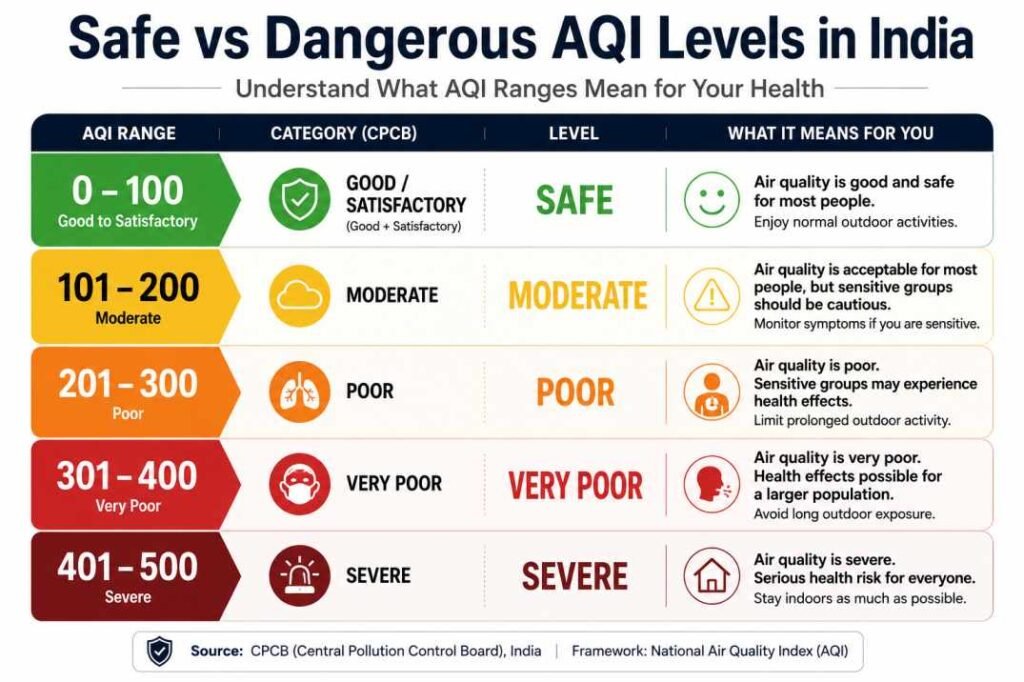
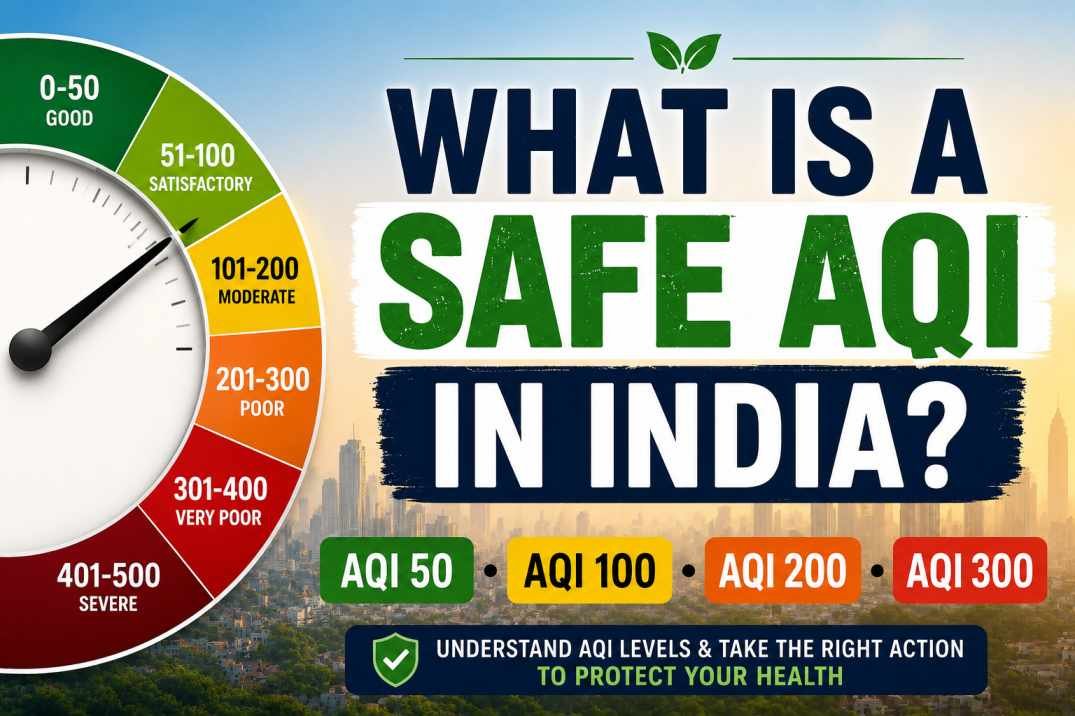
A safe AQI in India is generally between 0 and 100 under the CPCB Air Quality Index framework.
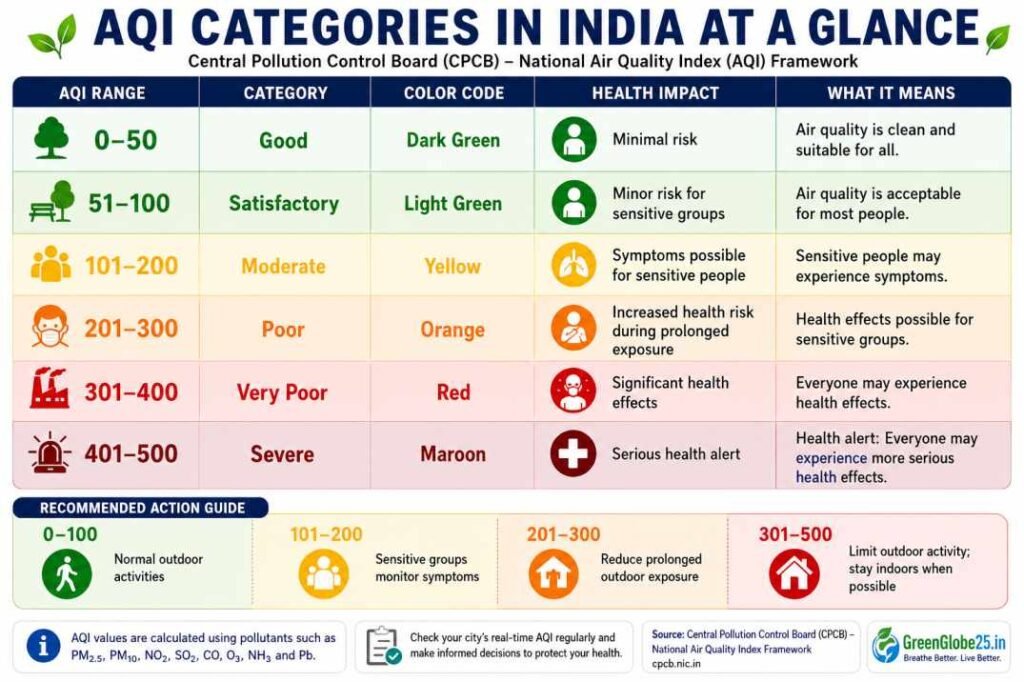
- AQI 0–50 = Good
- AQI 51–100 = Satisfactory
- AQI 101–200 = Moderate
- AQI 201–300 = Poor
- AQI 301–400 = Very Poor
- AQI 401–500 = Severe
For most people, AQI below 100 is considered safe. Once AQI exceeds 200, health risks increase and prolonged outdoor exposure may begin affecting even healthy individuals.
Table of Contents
What Is AQI and Why Does It Matter?
AQI (Air Quality Index) is a system used to describe how clean or polluted the air is at a particular location. Instead of showing pollution measurements for individual pollutants separately, AQI combines multiple pollutants into a single number that is easier for the public to understand. To understand these numbers better, see How AQI is Calculated in India.
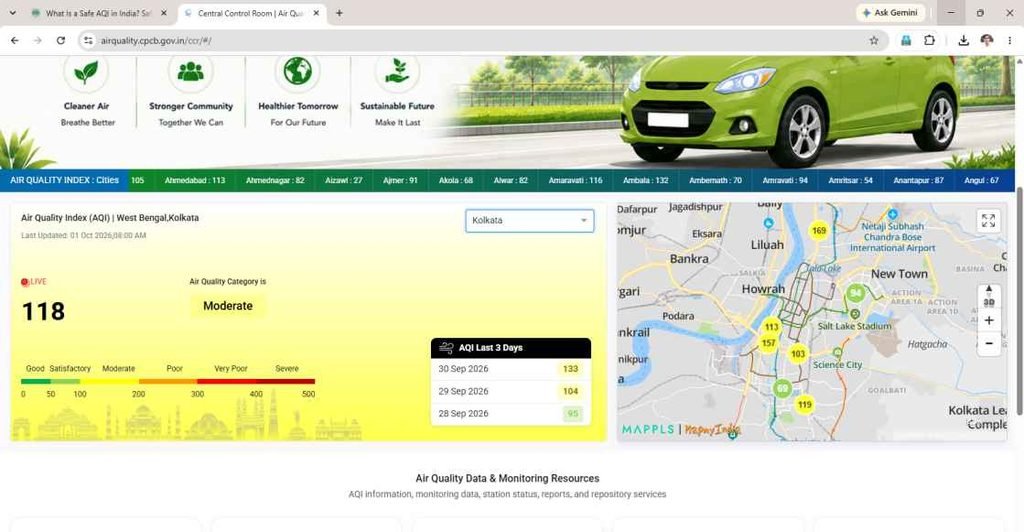
In India, the Central Pollution Control Board (CPCB) uses the National Air Quality Index framework to report air quality conditions across cities and monitoring stations. The underlying data comes from monitoring networks that continuously collect pollution measurements. Learn more in How Real-Time AQI Data Is Collected in India.
AQI is calculated using pollutants such as:
- PM2.5 (fine particulate matter)
- PM10 (coarse particulate matter)
- Nitrogen Dioxide (NO₂)
- Sulfur Dioxide (SO₂)
- Carbon Monoxide (CO)
- Ozone (O₃)
- Ammonia (NH₃)
- Lead (Pb)
As pollution levels increase, AQI values rise and potential health risks become greater.
For example:
- An AQI of 40 generally indicates clean air with minimal health concerns.
- An AQI of 120 suggests moderate pollution that may affect sensitive groups.
- An AQI of 250 indicates poor air quality where prolonged exposure can affect a larger portion of the population.
- An AQI above 400 represents severe pollution conditions requiring stronger precautions.
AQI matters because it helps people make practical decisions about outdoor activities, exercise, commuting, and pollution exposure. Rather than guessing whether the air is safe, AQI provides a standardized way to assess air quality and potential health risks. These AQI values are generated using data from Air Pollution Monitoring Stations located across India.
What Is Considered a Safe AQI in India?
Under India’s National Air Quality Index (AQI) framework, air quality is generally considered safe when AQI remains between 0 and 100. This range includes the Good and Satisfactory categories, where pollution levels are relatively low and health risks for the general population are minimal.
The CPCB AQI categories are shown below:
| AQI Range | Category | General Health Impact |
|---|---|---|
| 0–50 | Good | Minimal impact |
| 51–100 | Satisfactory | Minor breathing discomfort for a small number of sensitive individuals |
| 101–200 | Moderate | Breathing discomfort possible for people with respiratory conditions |
| 201–300 | Poor | Increased discomfort during prolonged exposure |
| 301–400 | Very Poor | Significant health effects possible |
| 401–500 | Severe | Serious health risks for a larger population |

For a detailed comparison between Indian and international air quality guidelines, see CPCB vs WHO Air Pollution Standards in India.
For most healthy adults, AQI below 100 is generally considered safe for normal outdoor activities, commuting, walking, and exercise.
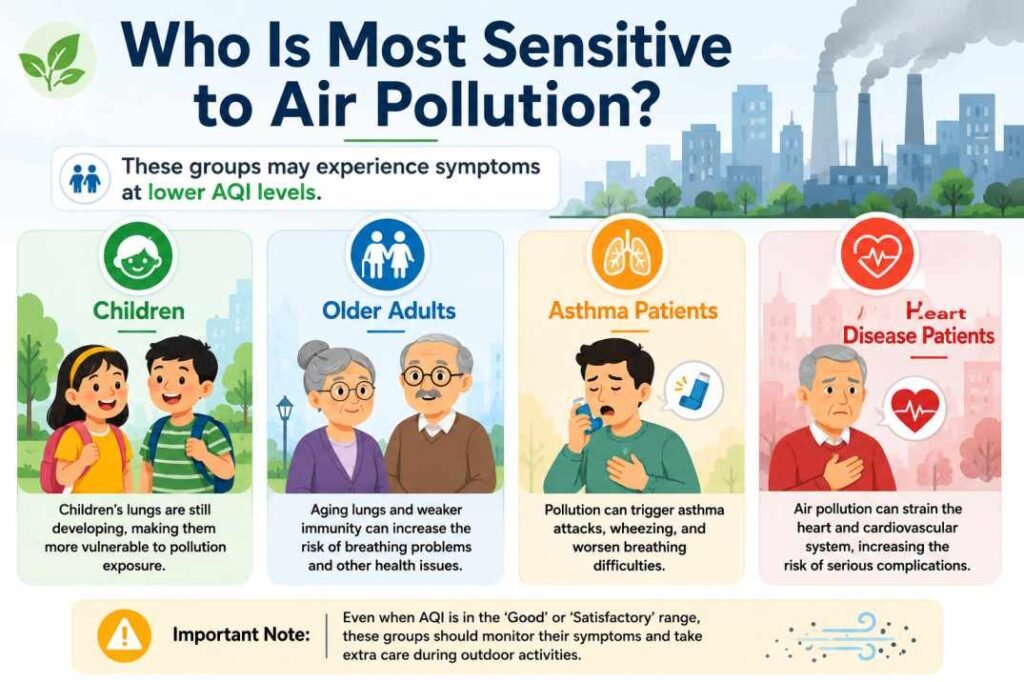
However, “safe” does not always mean the same thing for everyone. Children, older adults, and people with asthma or other respiratory conditions may be more sensitive to air pollution even when AQI remains within the satisfactory range.
As AQI rises above 100, pollution exposure gradually increases. This does not necessarily mean the air becomes immediately dangerous, but it indicates that some individuals may begin experiencing symptoms such as throat irritation, coughing, or breathing discomfort during extended outdoor exposure.
Once AQI exceeds 200, health concerns become more significant because pollution concentrations are high enough to affect a broader section of the population, particularly during repeated exposure over several days.
Author Observation
A common misconception is that air quality is either “safe” or “dangerous.” In reality, air pollution exists on a spectrum. The difference between AQI 80 and AQI 180 may not be obvious visually, but exposure levels and potential health impacts can be very different, especially for sensitive groups.
Is AQI 50 Safe?
Yes. AQI 50 falls within the Good category and is generally considered safe for nearly everyone.
At this level, air pollution concentrations are relatively low, and most people can continue normal outdoor activities without concern. Walking, cycling, outdoor exercise, sports, and daily commuting can typically be performed without pollution-related restrictions.
Children, older adults, and individuals with respiratory conditions generally face minimal pollution-related risk when AQI remains in the Good category.
Although AQI 50 is considered safe, it does not necessarily mean the air is completely free of pollutants. Instead, it indicates that pollution levels are low enough that adverse health effects are unlikely for the vast majority of the population.
Examples of activities generally considered safe at AQI 50 include:
- Outdoor exercise
- School sports activities
- Walking and cycling
- Outdoor recreation
- Children’s playground activities
For comparison, many cities experience AQI values significantly above 50 during periods of heavy traffic, industrial emissions, or unfavorable weather conditions. As a result, AQI 50 is often viewed as a desirable air quality target.
Is AQI 100 Safe?
In most situations, yes.
AQI 100 represents the upper limit of the Satisfactory category under the CPCB AQI framework. Air quality at this level is still generally considered acceptable for the general population.
Most healthy adults can continue normal outdoor activities without significant concern. However, individuals who are particularly sensitive to air pollution may begin noticing minor symptoms during prolonged outdoor exposure.
These sensitive groups may include:
- People with asthma
- Individuals with chronic respiratory conditions
- Older adults
- Young children
- People with cardiovascular disease
AQI 100 is not usually considered dangerous, but it does indicate higher pollution exposure than AQI values in the Good category.
AQI 50 vs AQI 100
Both AQI 50 and AQI 100 are generally considered safe. The difference is that AQI 100 represents a higher pollution level and a smaller margin before air quality begins entering the Moderate category.
For healthy individuals, the practical difference may be small. For sensitive groups, however, AQI 100 may require greater awareness of symptoms during extended outdoor activity.
In most Indian cities, AQI values fluctuate throughout the day. Therefore, a single AQI reading should be interpreted alongside overall exposure duration and daily air quality trends.
Is AQI 150 Safe?
AQI 150 falls within the Moderate category under the CPCB Air Quality Index framework. While it is not typically considered hazardous for the general population, it is no longer regarded as ideal air quality.
Most healthy adults can continue normal daily activities at AQI 150. However, pollution exposure is noticeably higher than in the Good or Satisfactory categories, and some sensitive individuals may begin experiencing symptoms during prolonged outdoor exposure.
People who may be more affected include:
- Children
- Older adults
- People with asthma
- Individuals with chronic respiratory diseases
- People with cardiovascular conditions
Common symptoms may include:
- Mild throat irritation
- Coughing
- Eye irritation
- Breathing discomfort during exercise
AQI 150 does not usually require people to remain indoors, but it may be sensible to reduce prolonged outdoor activities if pollution levels remain elevated for several hours or days.
Is AQI 150 Safe for Children?
Children are generally more sensitive to air pollution because their lungs are still developing and they tend to spend more time outdoors.
At AQI 150, most children can continue normal activities. However, schools, parents, and caregivers should pay attention to children who have asthma or other respiratory conditions.
If a child develops symptoms such as coughing, wheezing, or breathing discomfort, outdoor activity may need to be reduced.
Is AQI 150 Safe for Outdoor Exercise?
AQI 150 represents a situation where exercise decisions should be made more carefully.
Light and moderate activities such as:
- Walking
- Casual cycling
- Recreational outdoor activities
are generally acceptable for healthy individuals.
However, prolonged high-intensity exercise may increase pollution exposure because people breathe more deeply and inhale larger amounts of polluted air.
Examples of activities that may require caution include:
- Long-distance running
- Competitive sports
- High-intensity cycling
- Extended outdoor workouts
AQI 150 vs AQI 100
The difference between AQI 100 and AQI 150 is not always visible to the eye, but pollution concentrations are substantially higher.
| AQI | Category | General Interpretation |
|---|---|---|
| 100 | Satisfactory | Generally safe for most people |
| 150 | Moderate | Increased exposure for sensitive groups |
AQI 150 is often the point where sensitive groups begin paying closer attention to air quality conditions.
Author Observation
Many people assume that AQI becomes a concern only when it exceeds 200 or 300. In practice, repeated exposure to AQI around 150 can still be meaningful, particularly for people who spend several hours outdoors every day. Exposure duration often matters as much as the AQI number itself.
Is AQI 200 Dangerous?
AQI 200 sits at the upper end of the Moderate category and marks an important threshold in air quality assessment. While it is not classified as “Poor” under the CPCB framework until AQI exceeds 200, many people begin paying closer attention to air quality conditions as AQI approaches this level.
For healthy adults, short-term outdoor activities are usually still possible. However, prolonged exposure may increase the likelihood of respiratory discomfort, especially during physical activity.
At AQI 200, sensitive groups may experience:
- Increased coughing
- Throat irritation
- Breathing discomfort
- Asthma symptom aggravation
- Reduced exercise tolerance
The groups most likely to be affected include:
- Children
- Older adults
- People with asthma
- Individuals with chronic lung disease
- People with cardiovascular conditions
Is AQI 200 Dangerous for Children?
Children generally face higher pollution exposure risks because their lungs are still developing and they often spend more time outdoors.
At AQI 200:
- Outdoor sports may need to be reduced.
- Extended playground activities should be monitored.
- Children with asthma should follow medical advice and carry prescribed medications when necessary.
While AQI 200 is not typically considered an emergency, it represents a level where pollution-related symptoms become more likely for sensitive individuals.
Is AQI 200 Safe for Outdoor Exercise?
AQI 200 is often considered a caution point for outdoor exercise.
Activities such as:
- Running
- Competitive sports
- High-intensity cycling
- Extended outdoor workouts
may increase pollution exposure because breathing rates become significantly higher during exercise.
Many health organizations recommend reducing strenuous outdoor activity when air quality deteriorates to this level.
Light activities such as walking are generally associated with lower exposure than vigorous exercise.
AQI 150 vs AQI 200
Although both values fall within the Moderate category, AQI 200 represents substantially higher pollution exposure.
| AQI | Category | Practical Interpretation |
|---|---|---|
| 150 | Moderate | Sensitive groups should exercise caution |
| 200 | Moderate (upper limit) | Increased likelihood of symptoms during prolonged exposure |
As AQI approaches or exceeds 200, the probability of pollution-related discomfort increases, particularly for people who spend several hours outdoors.
Author Observation
Many people focus only on whether AQI has crossed a category boundary. In reality, the difference between AQI 120 and AQI 200 can be meaningful even though both may not look dramatically different. Pollution exposure tends to accumulate over time, especially during periods when elevated AQI persists for several consecutive days.
Is AQI 300 Dangerous?
Yes. AQI 300 represents a much more serious air quality situation than AQI 150 or AQI 200.
Under the CPCB Air Quality Index framework, AQI values above 200 enter the Poor category. As AQI approaches 300, pollution concentrations become high enough to affect a larger portion of the population, not just sensitive groups.
At AQI 300, health effects may become more noticeable because people are exposed to higher levels of particulate matter and other pollutants.
Possible symptoms include:
- Persistent coughing
- Throat irritation
- Eye irritation
- Shortness of breath during physical activity
- Increased respiratory discomfort
People with asthma, chronic respiratory diseases, and cardiovascular conditions face greater risks and may experience symptoms more quickly than healthy individuals.
Is AQI 300 Dangerous for Healthy Adults?
AQI 300 does not affect everyone in the same way, but it represents a level where even healthy adults may notice pollution-related discomfort.
Activities that may become more difficult include:
- Long-distance running
- Outdoor sports
- Cycling in heavy traffic areas
- Extended outdoor work
The longer a person remains outdoors, the greater the potential exposure to polluted air.
Is AQI 300 Dangerous for Children and Older Adults?
Children and older adults are generally considered more vulnerable to air pollution.
At AQI 300:
- Outdoor sports may need to be limited.
- Prolonged outdoor exposure should be reduced.
- Individuals with respiratory conditions should closely monitor symptoms.
- Schools and caregivers may choose to modify outdoor activities depending on local conditions.
Because children breathe more rapidly than adults, they may receive a higher pollution dose relative to their body size.
AQI 200 vs AQI 300
Many people assume AQI 300 is only slightly worse than AQI 200.
In reality, the difference can be substantial.
| AQI | Category | General Interpretation |
|---|---|---|
| 200 | Moderate (upper range) | Increased caution for sensitive groups |
| 201–300 | Poor | Health effects become more likely across a broader population |
| 300 | Upper Poor Range | Significant pollution exposure and greater health concerns |
As AQI increases, exposure risk does not rise in a perfectly linear way. Higher pollution concentrations can lead to disproportionately greater health impacts during prolonged exposure.
Should You Exercise Outdoors at AQI 300?
Many people choose to reduce or postpone strenuous outdoor exercise when AQI approaches 300.
This is because exercise increases breathing rate, causing larger volumes of polluted air to reach the lungs.
If AQI remains around 300:
- Light outdoor activity may be preferable to vigorous exercise.
- Sensitive individuals should exercise additional caution.
- Indoor exercise options may reduce exposure.
Author Observation
One common mistake is focusing only on whether AQI has reached the “Very Poor” category. In practice, AQI around 300 already represents a substantial pollution burden. Waiting until conditions become visibly severe can underestimate the cumulative effects of repeated exposure over several days.

Safe AQI Levels for Children, Older Adults, and People With Asthma
A safe AQI level can vary depending on a person’s age, health condition, and sensitivity to air pollution. While AQI below 100 is generally considered acceptable for most people, some groups may experience symptoms at lower pollution levels than the general population.
Safe AQI for Children
Children are often more vulnerable to air pollution because their lungs are still developing and they typically spend more time engaged in outdoor activities.
For most children:
- AQI 0–100 is generally considered acceptable.
- AQI above 100 may require additional attention for children with asthma or respiratory conditions.
- AQI above 200 may justify reducing prolonged outdoor activities, depending on individual health conditions.
Parents should pay attention to symptoms such as:
- Coughing
- Wheezing
- Breathing discomfort
- Unusual fatigue during outdoor play
Safe AQI for Older Adults
Older adults may be more sensitive to air pollution because of age-related changes in lung function and a higher likelihood of underlying health conditions.
For many older adults:
- AQI below 100 is generally preferred.
- AQI between 100 and 200 may require caution during prolonged outdoor exposure.
- AQI above 200 can increase the likelihood of respiratory or cardiovascular discomfort.
Individuals with existing heart or lung conditions should pay particular attention to local air quality reports.
Safe AQI for People With Asthma
People with asthma often respond to air pollution more quickly than the general population. These impacts are part of the broader Health Effects of Air Pollution observed during both short-term and long-term exposure.
Even moderate increases in pollution levels may trigger:
- Wheezing
- Chest tightness
- Shortness of breath
- Increased use of rescue inhalers
For many asthma patients:
- AQI below 100 is generally the most comfortable range.
- AQI above 100 may require monitoring symptoms more closely.
- AQI above 200 may significantly increase the likelihood of asthma-related symptoms.
People with asthma should follow the advice of their healthcare provider and keep prescribed medications available when spending time outdoors.
Comparison Table
| Group | Preferred AQI Range | Additional Caution Often Begins |
|---|---|---|
| Healthy Adults | 0–100 | Above 150 |
| Children | 0–100 | Above 100 |
| Older Adults | 0–100 | Above 100 |
| People With Asthma | 0–100 | Above 100 |
Author Observation
Many people search for a single “safe AQI number,” but pollution exposure is highly personal. Two people standing in the same location may experience very different effects depending on age, health status, activity level, and exposure duration. This is one reason why AQI guidance often focuses on sensitive groups separately from the general population.
Safe AQI for Outdoor Exercise
Air quality becomes especially important during exercise because physical activity increases breathing rate. When people exercise outdoors, they inhale larger volumes of air and may also inhale more pollutants.
As a result, the AQI level that feels acceptable during normal daily activities may not be ideal for vigorous exercise.
The table below provides general guidance for outdoor activities at different AQI levels.
| AQI Range | Category | Outdoor Exercise Guidance |
|---|---|---|
| 0–50 | Good | Generally safe for all outdoor activities |
| 51–100 | Satisfactory | Safe for most people, including exercise and sports |
| 101–150 | Moderate | Sensitive groups should monitor symptoms during prolonged activity |
| 151–200 | Moderate | Reduce prolonged high-intensity outdoor exercise if sensitive to pollution |
| 201–300 | Poor | Limit strenuous outdoor activity, especially for sensitive groups |
| 301–400 | Very Poor | Consider reducing outdoor exercise significantly |
| 401–500 | Severe | Outdoor exercise generally not recommended |
Is AQI 100 Safe for Exercise?
For most healthy adults, AQI 100 is generally considered acceptable for outdoor exercise.
Activities such as:
- Walking
- Jogging
- Cycling
- Recreational sports
can usually continue without significant restrictions.
However, individuals with asthma or respiratory conditions may prefer to monitor symptoms more closely as AQI approaches the upper end of the Satisfactory category.
Is AQI 150 Safe for Exercise?
AQI 150 represents a point where exercise decisions become more dependent on individual sensitivity.
Light and moderate activities are often manageable for healthy adults, but prolonged high-intensity exercise may increase pollution exposure.
Examples include:
- Long-distance running
- Competitive sports
- High-intensity interval training
- Extended cycling sessions
At this level, sensitive groups may choose to shorten workout duration or exercise during times when air quality is slightly better.
Is AQI 200 Safe for Exercise?
AQI 200 is generally considered a caution point for strenuous outdoor exercise.
During vigorous activity, people inhale significantly more air than during rest, increasing the amount of pollutants reaching the lungs.
At AQI 200:
- Walking may still be reasonable for many people.
- High-intensity exercise may increase pollution exposure substantially.
- Sensitive groups should exercise additional caution.
Why Exposure Duration Matters
Many people focus only on the AQI number, but exposure duration also plays an important role.
For example:
- A 15-minute walk at AQI 150 may result in relatively limited exposure.
- A two-hour outdoor training session at the same AQI may lead to much greater pollution intake.
This is one reason why air quality recommendations often consider both AQI levels and the amount of time spent outdoors.
Author Observation
People often ask whether a specific AQI value is “safe” for exercise. In practice, the answer depends on the intensity and duration of the activity. A short walk and a marathon training session place very different demands on the body, even when performed under the same AQI conditions.
Why Safe AQI Levels Can Be Different for Different People
Many people search for a single AQI value that is either “safe” or “unsafe.” In reality, air pollution affects people differently depending on age, health status, activity level, and exposure duration.
This is why the same AQI reading may have very different effects on different individuals.
Age Matters
Children and older adults are generally more sensitive to air pollution than healthy working-age adults.
Children:
- Have developing lungs
- Spend more time playing outdoors
- May inhale more air relative to their body size
Older adults:
- Often have reduced lung function
- May have underlying cardiovascular or respiratory conditions
- Can experience symptoms more easily during pollution episodes
As a result, AQI levels that are manageable for a healthy adult may cause discomfort for more vulnerable groups.
Existing Health Conditions Matter
People with certain medical conditions may be affected by air pollution at lower AQI levels.
Examples include:
- Asthma
- Chronic obstructive pulmonary disease (COPD)
- Heart disease
- Allergic respiratory conditions
For these individuals, even moderate pollution levels may trigger symptoms such as coughing, wheezing, chest tightness, or breathing discomfort.
Activity Level Matters
AQI exposure depends not only on pollution concentration but also on how much air a person breathes.
For example:
- Sitting indoors requires relatively little physical effort.
- Walking increases breathing rate.
- Running or playing sports significantly increases air intake.
This means two people exposed to the same AQI can receive very different pollution doses depending on their activity level.
Exposure Duration Matters
One of the most overlooked factors is exposure time.
A short period outdoors at AQI 150 may have limited impact on many people.
However:
- Several hours outdoors
- Daily exposure during commuting
- Repeated exposure over multiple days
can increase overall pollution intake substantially.
Weather and Local Conditions Matter
AQI values can change throughout the day because of:
- Traffic patterns
- Wind speed
- Temperature inversions
- Industrial activity
- Seasonal factors
This is one reason why people should consider both current AQI readings and broader air quality trends rather than relying on a single number.
Daily AQI fluctuations are often influenced by weather conditions, atmospheric mixing, and local emissions. Learn more in Why Air Pollution Changes Daily.
Author Observation
One common misconception is that air quality becomes important only when AQI reaches very high levels. In practice, long-term exposure to moderate pollution can be just as important as short-term exposure to severe pollution. Understanding personal exposure patterns often provides more useful insights than focusing on a single AQI reading alone.
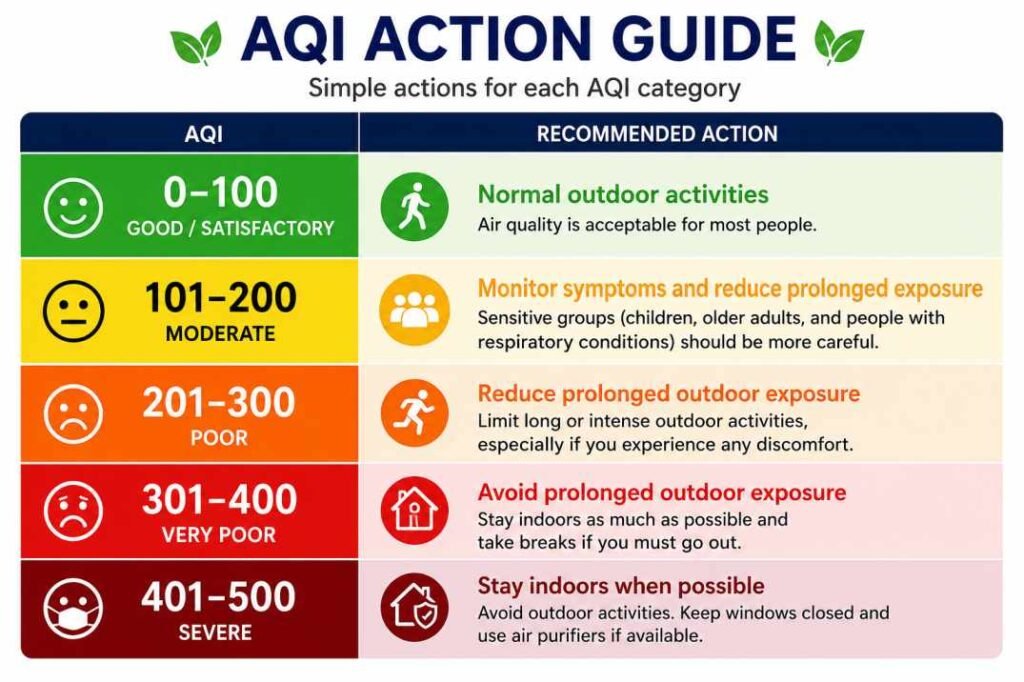
What Should You Do at Different AQI Levels?
AQI values are most useful when they help people make practical decisions. While a single AQI reading does not determine exactly how every individual will respond, it can provide general guidance for outdoor activities and pollution exposure.
The table below summarizes common precautions at different AQI levels.
| AQI Range | Category | Practical Advice |
|---|---|---|
| 0–50 | Good | Normal outdoor activities are generally safe. |
| 51–100 | Satisfactory | Most people can continue normal activities without restrictions. |
| 101–200 | Moderate | Sensitive groups should monitor symptoms during prolonged outdoor exposure. |
| 201–300 | Poor | Reduce prolonged outdoor activities, especially for children, older adults, and people with respiratory conditions. |
| 301–400 | Very Poor | Limit outdoor exposure when possible and reduce strenuous outdoor exercise. |
| 401–500 | Severe | Stay indoors when practical and follow local health advisories. |
AQI 0–100: Generally Safe for Most People
When AQI remains below 100, air quality is generally considered acceptable for daily activities.
Most people can:
- Walk outdoors
- Exercise normally
- Commute without special precautions
- Participate in outdoor sports and recreation
Sensitive individuals should still pay attention to personal symptoms, but significant restrictions are usually unnecessary.
AQI 101–200: Increased Awareness May Be Helpful
At this stage, air pollution levels begin rising above the ideal range.
People with asthma, allergies, or respiratory conditions may benefit from:
- Monitoring symptoms
- Avoiding unnecessary prolonged exposure
- Checking local AQI updates before outdoor activities
Healthy adults can usually continue normal activities, although exposure increases compared with cleaner air conditions.
AQI 201–300: Consider Reducing Exposure
AQI above 200 indicates that pollution levels are becoming high enough to affect a broader portion of the population.
At this level:
- Prolonged outdoor exercise may not be ideal.
- Sensitive groups should take additional precautions.
- Outdoor exposure should be reduced when practical.
People who spend several hours outdoors each day may receive substantially higher pollution exposure than occasional outdoor visitors.
AQI 301–400: Significant Pollution Levels
When AQI enters the Very Poor category, pollution concentrations become a more serious concern.
Many people choose to:
- Reduce outdoor exercise
- Limit unnecessary outdoor activities
- Monitor pollution forecasts more closely
Individuals with respiratory conditions may experience symptoms more easily during these periods.
AQI 401–500: Severe Air Quality Conditions
The Severe category represents the highest AQI range within the CPCB framework.
At this level:
- Outdoor exposure should be minimized when possible.
- Strenuous outdoor activities are generally discouraged.
- Sensitive groups may require additional precautions.
- Local authorities may issue health advisories depending on conditions.
Author Observation
Many people focus only on whether the AQI has crossed a specific threshold. In practice, pollution management is often about reducing unnecessary exposure rather than reacting only when conditions become severe. Small decisions—such as avoiding peak pollution hours or reducing prolonged outdoor activity—can help lower cumulative exposure over time.
Frequently Asked Questions
What is the safe AQI limit in India?
AQI between 0 and 100 is generally considered safe for most people under the CPCB Air Quality Index framework. This includes the Good and Satisfactory categories.
What is the normal AQI level in India?
There is no single normal AQI level because air quality varies by city, season, weather, and local pollution sources. However, AQI below 100 is generally considered acceptable.
Which AQI category is the best?
The Good category (AQI 0–50) represents the cleanest air and the lowest pollution-related health risk.
Is AQI 75 safe?
Yes. AQI 75 falls within the Satisfactory category and is generally considered safe for normal daily activities and outdoor exercise.
Is AQI 100 safe for outdoor exercise?
For most healthy adults, AQI 100 is generally considered acceptable for outdoor exercise. Sensitive individuals may choose to monitor symptoms during prolonged activity.
Is AQI 150 unhealthy?
AQI 150 falls within the Moderate category. While it is not usually considered dangerous for healthy adults, sensitive groups may experience breathing discomfort during prolonged exposure.
Is AQI 200 dangerous?
AQI 200 represents the upper end of the Moderate category and is often viewed as a caution point. Sensitive groups may experience noticeable symptoms, and prolonged outdoor exposure may increase health risks.
Is AQI 300 hazardous?
AQI 300 indicates poor air quality and significantly higher pollution exposure. Health effects become more likely across a broader portion of the population, especially during extended outdoor activity.
What AQI level should children avoid?
Children are generally more sensitive to air pollution than adults. When AQI exceeds 100, parents and schools may wish to monitor outdoor activity more carefully. Above AQI 200, prolonged outdoor exposure may need to be reduced.
What AQI level should people with asthma avoid?
People with asthma often experience symptoms more easily during pollution episodes. AQI above 100 may require additional caution, while AQI above 200 can significantly increase the likelihood of respiratory discomfort.

Conclusion
A safe AQI in India is generally considered to be between 0 and 100. Within this range, air quality is usually acceptable for most people, including normal outdoor activities and exercise.
As AQI rises above 100, pollution exposure increases and sensitive groups may begin experiencing symptoms. AQI above 200 represents a more significant health concern, particularly during prolonged exposure, while AQI above 300 can affect a much larger portion of the population.
The most important thing to remember is that air pollution risk depends not only on the AQI number itself but also on age, health status, activity level, and exposure duration. Understanding AQI categories can help individuals make better decisions about outdoor activities and reduce unnecessary pollution exposure.
Understanding the major Sources of Air Pollution can also help explain why AQI varies across cities and seasons.
References
- Central Pollution Control Board (CPCB). National Air Quality Index (AQI) Framework
https://cpcb.nic.in/air-quality-index/ - Central Pollution Control Board (CPCB). Air Quality Index Information and Public Guidance
https://www.airquality.cpcb.gov.in/ccr/ - World Health Organization (WHO). Ambient (Outdoor) Air Pollution
https://www.who.int/health-topics/air-pollution - World Health Organization (WHO). Global Air Quality Guidelines (2021)
https://www.who.int/publications/i/item/9789240034228 - Indian Institute of Tropical Meteorology (IITM). Air Quality Early Warning System (AQEWS)
https://aqews.tropmet.res.in/